Air on the G String on the ocarina
On a 12-hole it starts A, high D, B♭, G. Hard, 43 notes, in F major.
Goes up to high D, so it does not fit a 4-hole.
Air on the G String
Bar 1 of 6
What are the notes for Air on the G String?
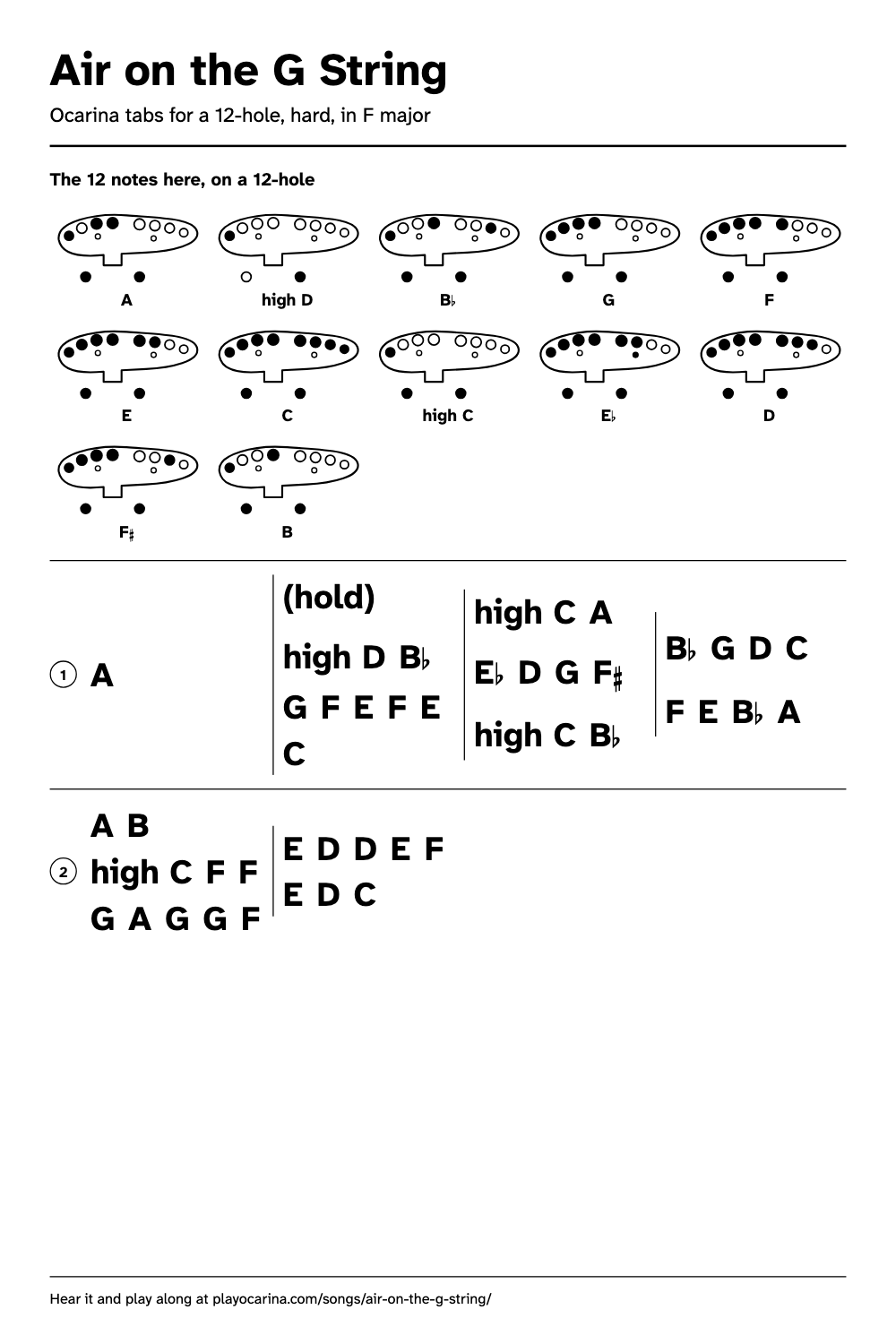
On a 12-hole. Read left to right, a line at a time.
- A(hold)high DB♭GFEFECTricky spot:high CAE♭DGF♯high CB♭B♭GDCFEB♭A
- ABhigh CFFGAGGFEDDEFEDC
The Air on the G String opens on one long note held for more than a bar, then unwinds in quick, falling turns. This is its main theme, the first six bars of the Air from Bach's Orchestral Suite No. 3, as the first violins play them in the 1885 Bach edition, in that printing's rhythm. The fastest notes there are thirty-second notes, so every length here is doubled: read each bar as four slow half-note beats. Moved from D major to F major, it runs from C to high D and fits a 6-hole as well as a 12-hole.
What is the hardest part of the Air on the G String?
The second half of the third bar, where the turn after the long high C goes through E flat, D, then G and F sharp: two cross-fingered notes a semitone from their neighbours, in quick notes. On a 12-hole, Air on the G String goes from E♭ to D: you lift the right sub-hole and cover the right ring. On a 6-hole, you lift the right middle and cover the right index.
Finger E flat and F sharp on their own first, then play the eight quick notes of that bar slowly until each one is clean. The next bar has the same shape a step lower, without the E flat and F sharp, so it sounds like an echo. The opening A is held for a whole bar and a beat: take a full breath before it and spend the air slowly, without letting the pitch sag at the end. In the fifth bar a B natural follows the long A; it is the only B natural in the theme, so watch for it after the B flats in the bars before.
Which ocarina can play Air on the G String?
A 4-hole ocarina cannot reach high D, so play Air on the G String in this key on a 12-hole or 6-hole ocarina in C. On an ocarina in G or F, use the same fingerings: the tune sounds in a different key, which is fine when you play alone. Each linked chart has every fingering for its ocarina, and you can check your notes with a tuner such as our free ocarina tuner.
The 12 notes here, on a 12-holeHoles in words, with a picture
| Note | Holes to cover | Picture |
|---|---|---|
| A | Cover the left pinky, left middle, left index, left thumb and right thumb | |
| high D | Cover the left pinky and right thumb | |
| B♭ | Cover the left pinky, left index, right ring, left thumb and right thumb | |
| G | Cover every main hole but the right index, right middle, right ring and right pinky | |
| F | Cover every main hole but the right middle, right ring and right pinky | |
| E | Cover every main hole but the right ring and right pinky | |
| C | Cover every main hole | |
| high C | Cover the left pinky, left thumb and right thumb | |
| E♭ | Cover every main hole but the right ring and right pinky, plus the right sub-hole | |
| D | Cover every main hole but the right pinky | |
| F♯ | Cover every main hole but the right index, right middle and right pinky | |
| B | Cover the left pinky, left index, left thumb and right thumb |
Drawn as you see it while playing: mouthpiece towards you, left hand on the left.
| Note | Holes to cover | Picture |
|---|---|---|
| A | Cover the left index, left thumb and right thumb | |
| high D | Cover the left thumb | |
| B♭ | Cover the right index, left thumb and right thumb | |
| G | Cover every hole but the left middle and right middle | |
| F | Cover every hole but the right middle and right index | |
| E | Cover every hole but the right index | |
| C | Cover every hole | |
| high C | Cover the left thumb and right thumb | |
| E♭ | Cover the left middle, right middle, left index, left thumb and right thumb; half-cover the right index | |
| D | Cover every hole but the right middle | |
| F♯ | Cover every hole but the left middle | |
| B | Cover the right middle, left thumb and right thumb |
Drawn as you see it while playing: mouthpiece towards you, left hand on the left.
Why is it called the Air on the G String?
The name comes from August Wilhelmj's 1871 arrangement, which moved the Air down to C major so a violinist could play the whole tune on the instrument's lowest string, the G string. Bach wrote it as the slow second movement of his Orchestral Suite No. 3 in D major, for strings and continuo; its oldest source is a set of parts from around 1730. Our tabs follow Bach's own first violin part, not Wilhelmj's, in the Bach Society's complete edition, printed in Leipzig in 1885, and move it from D major to F major. Bach died in 1750. Music: Johann Sebastian Bach (1685-1750), the Air from his Orchestral Suite No. 3 in D major, BWV 1068.