Carolina in the Morning on the ocarina
On a 12-hole it starts G, E, G, E. Medium, 145 notes, in C major.
Goes up to high D, so it does not fit a 4-hole.
Carolina in the Morning
Bar 1 of 32
What are the notes for Carolina in the Morning?
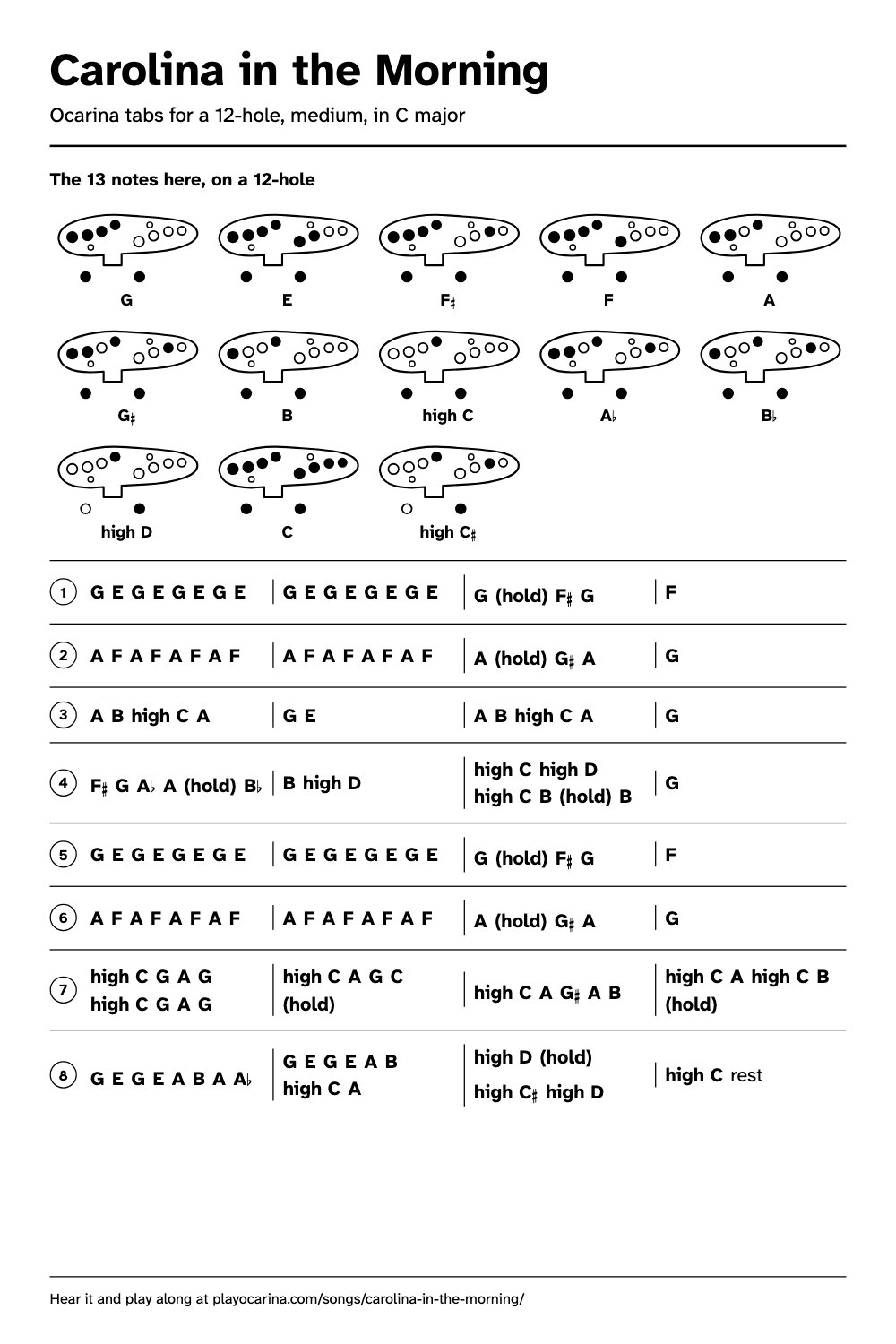
On a 12-hole. Read left to right, a line at a time.
- GEGEGEGEGEGEGEGEG(hold)F♯GF
- AFAFAFAFAFAFAFAFA(hold)G♯AG
- ABhigh CAGEABhigh CAG
- F♯GA♭A(hold)B♭Tricky spot:Bhigh Dhigh Chigh Dhigh CB(hold)BG
- GEGEGEGEGEGEGEGEG(hold)F♯GF
- AFAFAFAFAFAFAFAFA(hold)G♯AG
- high CGAGhigh CGAGhigh CAGC(hold)high CAG♯ABhigh CAhigh CB(hold)
- GEGEABAA♭GEGEABhigh CAhigh D(hold)high C♯high Dhigh Crest
Carolina in the Morning is a 1922 song whose chorus runs on one rhythm: a long note and a short one, four pairs to a bar, G, E, G, E over and over. Here is the chorus in C major, the key it was printed in, 32 bars from low C to high D, so it plays on a 12-hole or a 6-hole ocarina but not on a 4-hole.
What is the tricky spot in Carolina in the Morning?
The climb in the middle of the chorus: F#, G, A flat, A, B flat, B one after another, then the leap from that B up to a long high D. On a 12-hole, Carolina in the Morning goes from B to high D: you lift the left index and left thumb. On a 6-hole, you lift the right middle and right thumb.
Three of the six climbing notes, F#, A flat and B flat, are sharps or flats a C ocarina reaches with cross-fingerings, so play the climb slowly on its own until each finger change is clean, then bring it up to speed. Give the high D a little more air than the B before it. Near the end the tune holds a low C, then jumps an octave to high C: let the low C go a moment early, breathe, and aim the high C with firmer air. In the dotted bars keep the short note light and late, so the line swings instead of running even.
Where do you breathe in Carolina in the Morning?
After the whole note that ends each four-bar line, after the long E and the high D in the middle section, and after the held low C and the held B near the end. The last four bars play through to the final C.
Which ocarina can play Carolina in the Morning?
A 4-hole ocarina cannot reach high C♯ and high D, so play Carolina in the Morning in this key on a 12-hole or 6-hole ocarina in C. On an ocarina in G or F, use the same fingerings: the tune sounds in a different key, which is fine when you play alone. Each linked chart has every fingering for its ocarina, and you can check your notes with a tuner such as our free ocarina tuner.
The 13 notes here, on a 12-holeHoles in words, with a picture
| Note | Holes to cover | Picture |
|---|---|---|
| G | Cover every main hole but the right index, right middle, right ring and right pinky | |
| E | Cover every main hole but the right ring and right pinky | |
| F♯ | Cover every main hole but the right index, right middle and right pinky | |
| F | Cover every main hole but the right middle, right ring and right pinky | |
| A | Cover the left pinky, left middle, left index, left thumb and right thumb | |
| G♯ | Cover every main hole but the left ring, right index, right middle and right pinky | |
| B | Cover the left pinky, left index, left thumb and right thumb | |
| high C | Cover the left pinky, left thumb and right thumb | |
| A♭ | Cover every main hole but the left ring, right index, right middle and right pinky | |
| B♭ | Cover the left pinky, left index, right ring, left thumb and right thumb | |
| high D | Cover the left pinky and right thumb | |
| C | Cover every main hole | |
| high C♯ | Cover the left pinky, right ring and right thumb |
Drawn as you see it while playing: mouthpiece towards you, left hand on the left.
| Note | Holes to cover | Picture |
|---|---|---|
| G | Cover every hole but the left middle and right middle | |
| E | Cover every hole but the right index | |
| F♯ | Cover every hole but the left middle | |
| F | Cover every hole but the right middle and right index | |
| A | Cover the left index, left thumb and right thumb | |
| G♯ | Cover every hole but the left middle and right index | |
| B | Cover the right middle, left thumb and right thumb | |
| high C | Cover the left thumb and right thumb | |
| A♭ | Cover every hole but the left middle and right index | |
| B♭ | Cover the right index, left thumb and right thumb | |
| high D | Cover the left thumb | |
| C | Cover every hole | |
| high C♯ | Cover the right middle and left thumb |
Drawn as you see it while playing: mouthpiece towards you, left hand on the left.
Who wrote Carolina in the Morning?
Walter Donaldson wrote the music and Gus Kahn the words, as Wikipedia's article on the song and the 1922 printing both say. Our tabs follow the 1922 sheet music from Jerome H. Remick & Co. of New York and Detroit, a copy in the Lester S. Levy Collection at Johns Hopkins, which prints the song in C major in cut time, marked Moderato. It opens with a 12-bar verse, then a 32-bar chorus with two endings and a D.C. back to the verse; we give the chorus once, closing on the second ending, in C major as printed. We show the melody only. Music: Walter Donaldson, the music; lyric by Gus Kahn.