Daddy Wouldn't Buy Me a Bow-Wow on the ocarina
On a 12-hole it starts B♭, B♭, A, high C. Hard, 103 notes, in Bb major.
Goes up to high F, so it does not fit a 6-hole or 4-hole.
Daddy Wouldn't Buy Me a Bow-Wow
Bar 1 of 32
What are the notes for Daddy Wouldn't Buy Me a Bow-Wow?
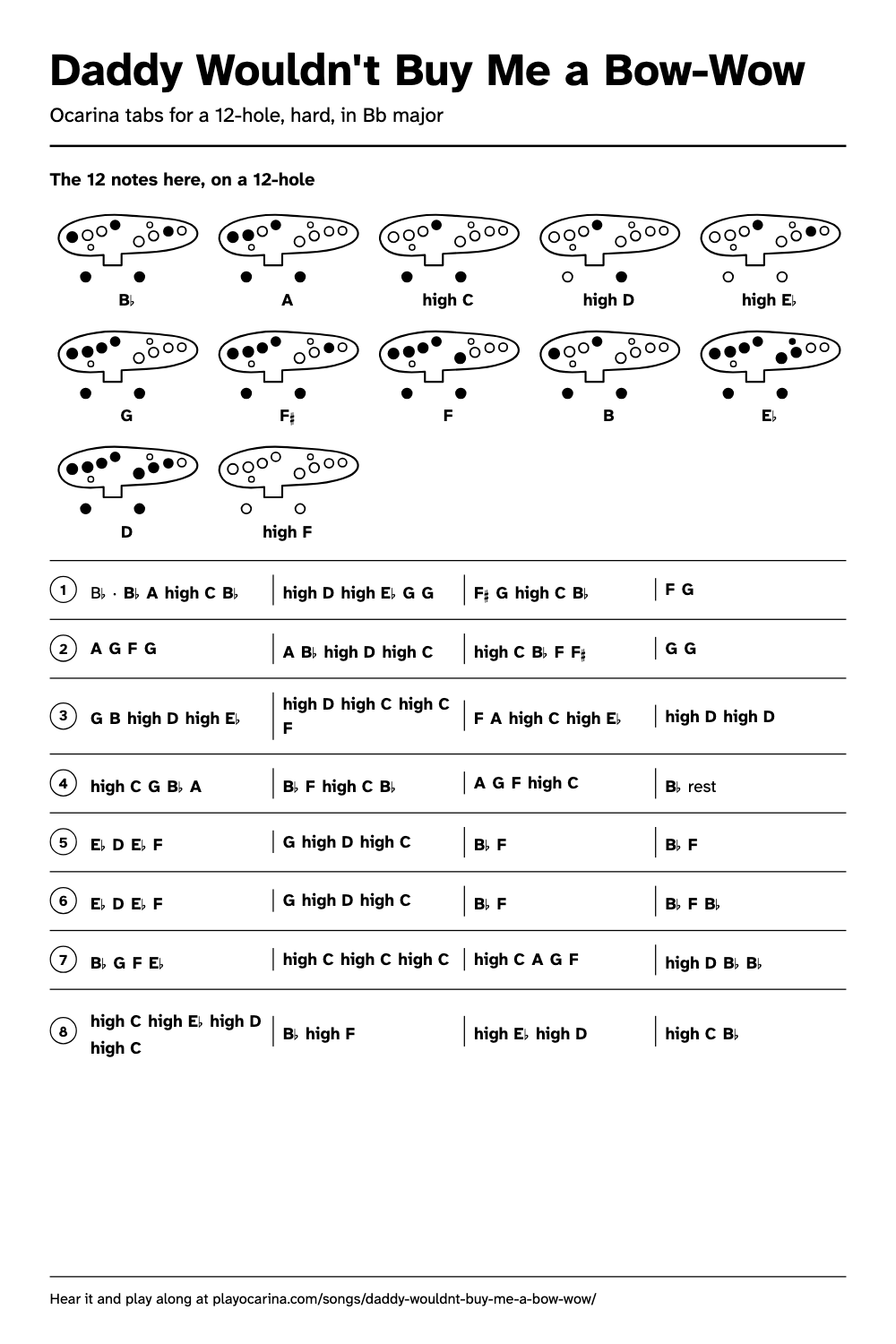
On a 12-hole. Read left to right, a line at a time.
- B♭ B♭Ahigh CB♭high Dhigh E♭GGF♯Ghigh CB♭FG
- AGFGAB♭high Dhigh Chigh CB♭FF♯GG
- GBhigh Dhigh E♭high Dhigh Chigh CFFAhigh Chigh E♭high Dhigh D
- high CGB♭AB♭Fhigh CB♭AGFhigh CB♭rest
- E♭DE♭FGhigh Dhigh CB♭FB♭F
- E♭DE♭FGhigh Dhigh CB♭FB♭FB♭
- B♭GFE♭high Chigh Chigh Chigh CAGFhigh DB♭B♭
- high Chigh E♭high Dhigh CTricky spot:B♭high Fhigh E♭high Dhigh CB♭
Daddy Wouldn't Buy Me a Bow-Wow is an 1892 music-hall song by Joseph Tabrar: a verse of quick, even eighth notes, then a chorus that barks in pairs, B-flat down to F. Here is one verse and the chorus, 32 bars in B-flat major as the song was printed, from D up to high F, so it needs a 12-hole ocarina.
What is the tricky spot in Daddy Wouldn't Buy Me a Bow-Wow?
The leap from B-flat up to high F near the end of the chorus: four quick notes, C, E-flat, D, C, settle on B-flat, then the tune jumps a fifth to F, the highest note in the song, and steps back down E-flat, D, C, B-flat. On a 12-hole, Daddy Wouldn't Buy Me a Bow-Wow goes from B♭ to high F: you lift the left pinky, left index, right ring, left thumb and right thumb.
High F needs more air than anything else in the song, so firm up the breath as you lift your fingers for it, then ease off on the way down so the E-flat and D stay in tune. That last B-flat ends the song, so land it softly and in tune. B-flat is a cross-fingering on a C ocarina and it comes in almost every bar: practise the chorus barks, B-flat, F, B-flat, F, slowly until the B-flat sits in tune, then bring them up to speed. The verse adds two notes outside the key, F-sharp just under G and B natural in the third line; each lasts one eighth, so let them go by lightly.
Where do you breathe in Daddy Wouldn't Buy Me a Bow-Wow?
At the end of each line of the verse: after the long F, the long G and the long D, and after the B-flat that closes it. In the chorus, after the second pair of barks and after the quarter-note C and the quarter-note D in the middle; the last line plays through to the final B-flat.
Which ocarina can play Daddy Wouldn't Buy Me a Bow-Wow?
A 6-hole ocarina cannot reach high F, and a 4-hole ocarina cannot reach high D, high E♭ and high F, so play Daddy Wouldn't Buy Me a Bow-Wow in this key on a 12-hole ocarina in C. On an ocarina in G or F, use the same fingerings: the tune sounds in a different key, which is fine when you play alone. The linked chart has every fingering, and you can check your notes with a tuner such as our free ocarina tuner.
The 12 notes here, on a 12-holeHoles in words, with a picture
| Note | Holes to cover | Picture |
|---|---|---|
| B♭ | Cover the left pinky, left index, right ring, left thumb and right thumb | |
| A | Cover the left pinky, left middle, left index, left thumb and right thumb | |
| high C | Cover the left pinky, left thumb and right thumb | |
| high D | Cover the left pinky and right thumb | |
| high E♭ | Cover the left pinky and right ring | |
| G | Cover every main hole but the right index, right middle, right ring and right pinky | |
| F♯ | Cover every main hole but the right index, right middle and right pinky | |
| F | Cover every main hole but the right middle, right ring and right pinky | |
| B | Cover the left pinky, left index, left thumb and right thumb | |
| E♭ | Cover every main hole but the right ring and right pinky, plus the right sub-hole | |
| D | Cover every main hole but the right pinky | |
| high F | All holes open |
Drawn as you see it while playing: mouthpiece towards you, left hand on the left.
Who wrote Daddy Wouldn't Buy Me a Bow-Wow?
Joseph Tabrar wrote the words and the music; he died in 1931. Our tabs follow an 1892 printing of the sheet music, headed "Song and Chorus. Written and Composed by Joseph Tabrar", copyright Francis, Day & Hunter. It prints the verse in 2/4 and the chorus in common time, both in B-flat major, with a repeat and two endings on the chorus. We write it in 2/4 bars, the verse and the chorus once, with the first ending, which comes home to B-flat; the second ending stops on E-flat, where the printing goes back to the start for the next verse. We show the melody only, without the small grace notes before two of the barks. Music: Joseph Tabrar (died 1931), words and music.