Dance of the Blessed Spirits on the ocarina
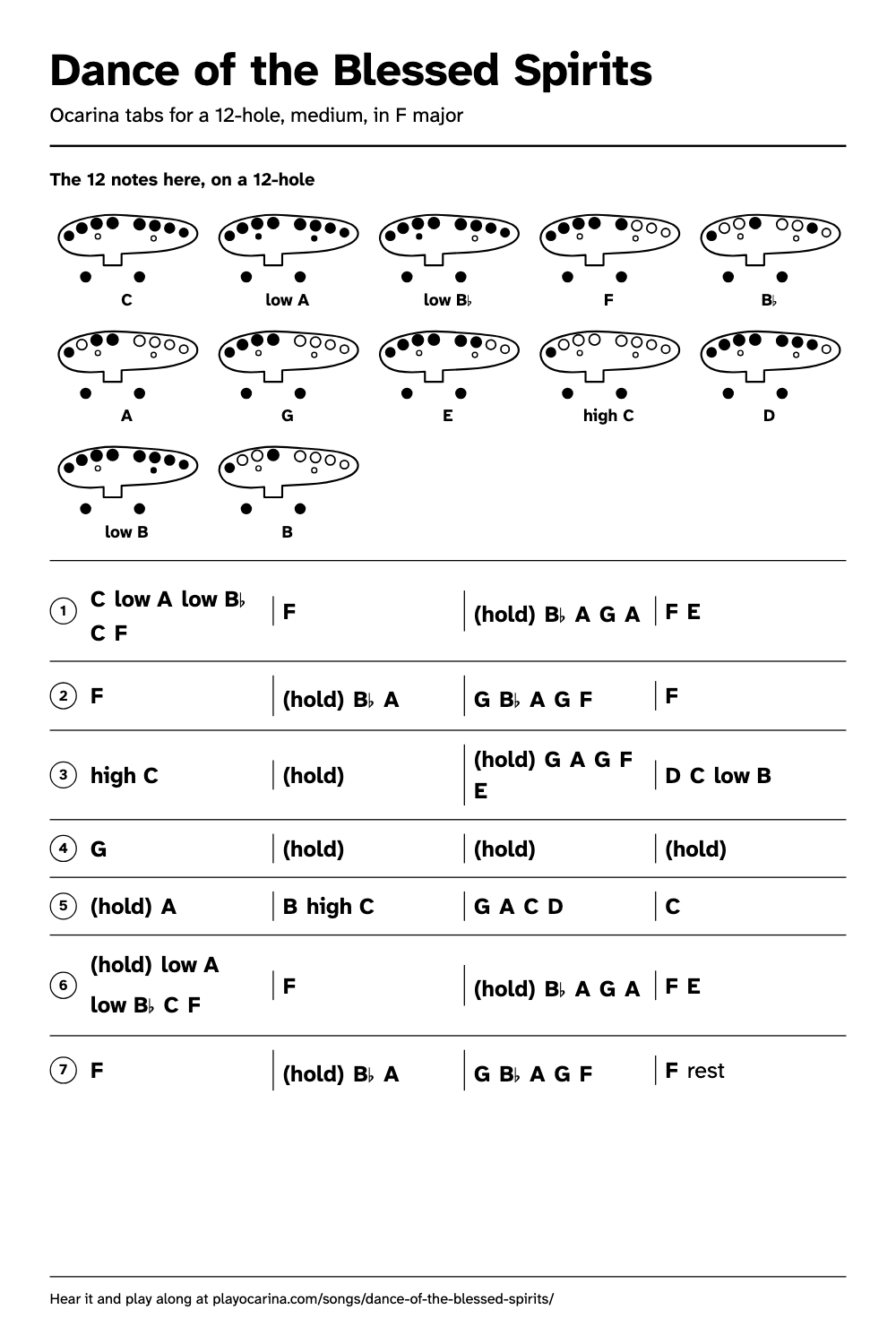
On a 12-hole it starts C, low A, low B♭, C. Medium, 59 notes, in F major.
Goes down to low A, so it does not fit a 6-hole or 4-hole.
Dance of the Blessed Spirits
Bar 1 of 28
What are the notes for Dance of the Blessed Spirits?
On a 12-hole. Read left to right, a line at a time.
- Clow Alow B♭CFF(hold)B♭AGAFE
- F(hold)B♭AGB♭AGFF
- high C(hold)(hold)GAGFEDClow B
- G(hold)(hold)(hold)
- (hold)ABhigh CTricky spot:GACDC
- (hold)low Alow B♭CFF(hold)B♭AGAFE
- F(hold)B♭AGB♭AGFFrest
The Dance of the Blessed Spirits opens on a quiet C, dips to a low A, and climbs through B flat and C to an F that is held for the whole next bar. Here is the whole first piece of the dance in its printed key, F major: an eight-bar tune, a longer second tune that starts on a held high C and a long G, and the opening again, 28 slow bars in three, from low A up to high C.
What is the tricky spot in Dance of the Blessed Spirits?
The drop near the end of the second tune, where the line falls from A down a sixth to C and then steps up to D, the widest jump in the piece. On a 12-hole, Dance of the Blessed Spirits goes from A to C: you cover the left ring, right index, right middle, right ring and right pinky.
Practise the end of the second tune alone: G and A as a quick pair, then C, then D. Ease the air as your fingers go down, because C is the lowest note that uses only the ten main holes, and it goes weak and flat if you keep blowing as hard as for the A. The tune also opens on its lowest notes: low A needs both sub-holes closed and low B flat just the left one, so check them before you play the first bar, and take the quick climb A, B flat, C, F gently. The printed score ties the G across five bars, fourteen beats; no one can hold that on one breath, so breathe after the second or third bar and start the G again softly. The low B natural that ends bar 12 is a different finger from low B flat: it takes the right sub-hole, not the left.
Where do you breathe in Dance of the Blessed Spirits?
At the end of each four-bar phrase of the opening tune, after the E in bar 4 and the long F in bar 8, and again after the last bar. In the second tune the high C is held for two bars and runs straight into the quick notes, so take a full breath before it, breathe again after the low B in bar 12, and break the long G where you need to.
Which ocarina can play Dance of the Blessed Spirits?
A 6-hole or 4-hole ocarina cannot reach low A, low B♭ and low B, so play Dance of the Blessed Spirits in this key on a 12-hole ocarina in C. On an ocarina in G or F, use the same fingerings: the tune sounds in a different key, which is fine when you play alone. The linked chart has every fingering, and you can check your notes with a tuner such as our free ocarina tuner.
The 12 notes here, on a 12-holeHoles in words, with a picture
| Note | Holes to cover | Picture |
|---|---|---|
| C | Cover every main hole | |
| low A | Cover every main hole, plus the left sub-hole and right sub-hole | |
| low B♭ | Cover every main hole, plus the left sub-hole | |
| F | Cover every main hole but the right middle, right ring and right pinky | |
| B♭ | Cover the left pinky, left index, right ring, left thumb and right thumb | |
| A | Cover the left pinky, left middle, left index, left thumb and right thumb | |
| G | Cover every main hole but the right index, right middle, right ring and right pinky | |
| E | Cover every main hole but the right ring and right pinky | |
| high C | Cover the left pinky, left thumb and right thumb | |
| D | Cover every main hole but the right pinky | |
| low B | Cover every main hole, plus the right sub-hole | |
| B | Cover the left pinky, left index, left thumb and right thumb |
Drawn as you see it while playing: mouthpiece towards you, left hand on the left.
Was the Dance of the Blessed Spirits in the first Orfeo?
Not as a long dance. Gluck's first Orfeo ed Euridice was first performed in Vienna on 5 October 1762, and its scene in Elysium had only a brief ballet. For the Paris version of 1774 that ballet became a four-movement dance with a prominent solo flute part. Our tabs follow the printed Paris score, whose title page says the opera was first played by the Académie Royale de Musique on Tuesday 2 August 1774. Scène II opens on page 87 with two flutes playing in thirds above the strings, marked Lent très doux, slow and very soft; we take the upper flute through the first piece, eight bars, a second tune of twelve bars and the opening again. Gluck died in 1787. We show the melody only, without the small grace notes of the printing. Music: Christoph Willibald Gluck (1714-1787), from his Paris opera Orphée et Eurydice, 1774.