Habanera (Carmen) on the ocarina
On a 12-hole it starts high D, high C♯, high C, high C. Hard, 80 notes, in D minor.
Goes up to high D, so it does not fit a 4-hole.
Habanera (Carmen)
Bar 1 of 16
What are the notes for the Habanera from Carmen?
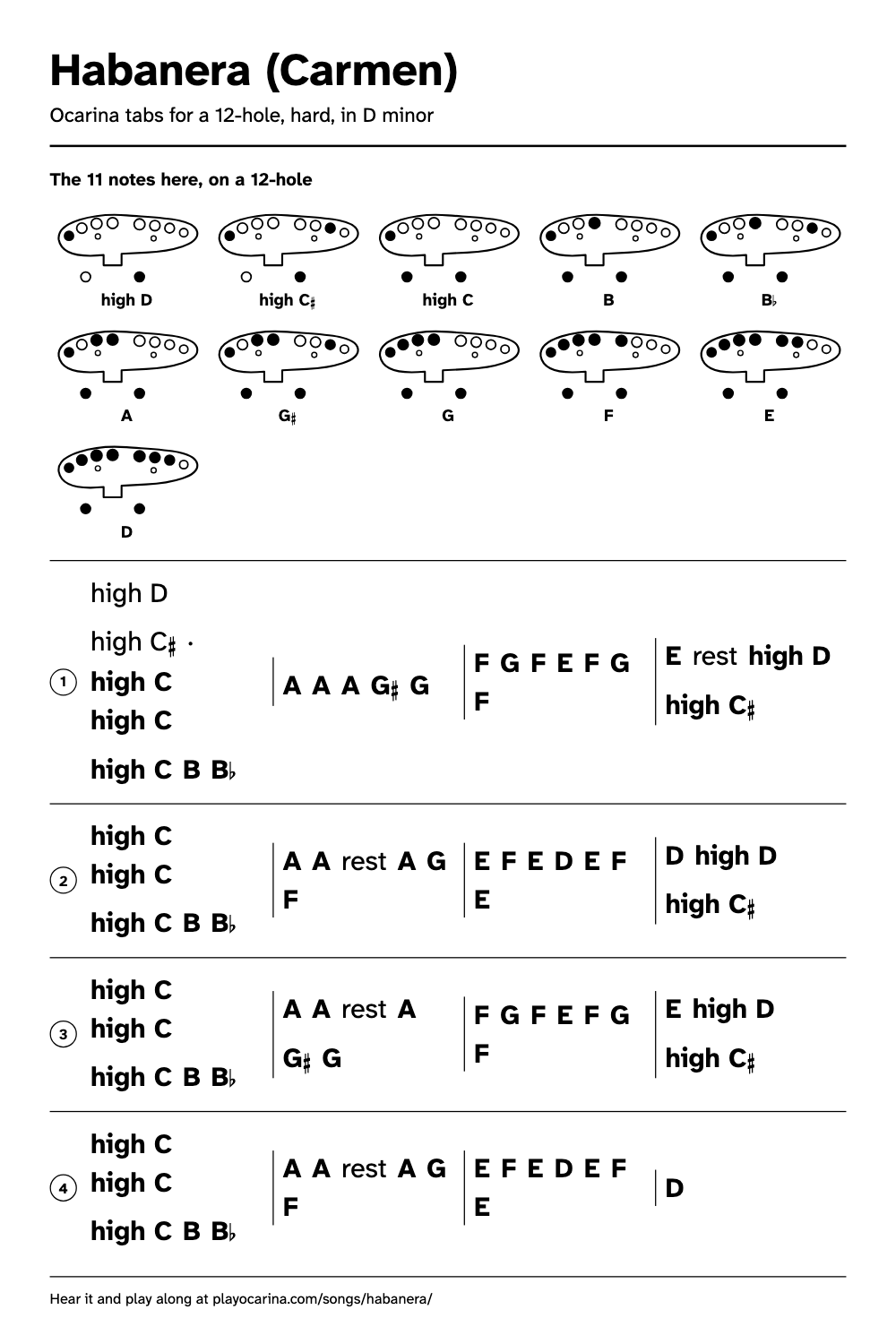
On a 12-hole. Read left to right, a line at a time.
- high Dhigh C♯ high Chigh Chigh CBB♭AAAG♯GFGFEFGFEresthigh Dhigh C♯
- high Chigh Chigh CBB♭AArestAGFEFEDEFETricky spot:Dhigh Dhigh C♯
- high Chigh Chigh CBB♭AArestAG♯GFGFEFGFEhigh Dhigh C♯
- high Chigh Chigh CBB♭AArestAGFEFEDEFED
The Habanera from Carmen starts on high D and C♯, then creeps down a half step at a time through C, B and B♭ to A, over a lazy dance rhythm. Here is its first verse in D minor, the key Bizet wrote it in, an octave higher: a one-beat pickup and 16 bars of 2/4, from D up to high D. It fits a 6-hole or a 12-hole ocarina, and the slow chromatic slide is the whole character of the tune, so take it gently.
What is the tricky spot in the Habanera from Carmen?
The end of the second phrase, where the tune lands on low D and at once leaps a full octave to high D to start the next one. On a 12-hole, the Habanera from Carmen goes from D to high D: you lift the left ring, left middle, left index, right index, right middle, right ring and left thumb. On a 6-hole, you lift the left middle, left index, right index and right thumb.
Low D wants nearly every hole covered and a soft breath, high D wants most holes open and a firmer one, so the jump asks your fingers and your air to change together. Practise the two notes on their own, low D for one count and high D straight after, until the top note speaks cleanly without a squeak. Then add the C♯ that follows, which is the next step of the slow slide down.
Which ocarina can play the Habanera from Carmen?
A 4-hole ocarina cannot reach high C♯ and high D, so play the Habanera from Carmen in this key on a 12-hole or 6-hole ocarina in C. On an ocarina in G or F, use the same fingerings: the tune sounds in a different key, which is fine when you play alone. Each linked chart has every fingering for its ocarina, and you can check your notes with a tuner such as our free ocarina tuner.
The 11 notes here, on a 12-holeHoles in words, with a picture
| Note | Holes to cover | Picture |
|---|---|---|
| high D | Cover the left pinky and right thumb | |
| high C♯ | Cover the left pinky, right ring and right thumb | |
| high C | Cover the left pinky, left thumb and right thumb | |
| B | Cover the left pinky, left index, left thumb and right thumb | |
| B♭ | Cover the left pinky, left index, right ring, left thumb and right thumb | |
| A | Cover the left pinky, left middle, left index, left thumb and right thumb | |
| G♯ | Cover every main hole but the left ring, right index, right middle and right pinky | |
| G | Cover every main hole but the right index, right middle, right ring and right pinky | |
| F | Cover every main hole but the right middle, right ring and right pinky | |
| E | Cover every main hole but the right ring and right pinky | |
| D | Cover every main hole but the right pinky |
Drawn as you see it while playing: mouthpiece towards you, left hand on the left.
| Note | Holes to cover | Picture |
|---|---|---|
| high D | Cover the left thumb | |
| high C♯ | Cover the right middle and left thumb | |
| high C | Cover the left thumb and right thumb | |
| B | Cover the right middle, left thumb and right thumb | |
| B♭ | Cover the right index, left thumb and right thumb | |
| A | Cover the left index, left thumb and right thumb | |
| G♯ | Cover every hole but the left middle and right index | |
| G | Cover every hole but the left middle and right middle | |
| F | Cover every hole but the right middle and right index | |
| E | Cover every hole but the right index | |
| D | Cover every hole but the right middle |
Drawn as you see it while playing: mouthpiece towards you, left hand on the left.
Did Bizet write the Habanera?
He shaped it from someone else's song. Bizet adapted it from El Arreglito, a habanera by the Spanish composer Sebastián Iradier, believing it was a folk tune; when he learned that Iradier had died in 1865, he added a note to the first vocal score. That note is at the foot of page 49 of the 1875 Choudens score: "Imitée d'une chanson espagnole", imitated from a Spanish song. The same score lists Célestine Galli-Marié as Carmen; she first sang the aria on 3 March 1875, and Bizet died that June. Our tabs follow that page: the first verse of Carmen's entrance aria, an octave higher. We show the melody only. Music: Georges Bizet (1838-1875), Carmen's entrance aria in his opera Carmen, 1875, adapted from El Arreglito by Sebastián Iradier (1809-1865).