Handel's Largo (Ombra mai fu) on the ocarina
On a 12-hole it starts high C, A, G, F. Hard, 82 notes, in F major.
Goes up to high F, so it does not fit a 6-hole or 4-hole.
Handel's Largo (Ombra mai fu)
Bar 1 of 30
What are the notes for Handel's Largo?
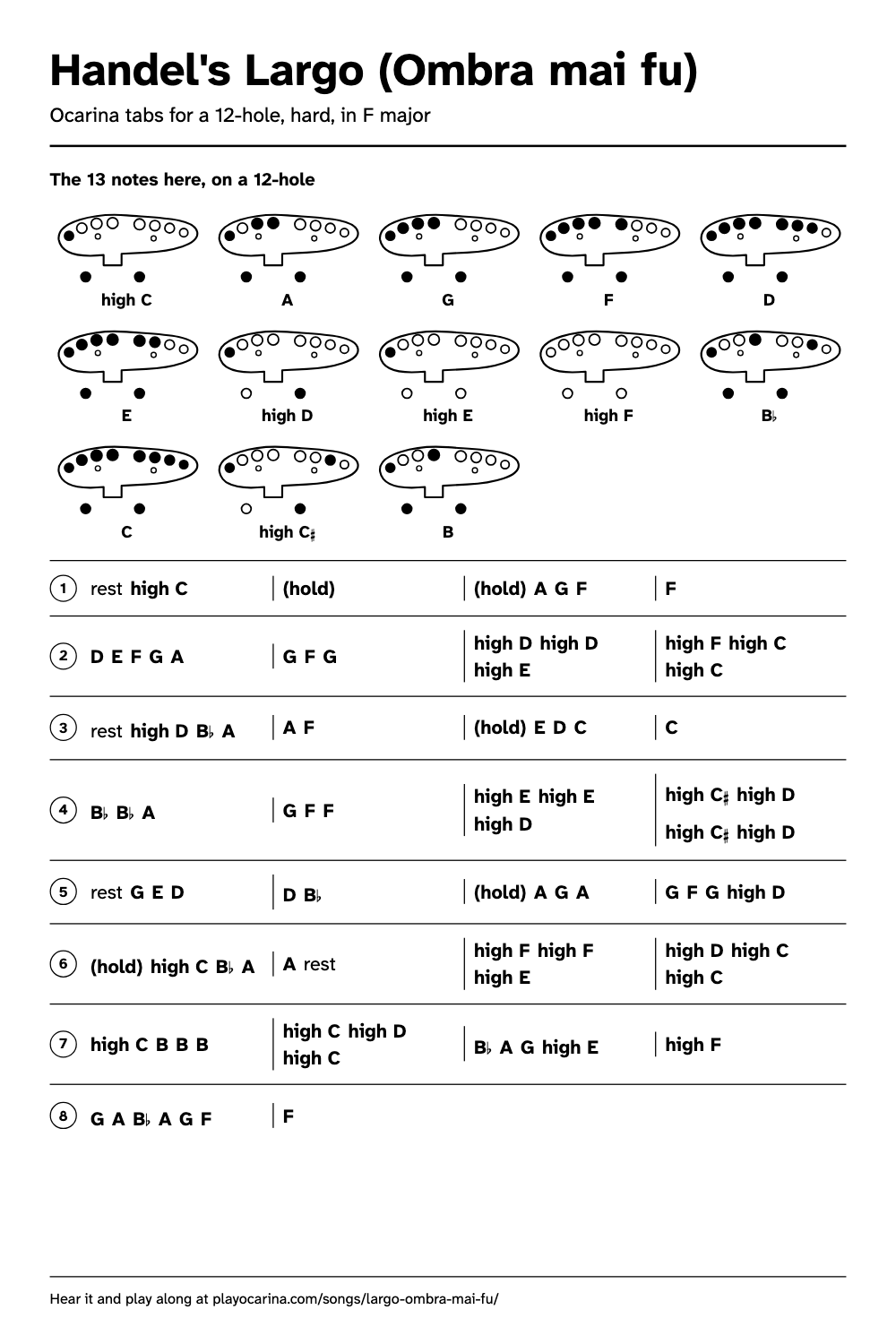
On a 12-hole. Read left to right, a line at a time.
- resthigh C(hold)(hold)AGFF
- DEFGAGFGhigh Dhigh Dhigh Ehigh Fhigh Chigh C
- resthigh DB♭AAF(hold)EDCC
- B♭B♭AGFFhigh Ehigh Ehigh Dhigh C♯high Dhigh C♯high D
- restGEDDB♭(hold)AGAGFGhigh D
- (hold)high CB♭AAresthigh Fhigh Fhigh Ehigh Dhigh Chigh C
- Tricky spot:high CBBBhigh Chigh Dhigh CB♭AGhigh Ehigh F
- GAB♭AGFF
Handel's Largo is the slow aria Ombra mai fu from his opera Serse. It starts with one high C held for six beats, then falls through A and G to F. Here is the singer's whole line, 30 bars of 3/4 in F major, from C up to high F, an octave above the voice. It needs a 12-hole ocarina for its range.
What is the hardest part of Handel's Largo?
The last time the tune comes round, B♭ turns into B natural for three notes in a row, then back to B♭ two bars later. Every other B in the piece is flat. On a 12-hole, Handel's Largo goes from high C to B: you cover the left index.
Play bar 25 on its own first, high C, B, B, B, then high C, D, C, and listen for the B sitting a half step under C. The other hard part is slow, high, long notes: the opening high C lasts six beats and the high F with a pause over it in bar 28 is held for a full bar, so start them with a gentle tongue and keep the air steady rather than pushing. The score marks the aria only Larghetto, fairly slow; our player starts at 60 beats a minute.
Where do you breathe in Handel's Largo?
The singer's rests are the easy places: the eighth rests that start bars 9 and 17 and the quarter rest that ends bar 22. Breathe after the long F that ends bar 4 and the long C of bar 12 too, and take a full breath before the high F in bar 28 so the last two bars come out in one breath.
Which ocarina can play Handel's Largo?
A 6-hole ocarina cannot reach high F, and a 4-hole ocarina cannot reach high C♯, high D, high E and high F, so play Handel's Largo in this key on a 12-hole ocarina in C. On an ocarina in G or F, use the same fingerings: the tune sounds in a different key, which is fine when you play alone. The linked chart has every fingering, and you can check your notes with a tuner such as our free ocarina tuner.
The 13 notes here, on a 12-holeHoles in words, with a picture
| Note | Holes to cover | Picture |
|---|---|---|
| high C | Cover the left pinky, left thumb and right thumb | |
| A | Cover the left pinky, left middle, left index, left thumb and right thumb | |
| G | Cover every main hole but the right index, right middle, right ring and right pinky | |
| F | Cover every main hole but the right middle, right ring and right pinky | |
| D | Cover every main hole but the right pinky | |
| E | Cover every main hole but the right ring and right pinky | |
| high D | Cover the left pinky and right thumb | |
| high E | Cover the left pinky | |
| high F | All holes open | |
| B♭ | Cover the left pinky, left index, right ring, left thumb and right thumb | |
| C | Cover every main hole | |
| high C♯ | Cover the left pinky, right ring and right thumb | |
| B | Cover the left pinky, left index, left thumb and right thumb |
Drawn as you see it while playing: mouthpiece towards you, left hand on the left.
Why is Ombra mai fu called Handel's Largo?
Because the aria, rediscovered in the 19th century, is often played on the organ, the violin or by strings under the title Largo from Xerxes, though Handel marked it larghetto. It is the opening aria of Serse, his 1738 opera about the Persian king Xerxes, who sings it to the shade of a plane tree; the opera itself closed after five performances in London. Handel wrote the part for a soprano castrato. Our tabs follow the voice part in the full score of the Händel-Gesellschaft complete edition, printed in Leipzig in 1884, where the aria takes 52 bars and the stage direction after the last sung note has Serse still admiring the tree. The voice sings bars 15 to 46, from middle C up to high F, in F major; our tabs keep the key, move every note up one octave so it fits a 12-hole, and leave out the two bars where the singer waits while the strings play. Handel died in 1759. We show the melody only. Music: George Frideric Handel (1685-1759), the aria Ombra mai fu that opens his opera Serse (Xerxes), 1738.