Molly Malone on the ocarina
On a 12-hole it starts D, G, G, G. Easy, 73 notes, in G major.
Goes up to high D, so it does not fit a 4-hole.
Molly Malone
Bar 1 of 24
What are the notes for Molly Malone?
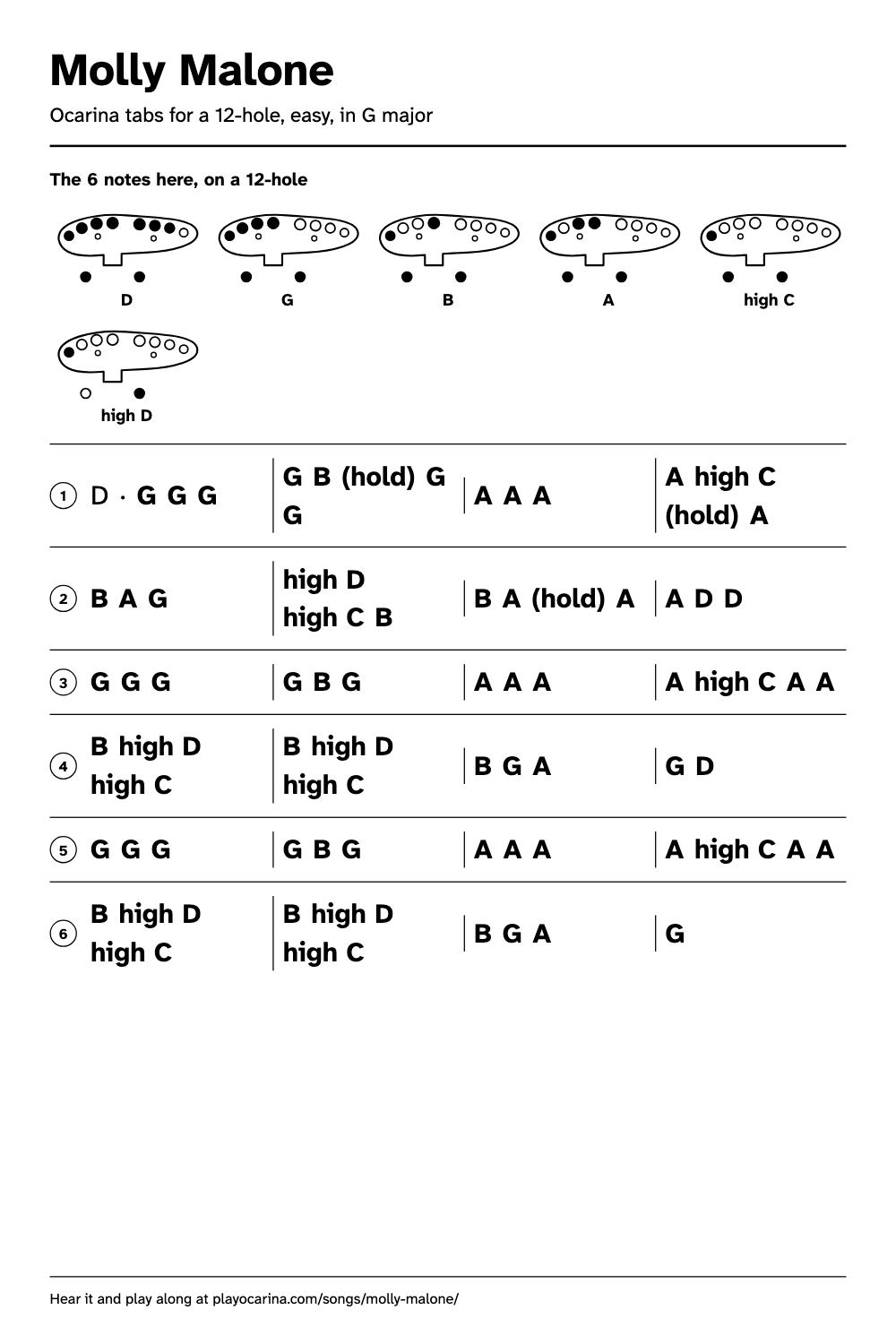
On a 12-hole. Read left to right, a line at a time.
- D GGGGB(hold)GGAAAAhigh C(hold)A
- BAGhigh Dhigh CBBA(hold)AADD
- GGGGBGAAAAhigh CAA
- Tricky spot:Bhigh Dhigh CBhigh Dhigh CBGAGD
- GGGGBGAAAAhigh CAA
- Bhigh Dhigh CBhigh Dhigh CBGAG
Molly Malone, also called Cockles and Mussels, is a gentle song in three time, and most of its bars lean on a long note followed by a short one. Here are the first verse and the chorus in G major, from D up to high D, with no sharps or flats. The verse has four lines and the chorus two, and the last line of each climbs to high D twice before settling on G.
What is the tricky spot in Molly Malone?
The leap from B up to high D, made twice in a row in the last line of the verse and again in the chorus. On a 12-hole, Molly Malone goes from B to high D: you lift the left index and left thumb. On a 6-hole, you lift the right middle and right thumb.
High D is the top of this tune and the hardest note to keep steady: it wants a firmer, faster stream of air than the B just before it. The B is short, so have the fingers ready and lift them together; a ragged lift lets a stray note squeak in between. Hold the D for its full beat and a half, then ease the air back for the C that follows. Practise the three notes B, D and C slowly until the D speaks cleanly every time, then bring them up to speed.
Where do you breathe in Molly Malone?
At the end of each line, on its long note. The best places are after the long A that closes the second line, before the two quick Ds, and after the long G that closes the verse, before the single D that leads into the chorus. The first line ends on a held high C that runs straight on, so take only a small sip of air there if you need one.
Which ocarina can play Molly Malone?
A 4-hole ocarina cannot reach high D, so play Molly Malone in this key on a 12-hole or 6-hole ocarina in C. On an ocarina in G or F, use the same fingerings: the tune sounds in a different key, which is fine when you play alone. Each linked chart has every fingering for its ocarina, and you can check your notes with a tuner such as our free ocarina tuner.
The 6 notes here, on a 12-holeHoles in words, with a picture
| Note | Holes to cover | Picture |
|---|---|---|
| D | Cover every main hole but the right pinky | |
| G | Cover every main hole but the right index, right middle, right ring and right pinky | |
| B | Cover the left pinky, left index, left thumb and right thumb | |
| A | Cover the left pinky, left middle, left index, left thumb and right thumb | |
| high C | Cover the left pinky, left thumb and right thumb | |
| high D | Cover the left pinky and right thumb |
Drawn as you see it while playing: mouthpiece towards you, left hand on the left.
| Note | Holes to cover | Picture |
|---|---|---|
| D | Cover every hole but the right middle | |
| G | Cover every hole but the left middle and right middle | |
| B | Cover the right middle, left thumb and right thumb | |
| A | Cover the left index, left thumb and right thumb | |
| high C | Cover the left thumb and right thumb | |
| high D | Cover the left thumb |
Drawn as you see it while playing: mouthpiece towards you, left hand on the left.
Is Molly Malone an old Irish folk song?
Probably not, though it has become the unofficial anthem of Dublin. The oldest printing anyone has found is from Boston, in 1876: on page 73 of Carmina Collegensia it is called Cockles and Mussels and no writer is named, and its tune is a close cousin of today's that parts from it in several bars, leaping straight up to the high notes where the familiar melody first steps down. A London edition of 1884 gave it as written and composed by James Yorkston of Edinburgh. An Edinburgh local history site traced him: Yorkston collected payments for the gas company and taught singing, and he was born in 1839 and died in 1906. Siobhán Kilfeather, writing a cultural history of Dublin, found that neither its melody nor its words relate to the Irish street ballad tradition. Our tabs follow The Scottish Students' Song Book, dated 1897 in the Boston Public Library's catalogue, where the page reads "Music by James Yorkston" and the song appears by permission of Köhler & Son of Edinburgh. We take the voice line of the first verse and the chorus, leave out the piano part and the words, and move it from B flat major up a major sixth to G major. Music: James Yorkston (1839-1906) of Edinburgh; first printed in Boston in 1876 with no writer named.