Morning Has Broken on the ocarina
On a 12-hole it starts C, E, G, high C. Easy, 38 notes, in C major.
Goes up to high D, so it does not fit a 4-hole.
Morning Has Broken
Bar 1 of 24
What are the notes for Morning Has Broken?
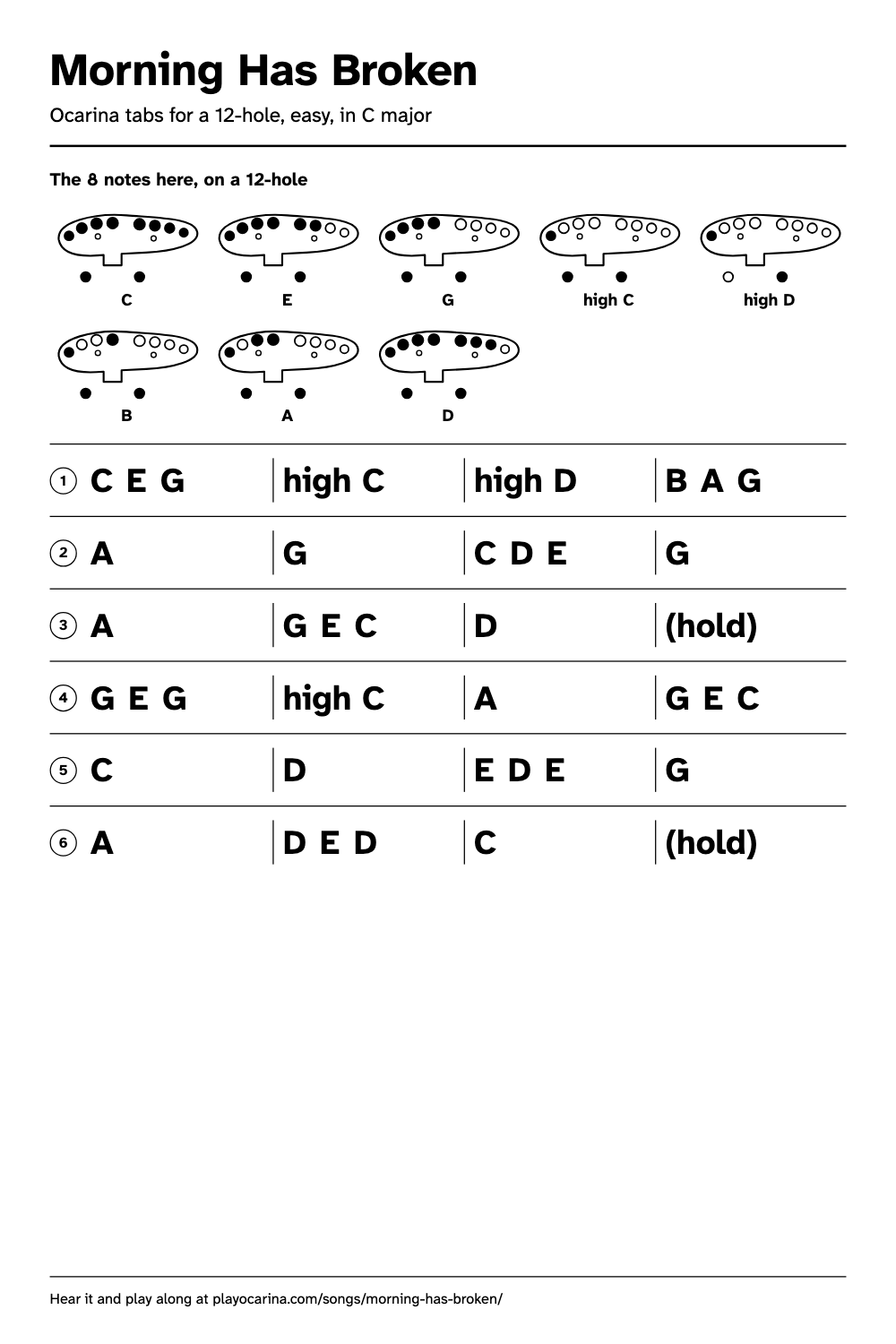
On a 12-hole. Read left to right, a line at a time.
- CEGTricky spot:high Chigh DBAG
- AGCDEG
- AGECD(hold)
- GEGhigh CAGEC
- CDEDEG
- ADEDC(hold)
Morning Has Broken is the Gaelic tune Bunessan, and it opens C, E, G and a long high C, then holds a high D for a whole bar. Every bar of the tune is either three even quarter notes or one note held for the whole bar, so nothing is quick. In C major it runs from C to high D with no sharps or flats, which fits a 12-hole and a 6-hole ocarina in C, but not a 4-hole.
What is the tricky spot in Morning Has Broken?
The opening climb, C, E, G to a long high C and straight on to a long high D, the top note of the tune, all in the first three bars. On a 12-hole, Morning Has Broken goes from high C to high D: you lift the left thumb. On a 6-hole, you lift the right thumb.
High D comes while you are still on your first breath, and a held high note sags flat as the air runs out. Give high C and high D a firmer, steadier breath than the notes below them and keep it even through each three-beat hold (why high notes go airy or flat). The other spot to practise is near the end, where a held A drops straight down to D, a fifth. Play A, D, A slowly a few times so the D lands in tune and does not crack.
Where do you breathe in Morning Has Broken?
The tune moves in three-bar phrases, each ending on a held note: high D in the third bar, G in the sixth, and so on. Breathe at the end of those held notes. The longest are the two six-beat holds, the D halfway through and the C at the very end, so take a full breath before the phrase that leads into each.
Which ocarina can play Morning Has Broken?
A 4-hole ocarina cannot reach high D, so play Morning Has Broken in this key on a 12-hole or 6-hole ocarina in C. On an ocarina in G or F, use the same fingerings: the tune sounds in a different key, which is fine when you play alone. Each linked chart has every fingering for its ocarina, and you can check your notes with a tuner such as our free ocarina tuner.
The 8 notes here, on a 12-holeHoles in words, with a picture
| Note | Holes to cover | Picture |
|---|---|---|
| C | Cover every main hole | |
| E | Cover every main hole but the right ring and right pinky | |
| G | Cover every main hole but the right index, right middle, right ring and right pinky | |
| high C | Cover the left pinky, left thumb and right thumb | |
| high D | Cover the left pinky and right thumb | |
| B | Cover the left pinky, left index, left thumb and right thumb | |
| A | Cover the left pinky, left middle, left index, left thumb and right thumb | |
| D | Cover every main hole but the right pinky |
Drawn as you see it while playing: mouthpiece towards you, left hand on the left.
| Note | Holes to cover | Picture |
|---|---|---|
| C | Cover every hole | |
| E | Cover every hole but the right index | |
| G | Cover every hole but the left middle and right middle | |
| high C | Cover the left thumb and right thumb | |
| high D | Cover the left thumb | |
| B | Cover the right middle, left thumb and right thumb | |
| A | Cover the left index, left thumb and right thumb | |
| D | Cover every hole but the right middle |
Drawn as you see it while playing: mouthpiece towards you, left hand on the left.
Where does the tune of Morning Has Broken come from?
From the Isle of Mull. It is a traditional Gaelic melody. Mary MacDonald, who lived at Ardtun near Bunessan, set her hymn "Leanabh an Àigh" to it; Lachlan Macbean translated the hymn as "Child in the Manger" and named the tune after her village. Our tabs follow his Songs and Hymns of the Scottish Highlands of 1888, which prints the tune in E flat on a staff with tonic sol-fa underneath and no time signature, six beats to a printed bar; we write it in C and in 3/4. The words most people sing came later: Eleanor Farjeon wrote Morning Has Broken for the 1931 edition of Songs of Praise, and Cat Stevens recorded it in 1971. MacDonald died in 1872 and Macbean in 1931. We show the melody only. Music: the traditional Scottish Gaelic melody "Bunessan", as Lachlan Macbean (1853-1931) printed it in 1888; the words sung to it today are by Eleanor Farjeon (1931) and are not shown.