My Bonnie Lies over the Ocean on the ocarina
On a 12-hole it starts G, high E, high D, high C. Medium, 59 notes, in C major.
Goes up to high E, so it does not fit a 4-hole.
My Bonnie Lies over the Ocean
Bar 1 of 32
What are the notes for My Bonnie Lies over the Ocean?
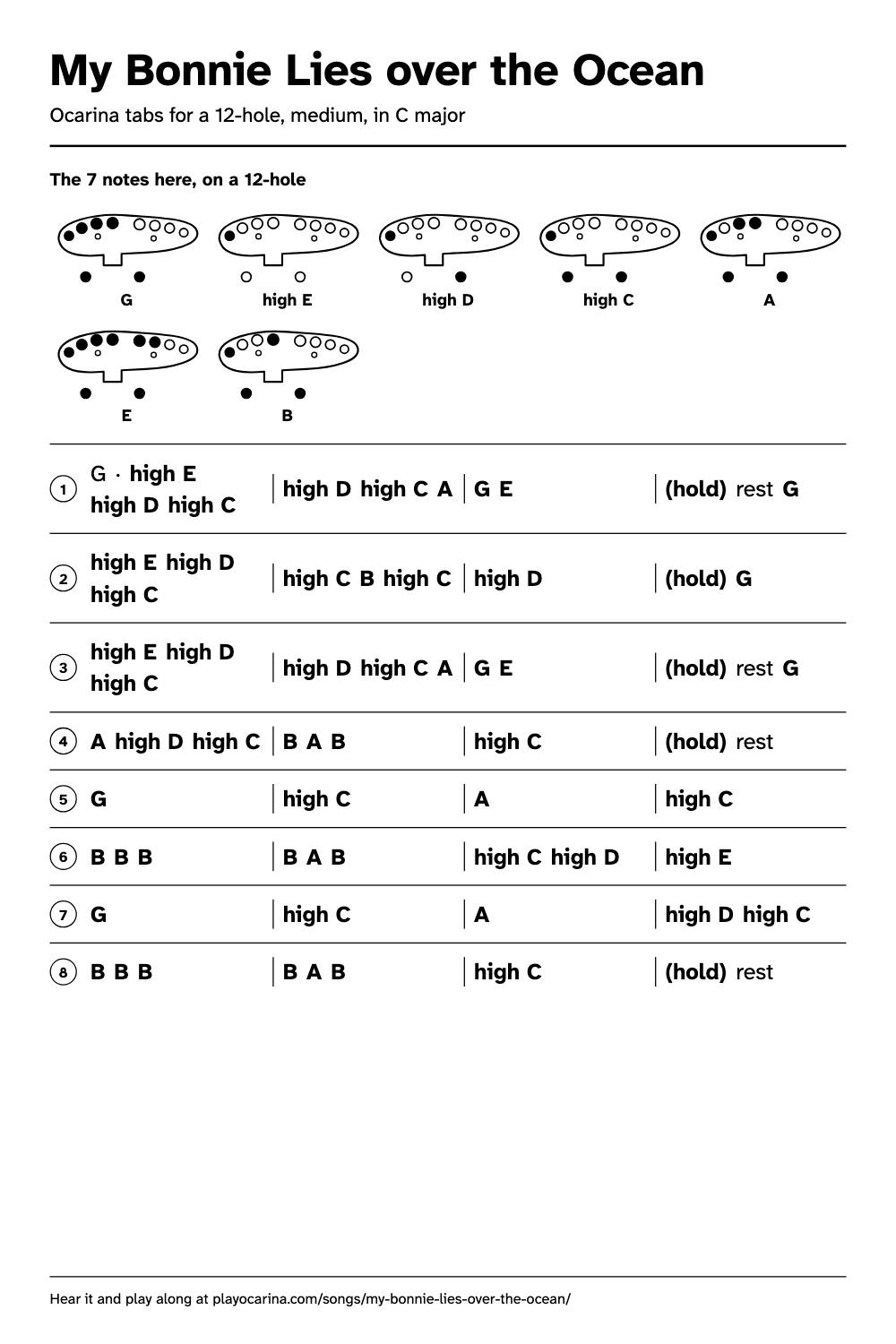
On a 12-hole. Read left to right, a line at a time.
- G high Ehigh Dhigh Chigh Dhigh CAGE(hold)restG
- high Ehigh Dhigh Chigh CBhigh Chigh D(hold)G
- high Ehigh Dhigh Chigh Dhigh CAGE(hold)restG
- Ahigh Dhigh CBABhigh C(hold)rest
- Ghigh CAhigh C
- BBBBABhigh Chigh Dhigh E
- Ghigh CAhigh Dhigh C
- BBBBABhigh C(hold)rest
My Bonnie Lies over the Ocean starts on G and leaps straight up to high E, then falls back through D, C, D, C and A. Here it is in C major, from E up to high E, with no sharps or flats: the verse once, then the chorus. It moves in a slow three to the bar, and the first and third lines of the verse both settle on a long low E.
What is the tricky spot in My Bonnie Lies over the Ocean?
The leap from G up to high E on the second note, which comes back at the start of three of the verse's four lines. On a 12-hole, My Bonnie Lies over the Ocean goes from G to high E: you lift the left ring, left middle, left index, left thumb and right thumb. On a 6-hole, you lift the left index, right index, left thumb and right thumb.
High E is the top note of the song, one step above the high D where many beginner tunes stop, so give it a firmer, quicker breath than the G before it and move all the fingers at once. Practise G to high E slowly, then add the dotted D and the quick C that fall away from it. The chorus has the same jump the other way: after the long high E halfway through, it drops straight back to G.
Where do you breathe in My Bonnie Lies over the Ocean?
The first and third lines of the verse end on a long E followed by a one-beat rest, the easiest places to breathe. In the second line, breathe after the long high D, before the G that starts the next line. In the chorus each of the first four notes lasts a whole bar, so take a full breath before it and a second one after the long high E in the middle.
Which ocarina can play My Bonnie Lies over the Ocean?
A 4-hole ocarina cannot reach high D and high E, so play My Bonnie Lies over the Ocean in this key on a 12-hole or 6-hole ocarina in C. On an ocarina in G or F, use the same fingerings: the tune sounds in a different key, which is fine when you play alone. Each linked chart has every fingering for its ocarina, and you can check your notes with a tuner such as our free ocarina tuner.
The 7 notes here, on a 12-holeHoles in words, with a picture
| Note | Holes to cover | Picture |
|---|---|---|
| G | Cover every main hole but the right index, right middle, right ring and right pinky | |
| high E | Cover the left pinky | |
| high D | Cover the left pinky and right thumb | |
| high C | Cover the left pinky, left thumb and right thumb | |
| A | Cover the left pinky, left middle, left index, left thumb and right thumb | |
| E | Cover every main hole but the right ring and right pinky | |
| B | Cover the left pinky, left index, left thumb and right thumb |
Drawn as you see it while playing: mouthpiece towards you, left hand on the left.
| Note | Holes to cover | Picture |
|---|---|---|
| G | Cover every hole but the left middle and right middle | |
| high E | All holes open | |
| high D | Cover the left thumb | |
| high C | Cover the left thumb and right thumb | |
| A | Cover the left index, left thumb and right thumb | |
| E | Cover every hole but the right index | |
| B | Cover the right middle, left thumb and right thumb |
Drawn as you see it while playing: mouthpiece towards you, left hand on the left.
Who first published My Bonnie Lies over the Ocean?
Nobody knows who made the tune: its origin is uncertain, and in 1881 Charles E. Pratt published it as sheet music, Bring Back My Bonnie to Me, under two pen names. Pratt died in 1902. By 1909 it was a college favourite: the foreword of Heart Songs, a songbook published in Boston that year, says it appeared "equally attractive to various alma maters". Our tabs follow that book's page 179, where it is headed simply "Bonnie" with no author named: the verse line, then the top line of the chorus, which the page sets in four parts. The book writes it in C major starting from low E; we keep the key and move every note up an octave, so it runs from E to high E. One detail of the page we kept: in the fourth bar of the chorus it holds one long C, and only at the same spot in the second half does it step from D down to C. We show the melody only. Music: traditional; first published as sheet music by Charles E. Pratt (1841-1902) in 1881.