Old Folks at Home (Swanee River) on the ocarina
On a 12-hole it starts E, D, C, E. Medium, 86 notes, in C major.
Goes up to high D, so it does not fit a 4-hole.
Old Folks at Home (Swanee River)
Bar 1 of 24
What are the notes for Old Folks at Home (Swanee River)?
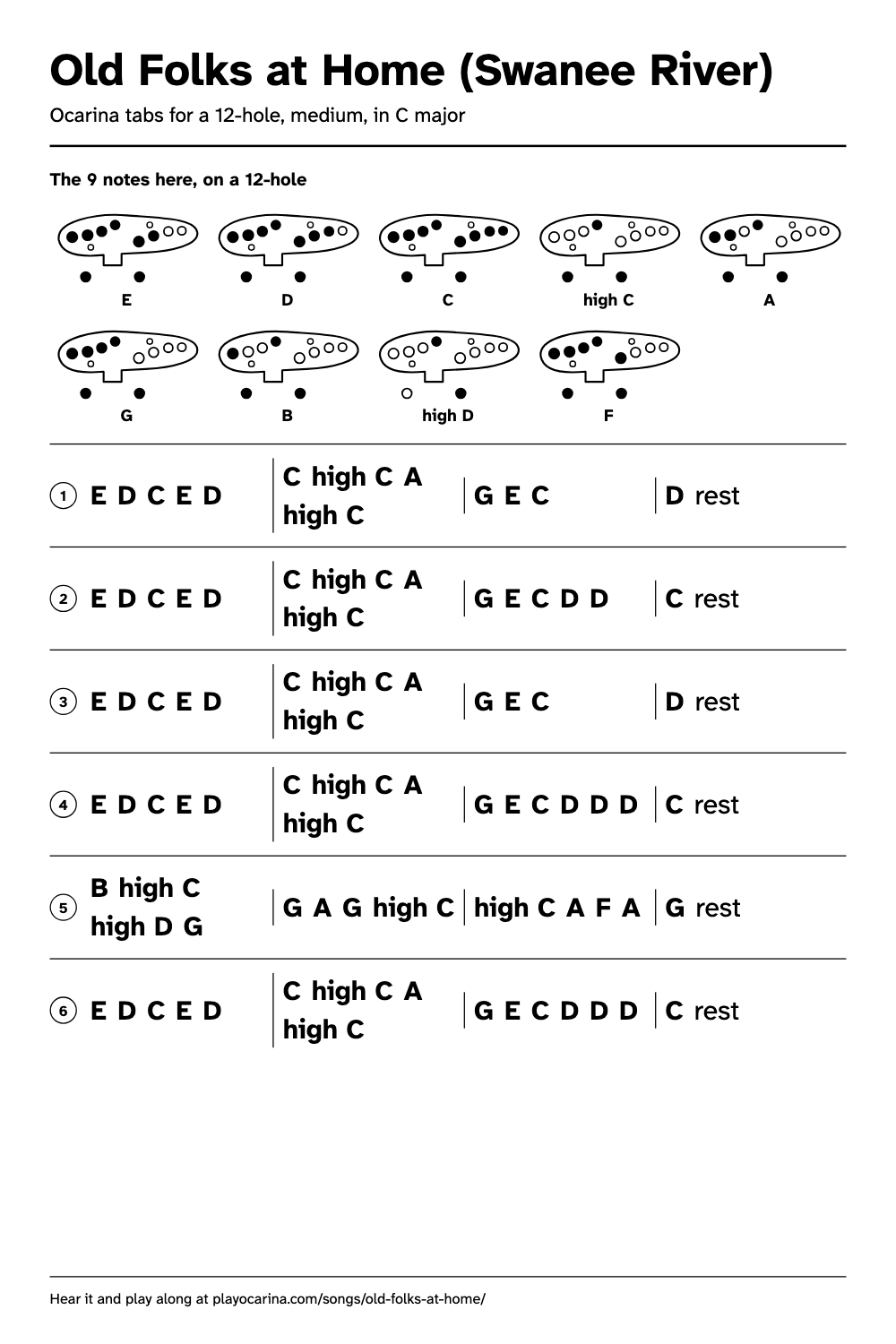
On a 12-hole. Read left to right, a line at a time.
- EDCEDTricky spot:Chigh CAhigh CGECDrest
- EDCEDChigh CAhigh CGECDDCrest
- EDCEDChigh CAhigh CGECDrest
- EDCEDChigh CAhigh CGECDDDCrest
- Bhigh Chigh DGGAGhigh Chigh CAFAGrest
- EDCEDChigh CAhigh CGECDDDCrest
Old Folks at Home, also called Swanee River, is a slow song in four-beat bars, and each verse line starts with the same falling figure, E, D, C, E, D, before an octave leap. Here it is in C major, from C up to high D: the four lines of the verse, then the chorus, as Firth, Pond & Co. printed it in 1851.
What is the tricky spot in Old Folks at Home (Swanee River)?
The second bar of each line, where the tune jumps a whole octave from C straight up to high C. On a 12-hole, Old Folks at Home (Swanee River) goes from C to high C: you lift the left ring, left middle, left index, right index, right middle, right ring and right pinky. On a 6-hole, you lift the left middle, right middle, left index and right index.
Do not blow the high C as hard as you can: it needs only a little more air than the C below, and too much makes it sharp or squeaky. Practise the jump slowly, low C, high C, A, high C, until the top note speaks on time. In the first two lines the A is short and the high C after it is long; in the last two lines all four notes are even. The 1851 printing puts a pause mark on the high C near the end of the chorus, so you can hold it a little before the last phrase.
Where do you breathe in Old Folks at Home (Swanee River)?
Every line but the last ends on a long note with a rest after it: the three-beat D or C at the end of bars 4, 8, 12 and 16, and the long G that ends the first half of the chorus in bar 20. Breathe in each of those rests.
Which ocarina can play Old Folks at Home (Swanee River)?
A 4-hole ocarina cannot reach high D, so play Old Folks at Home (Swanee River) in this key on a 12-hole or 6-hole ocarina in C. On an ocarina in G or F, use the same fingerings: the tune sounds in a different key, which is fine when you play alone. Each linked chart has every fingering for its ocarina, and you can check your notes with a tuner such as our free ocarina tuner.
The 9 notes here, on a 12-holeHoles in words, with a picture
| Note | Holes to cover | Picture |
|---|---|---|
| E | Cover every main hole but the right ring and right pinky | |
| D | Cover every main hole but the right pinky | |
| C | Cover every main hole | |
| high C | Cover the left pinky, left thumb and right thumb | |
| A | Cover the left pinky, left middle, left index, left thumb and right thumb | |
| G | Cover every main hole but the right index, right middle, right ring and right pinky | |
| B | Cover the left pinky, left index, left thumb and right thumb | |
| high D | Cover the left pinky and right thumb | |
| F | Cover every main hole but the right middle, right ring and right pinky |
Drawn as you see it while playing: mouthpiece towards you, left hand on the left.
| Note | Holes to cover | Picture |
|---|---|---|
| E | Cover every hole but the right index | |
| D | Cover every hole but the right middle | |
| C | Cover every hole | |
| high C | Cover the left thumb and right thumb | |
| A | Cover the left index, left thumb and right thumb | |
| G | Cover every hole but the left middle and right middle | |
| B | Cover the right middle, left thumb and right thumb | |
| high D | Cover the left thumb | |
| F | Cover every hole but the right middle and right index |
Drawn as you see it while playing: mouthpiece towards you, left hand on the left.
Who wrote Old Folks at Home?
Stephen Foster, in 1851, for E. P. Christy's minstrel troupe. Christy asked to be credited as the song's creator, and the 1851 sheet music from Firth, Pond & Co. does say "Words and Music by E. P. Christy". The words are in the mock dialect of the minstrel shows, which is one reason this page teaches the tune and leaves out the words. Our tabs follow that 1851 printing, moved from D major to C major. Music: Stephen Foster (1826-1864).