The Sailor's Hornpipe on the ocarina
On a 12-hole it starts A, G, F, F. Hard, 105 notes, in F major.
Goes up to high F, so it does not fit a 6-hole or 4-hole.
The Sailor's Hornpipe
Bar 1 of 16
What are the notes for The Sailor's Hornpipe?
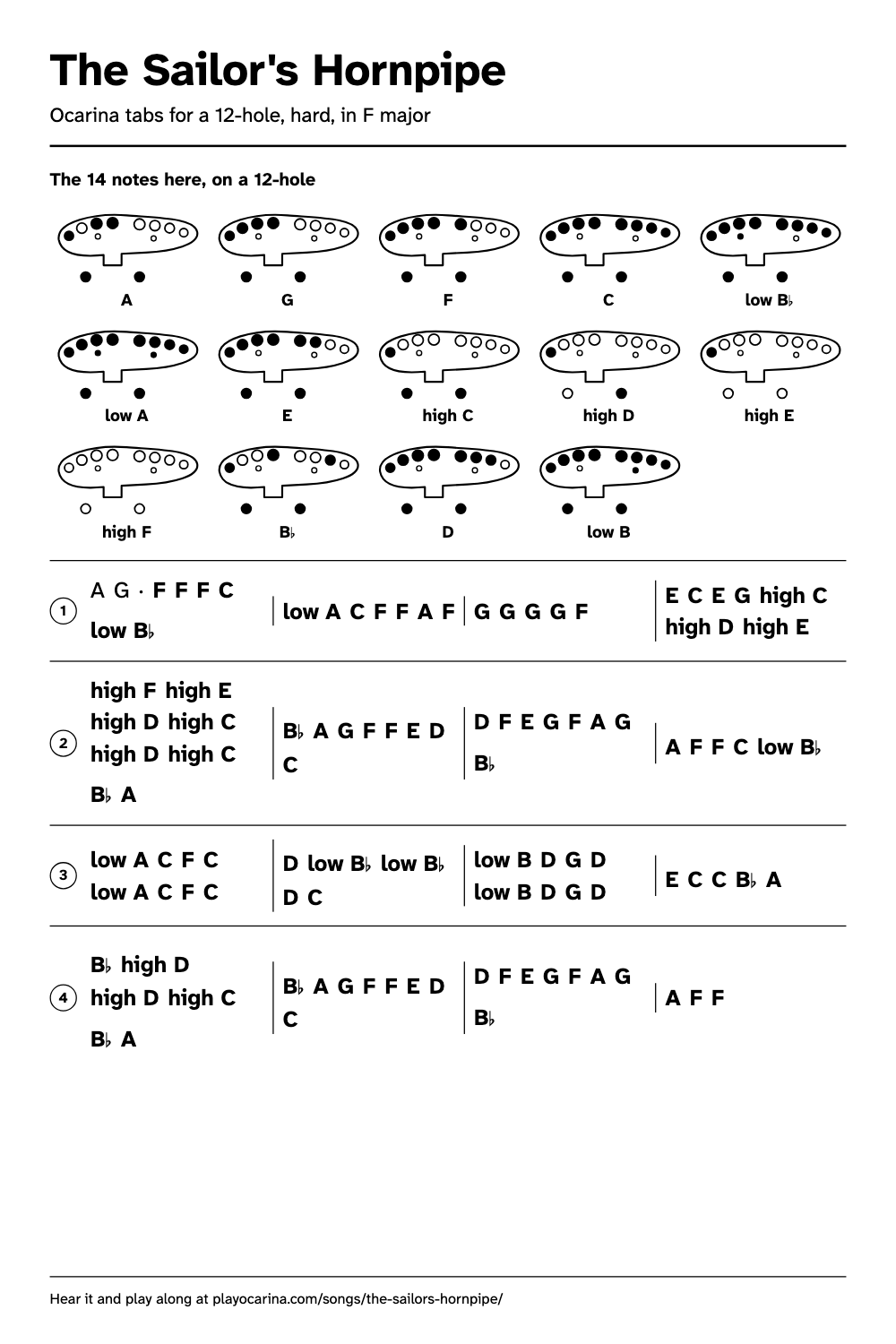
On a 12-hole. Read left to right, a line at a time.
- AG FFFClow B♭low ACFFAFGGGGFTricky spot:ECEGhigh Chigh Dhigh E
- high Fhigh Ehigh Dhigh Chigh Dhigh CB♭AB♭AGFFEDCDFEGFAGB♭AFFClow B♭
- low ACFClow ACFCDlow B♭low B♭DClow BDGDlow BDGDECCB♭A
- B♭high Dhigh Dhigh CB♭AB♭AGFFEDCDFEGFAGB♭AFF
The Sailor's Hornpipe opens with two quick lead-in notes, A and G, then F, F, F and a quick C, B flat down to low A. Here are both parts in F major, from low A up to high F, in quick notes almost all the way. It has accidentals: B flat, low and high, and in the second part one bar of B naturals.
What is the tricky spot in The Sailor's Hornpipe?
The run to the top of the tune: in the fourth bar it climbs E, C, E, G, high C, high D, high E and lands on high F on the next beat, then runs straight back down. On a 12-hole, The Sailor's Hornpipe goes from high E to high F: you lift the left pinky.
Count every bar as two beats of four quick notes, "1 e and a, 2 e and a", and tongue each note lightly with a "du". Practise the climb from G to high F slowly until each note speaks, then bring it up to speed. High F is the highest note in the tune and needs the firmest breath (more on high notes): push a little harder as you climb and ease off as the run falls back to A. The second part has its own jump, in its fourth bar, from C straight up to high B flat.
Where do you breathe in The Sailor's Hornpipe?
Each part runs eight bars of quick notes without a rest. The three slower notes that close each part, A, F, F, are the place to breathe: breathe after the last F, and if that is too short, leave out the two lead-in notes into the next part. The F, F, F of the first bar and the G, G, G of the third are slower too, so a quick sip fits after them.
Which ocarina can play The Sailor's Hornpipe?
A 6-hole ocarina cannot reach low A, low B♭, low B and high F, and a 4-hole ocarina cannot reach low A, low B♭, low B, high D, high E and high F, so play The Sailor's Hornpipe in this key on a 12-hole ocarina in C. On an ocarina in G or F, use the same fingerings: the tune sounds in a different key, which is fine when you play alone. The linked chart has every fingering, and you can check your notes with a tuner such as our free ocarina tuner.
The 14 notes here, on a 12-holeHoles in words, with a picture
| Note | Holes to cover | Picture |
|---|---|---|
| A | Cover the left pinky, left middle, left index, left thumb and right thumb | |
| G | Cover every main hole but the right index, right middle, right ring and right pinky | |
| F | Cover every main hole but the right middle, right ring and right pinky | |
| C | Cover every main hole | |
| low B♭ | Cover every main hole, plus the left sub-hole | |
| low A | Cover every main hole, plus the left sub-hole and right sub-hole | |
| E | Cover every main hole but the right ring and right pinky | |
| high C | Cover the left pinky, left thumb and right thumb | |
| high D | Cover the left pinky and right thumb | |
| high E | Cover the left pinky | |
| high F | All holes open | |
| B♭ | Cover the left pinky, left index, right ring, left thumb and right thumb | |
| D | Cover every main hole but the right pinky | |
| low B | Cover every main hole, plus the right sub-hole |
Drawn as you see it while playing: mouthpiece towards you, left hand on the left.
Is The Sailor's Hornpipe the tune from Popeye?
Yes. It is usually the first thing heard in the opening credits of the Popeye cartoons Max Fleischer made from 1933, before the theme song, but the tune is much older than the films. Also called the College Hornpipe and Jack's the Lad, it was first printed as "The College" in a hornpipe collection of about 1757. William Chappell, writing in London about 1859, said the College Hornpipe, "in spite of its extended compass", was the tune of an old sailor's song called "Jack's the lad". Our tabs follow Ryan's Mammoth Collection (Boston, 1883), which prints it as College Hornpipe in B flat; we moved it up a fifth to F major. The tune spans two full octaves, four semitones more than a 12-hole ocarina can play in any key, so in the first and third bars the two notes that drop an octave are played in the upper octave, as repeated notes; every other note is as printed. The page repeats each part; the tabs play each part once. No composer's name has come down with it. Music: traditional hornpipe, anonymous.