The Star-Spangled Banner on the ocarina
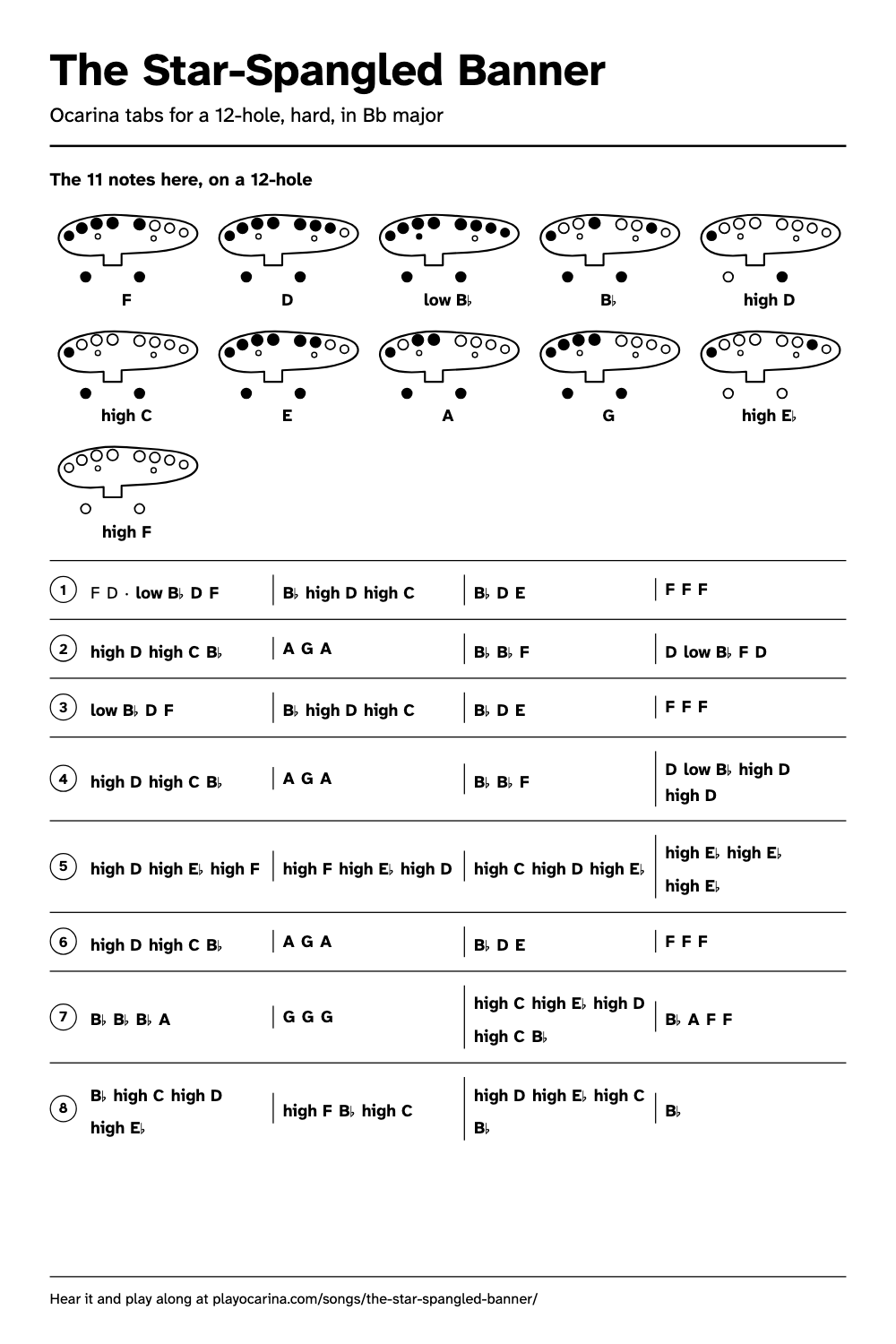
On a 12-hole it starts F, D, low B♭, D. Hard, 104 notes, in Bb major.
Goes up to high F, so it does not fit a 6-hole or 4-hole.
The Star-Spangled Banner
Bar 1 of 32
What are the notes for The Star-Spangled Banner?
On a 12-hole. Read left to right, a line at a time.
- FD low B♭DFB♭high Dhigh CB♭DEFFF
- high Dhigh CB♭AGAB♭B♭FDlow B♭FD
- low B♭DFB♭high Dhigh CB♭DEFFF
- high Dhigh CB♭AGAB♭B♭FTricky spot:Dlow B♭high Dhigh D
- high Dhigh E♭high Fhigh Fhigh E♭high Dhigh Chigh Dhigh E♭high E♭high E♭high E♭
- high Dhigh CB♭AGAB♭DEFFF
- B♭B♭B♭AGGGhigh Chigh E♭high Dhigh CB♭B♭AFF
- B♭high Chigh Dhigh E♭high FB♭high Chigh Dhigh E♭high CB♭B♭
The Star-Spangled Banner starts low and climbs: a short lead-in, then three notes up from low B flat, a leap to high B flat and a rising line to the top. Here it is in B flat major, one verse, 32 bars of 3/4, from low B flat to high F, the top note of a 12-hole ocarina. It spans a twelfth, so only a full 12-hole plays it.
What is the hardest leap in The Star-Spangled Banner?
The leap in the sixteenth bar, from low B flat up to high D, a tenth, which opens the climb to the top of the tune. On a 12-hole, The Star-Spangled Banner goes from low B♭ to high D: you lift the left ring, left middle, left index, right index, right middle, right ring, right pinky, left thumb and left sub-hole.
Take a full breath at the bar before and let the low B flat ring its whole beat, then jump: high D needs a quicker, firmer breath than anything before it. The next bars climb on to E flat and high F, played with every hole open, so keep the air steady and do not push. An E natural comes three times in the first half, in the third, eleventh and twenty-third bars; it sits half a step above the E flat you use at the top, so do not mix them up.
Where do you breathe in The Star-Spangled Banner?
After the half-note F that ends each of the first lines, in the fourth, twelfth and twenty-fourth bars, and after the half-note E flat in the twentieth bar. Take a last big breath before the final climb, in the twenty-eighth bar.
Which ocarina can play The Star-Spangled Banner?
A 6-hole ocarina cannot reach low B♭ and high F, and a 4-hole ocarina cannot reach low B♭, high D, high E♭ and high F, so play The Star-Spangled Banner in this key on a 12-hole ocarina in C. On an ocarina in G or F, use the same fingerings: the tune sounds in a different key, which is fine when you play alone. The linked chart has every fingering, and you can check your notes with a tuner such as our free ocarina tuner.
The 11 notes here, on a 12-holeHoles in words, with a picture
| Note | Holes to cover | Picture |
|---|---|---|
| F | Cover every main hole but the right middle, right ring and right pinky | |
| D | Cover every main hole but the right pinky | |
| low B♭ | Cover every main hole, plus the left sub-hole | |
| B♭ | Cover the left pinky, left index, right ring, left thumb and right thumb | |
| high D | Cover the left pinky and right thumb | |
| high C | Cover the left pinky, left thumb and right thumb | |
| E | Cover every main hole but the right ring and right pinky | |
| A | Cover the left pinky, left middle, left index, left thumb and right thumb | |
| G | Cover every main hole but the right index, right middle, right ring and right pinky | |
| high E♭ | Cover the left pinky and right ring | |
| high F | All holes open |
Drawn as you see it while playing: mouthpiece towards you, left hand on the left.
Who wrote the tune of The Star-Spangled Banner?
Francis Scott Key wrote the words in 1814, and they were fitted to The Anacreontic Song, the tune John Stafford Smith wrote for a London gentlemen's club of amateur musicians. Our tabs follow a 1909 songbook, which credits the tune to Samuel Arnold; a 1909 Library of Congress report says the tune was for a long time given to Arnold, if it was given to anyone. Wikipedia counts a range of 19 semitones, which is why the tune is hard to sing and why only a 12-hole ocarina plays it. Congress made it the national anthem in 1931. We show the melody only. Music: John Stafford Smith (died 1836), from his Anacreontic Song, in London by 1773; words by Francis Scott Key (died 1843), 1814.