When You and I Were Young, Maggie on the ocarina
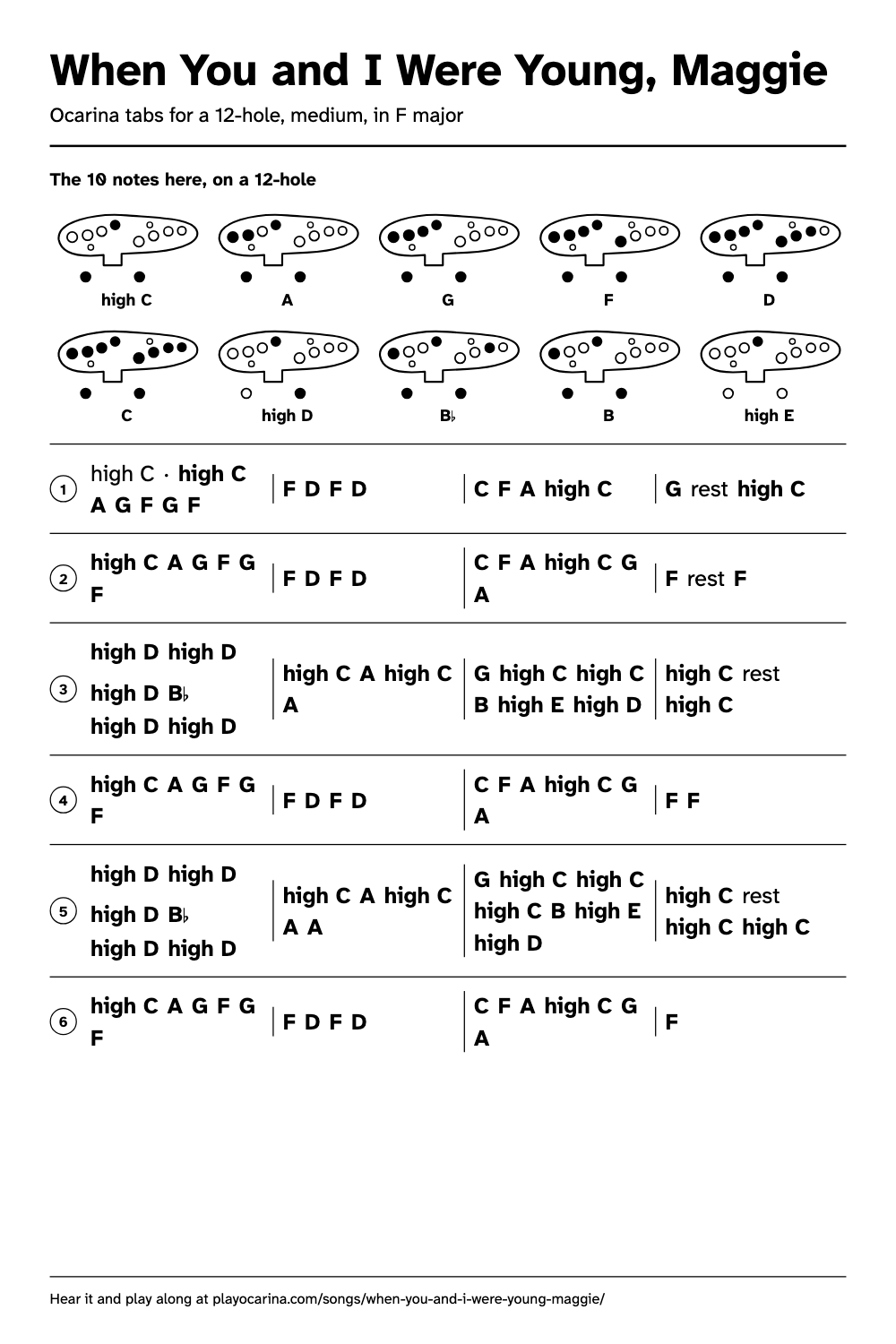
On a 12-hole it starts high C, high C, A, G. Medium, 109 notes, in F major.
Goes up to high E, so it does not fit a 4-hole.
When You and I Were Young, Maggie
Bar 1 of 24
What are the notes for When You and I Were Young, Maggie?
On a 12-hole. Read left to right, a line at a time.
- high C high CAGFGFFDFDCFAhigh CGresthigh C
- high CAGFGFFDFDCFAhigh CGATricky spot:FrestF
- high Dhigh Dhigh DB♭high Dhigh Dhigh CAhigh CAGhigh Chigh CBhigh Ehigh Dhigh Cresthigh C
- high CAGFGFFDFDCFAhigh CGAFF
- high Dhigh Dhigh DB♭high Dhigh Dhigh CAhigh CAAGhigh Chigh Chigh CBhigh Ehigh Dhigh Cresthigh Chigh C
- high CAGFGFFDFDCFAhigh CGAF
When You and I Were Young, Maggie is a slow song in 4/4: three of the verse's four lines start on a high C, drop to A and step down through G to F. Here it is in F major, the verse and then the chorus, 24 bars from low C up to high E, so a 12-hole or a 6-hole ocarina in C plays it. The chorus sings the tune of the verse's last eight bars again, with a few rhythms changed to fit the new words. The tabs follow an Oliver Ditson edition from Boston, a printing the Internet Archive dates to 1909.
What is the tricky spot in When You and I Were Young, Maggie?
The start of the verse's third line, and again of the chorus, where a single F leaps up a sixth to high D and the tune stays high: three D's, a B flat, two more D's, and two bars later the highest note in the song, high E. On a 12-hole, When You and I Were Young, Maggie goes from F to high D: you lift the left ring, left middle, left index, right index and left thumb. On a 6-hole, you lift the left middle, left index and right thumb.
Practise F to high D slowly until the D speaks clean on the beat. High D wants a faster, firmer breath than the F, so change the air as you lift your fingers, not after. B flat is the one flat in the song, and a C ocarina cross-fingers it: play D, B flat, D on its own until the B flat sits in tune. In bars 11 and 19 the tune runs C, B, then up to high E and down to D in two quick pairs; the printing slows down there, so take your time and give the E a little more air. Everywhere else, the dotted pairs are a long note and a very short one: keep the short note to a quarter of a beat, so it leads straight into the next note.
Where do you breathe in When You and I Were Young, Maggie?
Breathe in the rest at the end of each of the verse's first three lines: after the long G in bar 4, the long F in bar 8 and the long C in bar 12. The verse's last line has no rest, so take a small breath in bar 14, after the F the printing holds with a pause, before the short low D that leads into the verse's last two bars. Breathe again in bar 16, after the long F that ends the verse and before the single F that starts the chorus. The chorus breathes like the second half of the verse: in the rest after the long C in bar 20, and after the paused F in bar 22.
Which ocarina can play When You and I Were Young, Maggie?
A 4-hole ocarina cannot reach high D and high E, so play When You and I Were Young, Maggie in this key on a 12-hole or 6-hole ocarina in C. On an ocarina in G or F, use the same fingerings: the tune sounds in a different key, which is fine when you play alone. Each linked chart has every fingering for its ocarina, and you can check your notes with a tuner such as our free ocarina tuner.
The 10 notes here, on a 12-holeHoles in words, with a picture
| Note | Holes to cover | Picture |
|---|---|---|
| high C | Cover the left pinky, left thumb and right thumb | |
| A | Cover the left pinky, left middle, left index, left thumb and right thumb | |
| G | Cover every main hole but the right index, right middle, right ring and right pinky | |
| F | Cover every main hole but the right middle, right ring and right pinky | |
| D | Cover every main hole but the right pinky | |
| C | Cover every main hole | |
| high D | Cover the left pinky and right thumb | |
| B♭ | Cover the left pinky, left index, right ring, left thumb and right thumb | |
| B | Cover the left pinky, left index, left thumb and right thumb | |
| high E | Cover the left pinky |
Drawn as you see it while playing: mouthpiece towards you, left hand on the left.
| Note | Holes to cover | Picture |
|---|---|---|
| high C | Cover the left thumb and right thumb | |
| A | Cover the left index, left thumb and right thumb | |
| G | Cover every hole but the left middle and right middle | |
| F | Cover every hole but the right middle and right index | |
| D | Cover every hole but the right middle | |
| C | Cover every hole | |
| high D | Cover the left thumb | |
| B♭ | Cover the right index, left thumb and right thumb | |
| B | Cover the right middle, left thumb and right thumb | |
| high E | All holes open |
Drawn as you see it while playing: mouthpiece towards you, left hand on the left.
Who wrote When You and I Were Young, Maggie?
James Austin Butterfield wrote the music to a poem by George W. Johnson, and the song was first published in 1866. Our tabs follow an Oliver Ditson edition from Boston, edited by A. La Meda for medium voice and piano, pages 3 to 5, which the Internet Archive dates to 1909 from its copyright line; we did not find the 1866 first printing online. It sets three verses to the same 16 bars, then prints a chorus for four voices that it says may be sung as a solo. The tabs give one verse, in the printing's key of F major, an octave up, and then the chorus, with its soprano line as the tune. Where the printing splits a note to fit the words of the second or third verse, we follow the first verse, and we leave out the piano's four-bar introduction. We show the melody only. Music: James Austin Butterfield (1837-1891), to words by George W. Johnson.