Will the Circle Be Unbroken on the ocarina
On a 12-hole it starts low A, low B♭, C, C. Medium, 59 notes, in F major.
Goes down to low A, so it does not fit a 6-hole or 4-hole.
Will the Circle Be Unbroken
Bar 1 of 16
What are the notes for Will the Circle Be Unbroken?
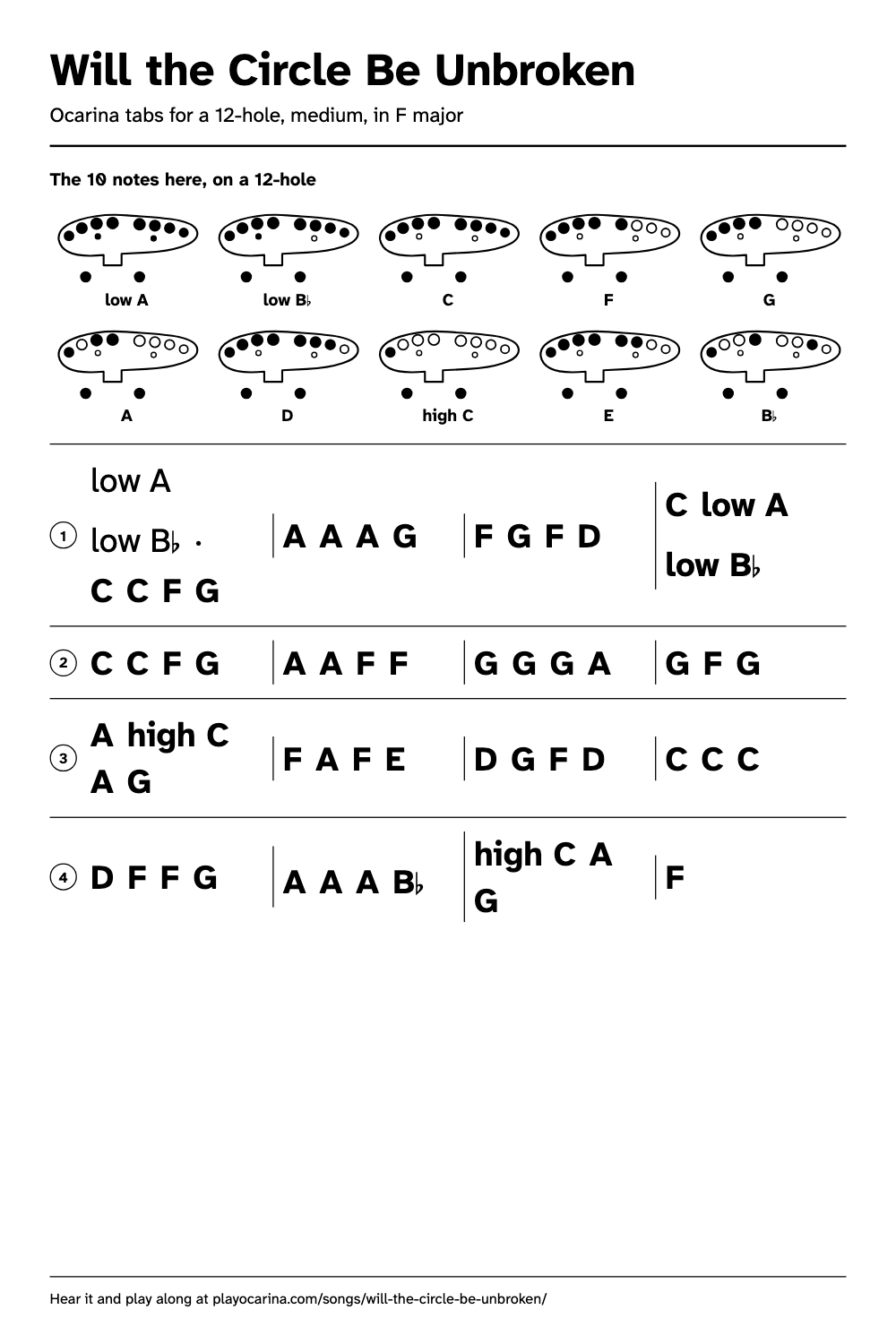
On a 12-hole. Read left to right, a line at a time.
- low Alow B♭ CCFGAAAGFGFDClow Alow B♭
- CCFGAAFFGGGAGFG
- Tricky spot:Ahigh CAGFAFEDGFDCCC
- DFFGAAAB♭high CAGF
Will the Circle Be Unbroken, as Charles H. Gabriel wrote it in 1907, opens with a quick A and B flat that lift into a long C, then climbs C, F, G to a held A. The verse and the chorus are eight bars each in F major, and the chorus reaches high C on its third note. This is the 1907 hymn tune, not the country tune most bands play today.
What is the tricky spot in Will the Circle Be Unbroken?
The first full bar of the chorus, where the tune jumps from A up to a two-beat high C, the top note of the song. On a 12-hole, Will the Circle Be Unbroken goes from A to high C: you lift the left middle and left index.
That high C comes back as the three-beat note near the end, after a quick B flat, so learn the two together: play A, B flat, C slowly until the B flat cross-fingering is clean. Each bar begins with a pickup pair, a dotted eighth and a sixteenth, so keep the long note long and flick the short one into the next beat rather than playing them as two equal notes.
Where do you breathe in Will the Circle Be Unbroken?
The song breathes every four bars, on the three-beat notes: the long C at the end of the first and third lines, the long G halfway, and the high C before the last pickup. Take the breath at the end of each held note, then play the quick pair that leads off the next line.
Which ocarina can play Will the Circle Be Unbroken?
A 6-hole or 4-hole ocarina cannot reach low A and low B♭, so play Will the Circle Be Unbroken in this key on a 12-hole ocarina in C. On an ocarina in G or F, use the same fingerings: the tune sounds in a different key, which is fine when you play alone. The linked chart has every fingering, and you can check your notes with a tuner such as our free ocarina tuner.
The 10 notes here, on a 12-holeHoles in words, with a picture
| Note | Holes to cover | Picture |
|---|---|---|
| low A | Cover every main hole, plus the left sub-hole and right sub-hole | |
| low B♭ | Cover every main hole, plus the left sub-hole | |
| C | Cover every main hole | |
| F | Cover every main hole but the right middle, right ring and right pinky | |
| G | Cover every main hole but the right index, right middle, right ring and right pinky | |
| A | Cover the left pinky, left middle, left index, left thumb and right thumb | |
| D | Cover every main hole but the right pinky | |
| high C | Cover the left pinky, left thumb and right thumb | |
| E | Cover every main hole but the right ring and right pinky | |
| B♭ | Cover the left pinky, left index, right ring, left thumb and right thumb |
Drawn as you see it while playing: mouthpiece towards you, left hand on the left.
Is this the tune of Will the Circle Be Unbroken that bands play?
Not quite. Ada R. Habershon wrote the words and Charles H. Gabriel the music in 1907, and Alexander's Gospel Songs, compiled by the revival song leader Charles M. Alexander and published in New York in 1908, prints it as hymn 55 with a verse and a chorus. Our tabs follow the top voice on that page, a sixth higher than the book's A flat major. Wikipedia notes that the tune most people sing today differs substantially from Gabriel's, and that the Carter Family's 1935 "Can the Circle Be Unbroken" has new verses of its own. We leave both of those out. Gabriel died in 1932 and Habershon in 1918. We show the melody only. Music: music by Charles H. Gabriel (1856-1932), words by Ada R. Habershon (1861-1918), 1907.