À la claire fontaine on the ocarina
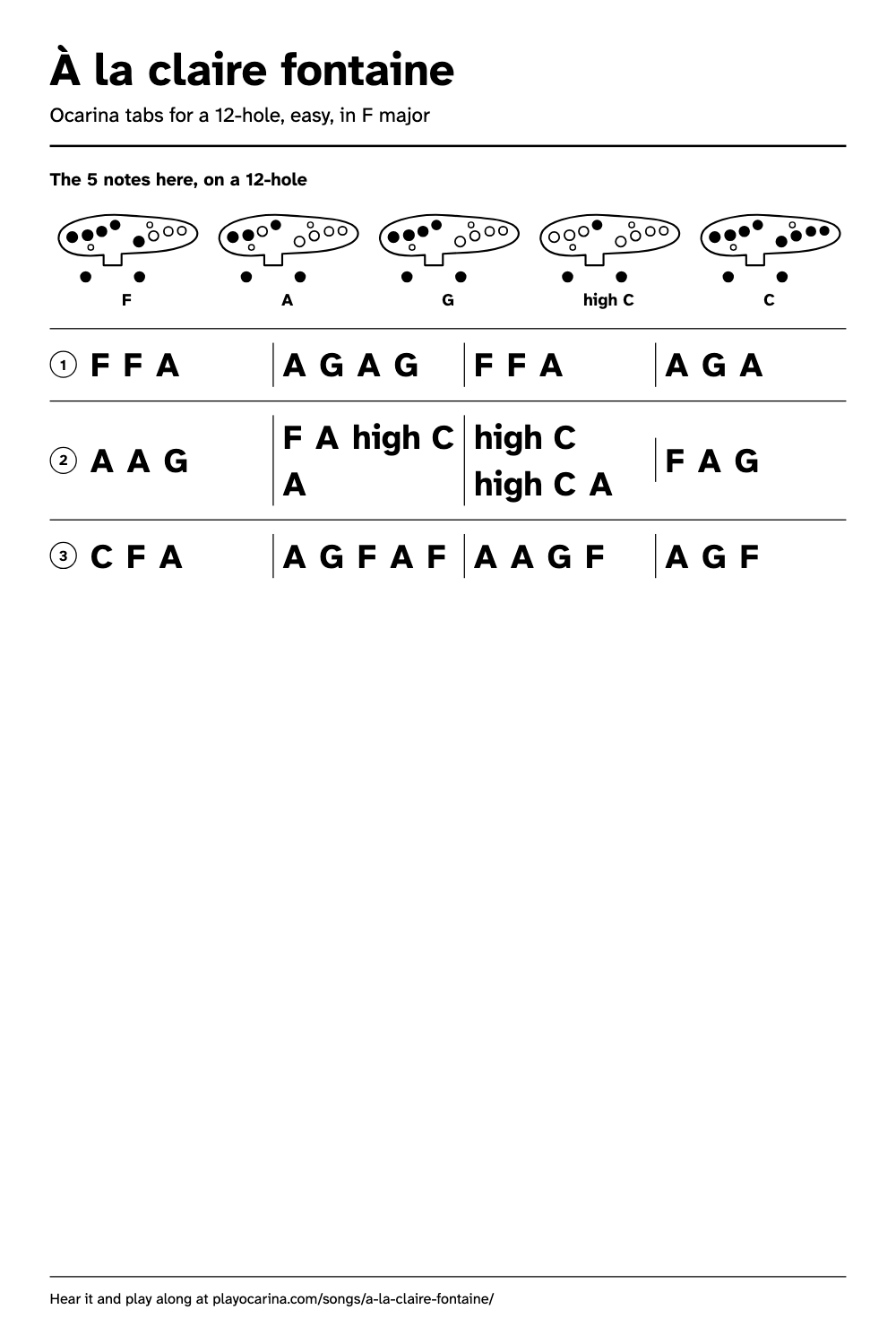
On a 12-hole it starts F, F, A, A. Easy, 41 notes, in F major.
À la claire fontaine
Bar 1 of 12
What are the notes for À la claire fontaine?
On a 12-hole. Read left to right, a line at a time.
- FFAAGAGFFAAGA
- AAGFAhigh CAhigh Chigh CATricky spot:FAG
- CFAAGFAFAAGFAGF
À la claire fontaine is a gentle French folk song that circles around F, G and A, reaching up to high C and once down to low C. Here it is in F major, the 12 bars Ernest Gagnon printed in Québec in 1865. The tune never uses the B flat of the key, so it has no sharps or flats to cross-finger and fits a 12-hole, 6-hole or 4-hole ocarina.
What is the tricky spot in À la claire fontaine?
The start of the last line, where the long G that ends the second line drops to low C, the lowest note in the song, and climbs straight back up through F to A. On a 12-hole, À la claire fontaine goes from G to C: you cover the right index, right middle, right ring and right pinky. On a 6-hole or 4-hole, you cover the left middle and right middle.
Low C needs each covered hole fully sealed and a gentle breath: too much air and it goes sharp or squeaks. Practise G, low C, F, A slowly until the C speaks cleanly, then take it at speed. The last line also has the only quick notes, G and F as a pair of sixteenths in bars 10 and 11; tongue them lightly with a "du" so they stay two notes and land back on the beat.
Where do you breathe in À la claire fontaine?
Breathe after the long A at the end of bar 4 and the long G at the end of bar 8, where the sung lines end. The last line is four bars: take a short breath after the F that ends bar 10, then play the last two bars in one go.
Which ocarina can play À la claire fontaine?
Any 12-hole, 6-hole or 4-hole ocarina in C plays À la claire fontaine in this key. On an ocarina in G or F, use the same fingerings: the tune sounds in a different key, which is fine when you play alone. Each linked chart has every fingering for its ocarina, and you can check your notes with a tuner such as our free ocarina tuner.
The 5 notes here, on a 12-holeHoles in words, with a picture
| Note | Holes to cover | Picture |
|---|---|---|
| F | Cover every main hole but the right middle, right ring and right pinky | |
| A | Cover the left pinky, left middle, left index, left thumb and right thumb | |
| G | Cover every main hole but the right index, right middle, right ring and right pinky | |
| high C | Cover the left pinky, left thumb and right thumb | |
| C | Cover every main hole |
Drawn as you see it while playing: mouthpiece towards you, left hand on the left.
| Note | Holes to cover | Picture |
|---|---|---|
| F | Cover every hole but the right middle and right index | |
| A | Cover the left index, left thumb and right thumb | |
| G | Cover every hole but the left middle and right middle | |
| high C | Cover the left thumb and right thumb | |
| C | Cover every hole |
Drawn as you see it while playing: mouthpiece towards you, left hand on the left.
| Note | Holes to cover | Picture |
|---|---|---|
| F | Cover the left middle and left index | |
| A | Cover the left index | |
| G | Cover the left index and right index | |
| high C | All holes open | |
| C | Cover every hole |
Drawn as you see it while playing: mouthpiece towards you, left hand on the left.
Where does À la claire fontaine come from?
It is a traditional French song whose title means "by the clear fountain", popular in Belgium and in Canada, above all in Quebec and the Maritime provinces. Our tabs follow Ernest Gagnon's Chansons populaires du Canada, printed in Québec in 1865, where he writes that everyone in Canada, from a child of seven to an old man with white hair, knows and sings it. He adds that in Normandy a song with nearly the same words is sung to a quite different tune, so this is the Canadian one. We play his 12 bars in F major, the key he printed, and leave out the short variant he gives for the start of the last line. We show the melody only. Music: traditional French folk song, the tune sung in Canada as printed by Ernest Gagnon in Québec, 1865.