America the Beautiful on the ocarina
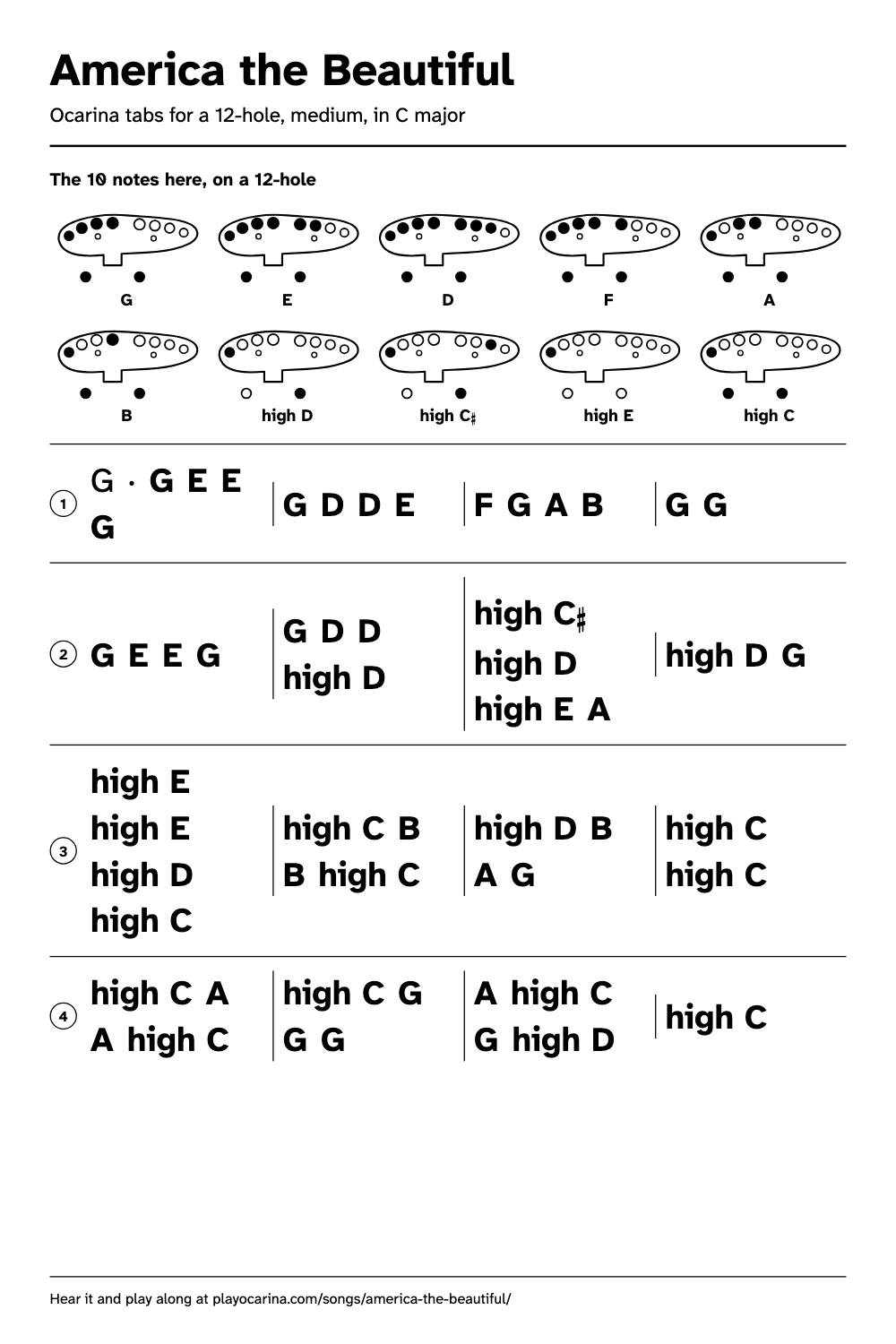
On a 12-hole it starts G, G, E, E. Medium, 56 notes, in C major.
Goes up to high E, so it does not fit a 4-hole.
America the Beautiful
Bar 1 of 16
What are the notes for America the Beautiful?
On a 12-hole. Read left to right, a line at a time.
- G GEEGGDDEFGABGG
- GEEGTricky spot:GDDhigh Dhigh C♯high Dhigh EAhigh DG
- high Ehigh Ehigh Dhigh Chigh CBBhigh Chigh DBAGhigh Chigh C
- high CAAhigh Chigh CGGGAhigh CGhigh Dhigh C
America the Beautiful starts on a quiet G and stays low and level for its first lines, then steps up through A and B and climbs to high E in the third line. Here it is in C major, the tune once through, 16 bars from D up to high E. It begins with one beat before the first full bar, so count a beat in before you play.
What is the hardest leap in America the Beautiful?
The jump of an octave at the end of the seventh bar, from D up to high D, which starts the climb to the top of the tune. On a 12-hole, America the Beautiful goes from D to high D: you lift the left ring, left middle, left index, right index, right middle, right ring and left thumb. On a 6-hole, you lift the left middle, left index, right index and right thumb.
Take a breath before the leap and do not rush the D that comes before it: it is a short note and the high D lands on the next beat. The C sharp in the next bar is the only note outside C major and passes quickly on its way up to D and E, so keep the three notes even.
Where do you breathe in America the Beautiful?
On the long notes that end each phrase, the dotted half notes at the end of the fourth, eighth, twelfth and sixteenth bars. Each is followed by a one-beat start into the next phrase, so breathe on the long note, not after it.
Which ocarina can play America the Beautiful?
A 4-hole ocarina cannot reach high C♯, high D and high E, so play America the Beautiful in this key on a 12-hole or 6-hole ocarina in C. On an ocarina in G or F, use the same fingerings: the tune sounds in a different key, which is fine when you play alone. Each linked chart has every fingering for its ocarina, and you can check your notes with a tuner such as our free ocarina tuner.
The 10 notes here, on a 12-holeHoles in words, with a picture
| Note | Holes to cover | Picture |
|---|---|---|
| G | Cover every main hole but the right index, right middle, right ring and right pinky | |
| E | Cover every main hole but the right ring and right pinky | |
| D | Cover every main hole but the right pinky | |
| F | Cover every main hole but the right middle, right ring and right pinky | |
| A | Cover the left pinky, left middle, left index, left thumb and right thumb | |
| B | Cover the left pinky, left index, left thumb and right thumb | |
| high D | Cover the left pinky and right thumb | |
| high C♯ | Cover the left pinky, right ring and right thumb | |
| high E | Cover the left pinky | |
| high C | Cover the left pinky, left thumb and right thumb |
Drawn as you see it while playing: mouthpiece towards you, left hand on the left.
| Note | Holes to cover | Picture |
|---|---|---|
| G | Cover every hole but the left middle and right middle | |
| E | Cover every hole but the right index | |
| D | Cover every hole but the right middle | |
| F | Cover every hole but the right middle and right index | |
| A | Cover the left index, left thumb and right thumb | |
| B | Cover the right middle, left thumb and right thumb | |
| high D | Cover the left thumb | |
| high C♯ | Cover the right middle and left thumb | |
| high E | All holes open | |
| high C | Cover the left thumb and right thumb |
Drawn as you see it while playing: mouthpiece towards you, left hand on the left.
Who wrote the tune of America the Beautiful?
Samuel A. Ward wrote the tune in 1882 for a hymn, O Mother Dear, Jerusalem, and named it Materna; it is said to have come to him on a ferry back from Coney Island, and he wrote it down at once. The hymn was first published in 1892, and the tune was joined to Katharine Lee Bates's poem in 1910, years after Ward had died. Our tabs follow the tune as the 1905 Methodist hymnal prints it; a 1920 church hymnal prints it the same way. We show the melody only. Music: Samuel A. Ward (died 1903), the tune Materna, 1882.