Battle Hymn of the Republic on the ocarina
On a 12-hole it starts G, G, G, G. Medium, 80 notes, in C major.
Goes up to high E, so it does not fit a 4-hole.
Battle Hymn of the Republic
Bar 1 of 16
What are the notes for the Battle Hymn of the Republic?
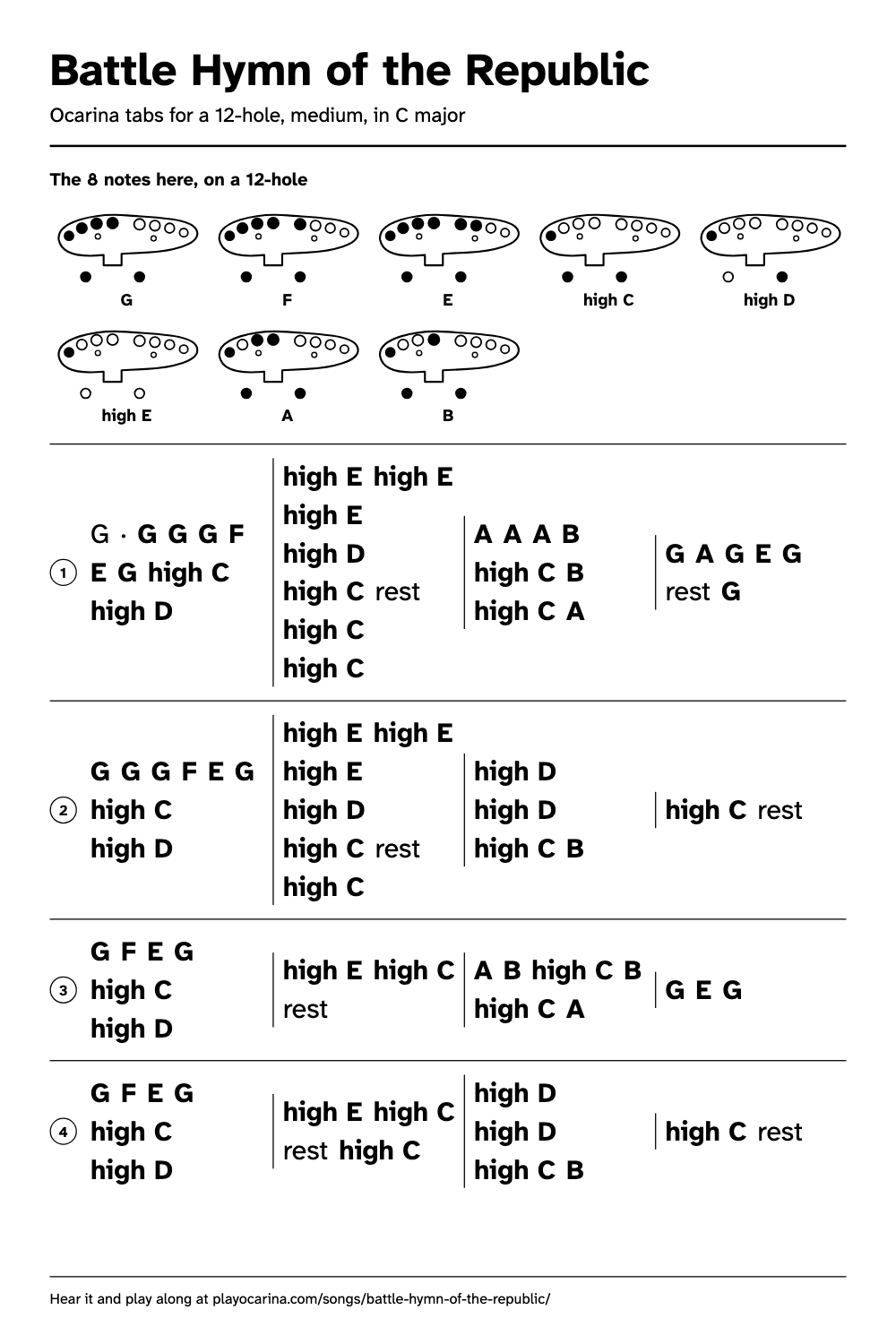
On a 12-hole. Read left to right, a line at a time.
- Tricky spot:G GGGFEGhigh Chigh Dhigh Ehigh Ehigh Ehigh Dhigh Cresthigh Chigh CAAABhigh CBhigh CAGAGEGrestG
- GGGFEGhigh Chigh Dhigh Ehigh Ehigh Ehigh Dhigh Cresthigh Chigh Dhigh Dhigh CBhigh Crest
- GFEGhigh Chigh Dhigh Ehigh CrestABhigh CBhigh CAGEG
- GFEGhigh Chigh Dhigh Ehigh Cresthigh Chigh Dhigh Dhigh CBhigh Crest
The Battle Hymn of the Republic starts with a short lead-in on G, rolls through the verse in dotted pairs and climbs to high E on "the coming of the Lord". Here it is in C major, one verse and the chorus, 16 bars from E up to high E with no sharps or flats, as an 1896 songbook printed it. The dotted pairs and the sixteenth notes make it quicker than it looks.
What is the hardest part of the Battle Hymn of the Republic?
The end of the first line, where a quick sixteenth D carries the tune up to high E, the top of the song, and the dotted pairs follow without a gap. On a 12-hole, the Battle Hymn of the Republic goes from high D to high E: you lift the right thumb. On a 6-hole, you lift the left thumb.
Practise the first line slowly with a steady count, so the sixteenth notes land after the dotted ones and not before: say long-short, long-short while you finger it. The same shape comes back at the end of the second line and in the chorus. High E is played with the first finger of each hand down and the rest open, so keep the breath light and do not squeeze the notes.
Where do you breathe in the Battle Hymn of the Republic?
At the eighth rests: the one after the long C that ends the first line, the one after the long G in the third, and the ones in the chorus after the long high E. The last note of each verse line is a good place for a quick breath.
Which ocarina can play the Battle Hymn of the Republic?
A 4-hole ocarina cannot reach high D and high E, so play the Battle Hymn of the Republic in this key on a 12-hole or 6-hole ocarina in C. On an ocarina in G or F, use the same fingerings: the tune sounds in a different key, which is fine when you play alone. Each linked chart has every fingering for its ocarina, and you can check your notes with a tuner such as our free ocarina tuner.
The 8 notes here, on a 12-holeHoles in words, with a picture
| Note | Holes to cover | Picture |
|---|---|---|
| G | Cover every main hole but the right index, right middle, right ring and right pinky | |
| F | Cover every main hole but the right middle, right ring and right pinky | |
| E | Cover every main hole but the right ring and right pinky | |
| high C | Cover the left pinky, left thumb and right thumb | |
| high D | Cover the left pinky and right thumb | |
| high E | Cover the left pinky | |
| A | Cover the left pinky, left middle, left index, left thumb and right thumb | |
| B | Cover the left pinky, left index, left thumb and right thumb |
Drawn as you see it while playing: mouthpiece towards you, left hand on the left.
| Note | Holes to cover | Picture |
|---|---|---|
| G | Cover every hole but the left middle and right middle | |
| F | Cover every hole but the right middle and right index | |
| E | Cover every hole but the right index | |
| high C | Cover the left thumb and right thumb | |
| high D | Cover the left thumb | |
| high E | All holes open | |
| A | Cover the left index, left thumb and right thumb | |
| B | Cover the right middle, left thumb and right thumb |
Drawn as you see it while playing: mouthpiece towards you, left hand on the left.
Where does the Battle Hymn of the Republic come from?
Julia Ward Howe wrote the words in November 1861, fitting them to the soldiers' song John Brown's Body, and sold them to The Atlantic Monthly for four dollars; they ran in its February 1862 issue. The tune is older: a camp-meeting hymn that William Steffe is credited with collecting around 1856. Our tabs follow the tune as an 1896 songbook prints it, with its dotted rhythms; a 1909 collection prints the same notes in plainer, even rhythms and calls the tune an Old Plantation Melody. We show the melody only. Music: an American camp-meeting tune of the 1850s, credited to William Steffe; words by Julia Ward Howe (died 1910), 1862.