Aquarium on the ocarina
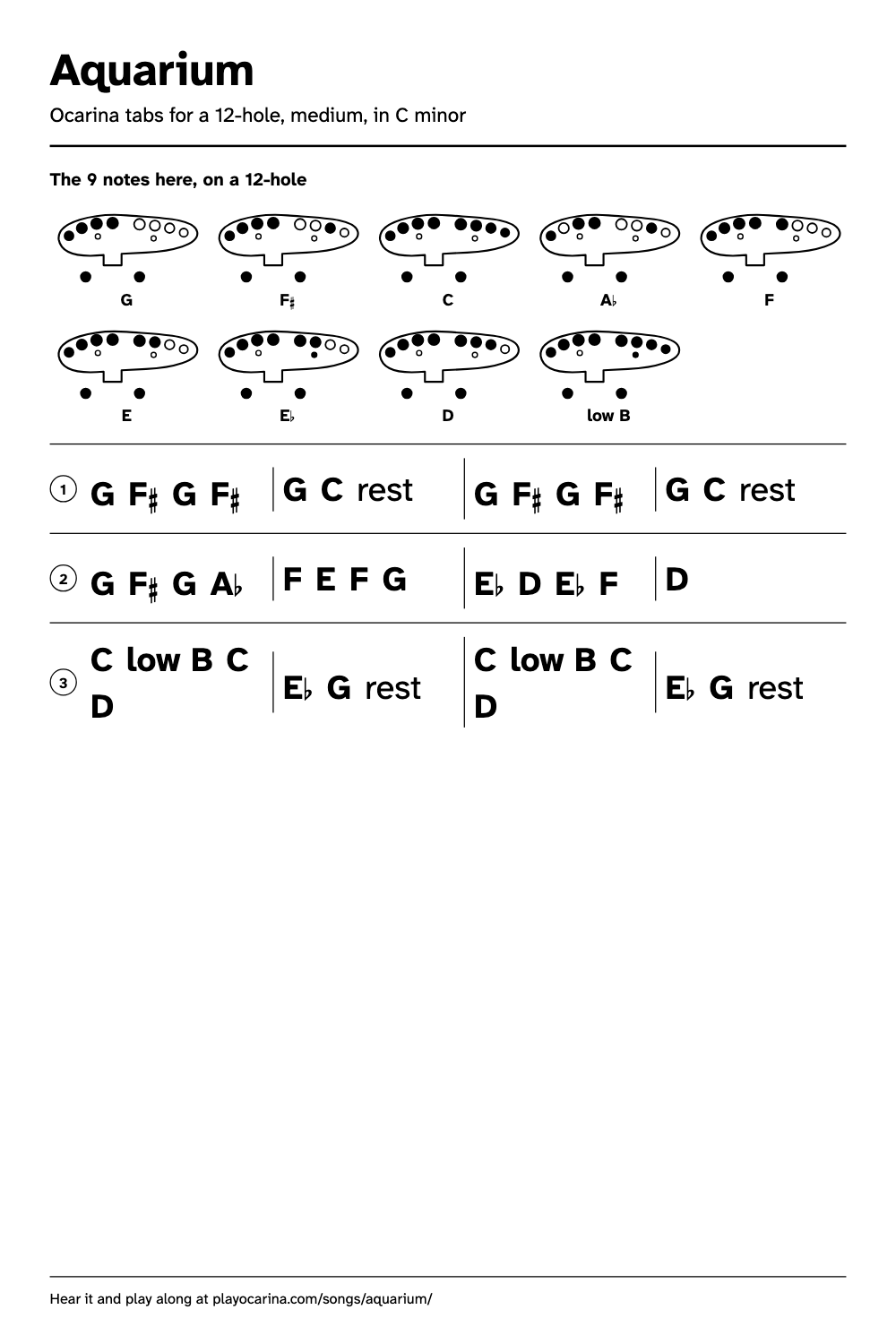
On a 12-hole it starts G, F♯, G, F♯. Medium, 37 notes, in C minor.
Goes down to low B, so it does not fit a 6-hole or 4-hole.
Aquarium
Bar 1 of 12
What are the notes for Aquarium?
On a 12-hole. Read left to right, a line at a time.
- GF♯GF♯Tricky spot:GCrestGF♯GF♯GCrest
- GF♯GA♭FEFGE♭DE♭FD
- Clow BCDE♭GrestClow BCDE♭Grest
Aquarium, the seventh piece of Saint-Saëns's Carnival of the Animals, opens with G and F♯ trading places, then drops to a long C. Here is the tune the flute plays, in C minor: 12 bars of slow 4/4, from low B up to high A♭. It needs a 12-hole ocarina, for the low B, and it has three cross-fingered notes, F♯, A♭ and E♭.
What is the tricky spot in Aquarium?
The drop in bar 2 from G to a long C, a fifth lower, which is held for two and a half beats. On a 12-hole, Aquarium goes from G to C: you cover the right index, right middle, right ring and right pinky.
C is the all-covered note, so every main hole comes down for it; lower your fingers together, not one at a time, and start the note softly. It is held for two and a half beats before a short rest, so keep the air even and gentle, because a note held that long sags flat as the breath runs out. The same drop comes in bar 4, and the long G that ends the answering phrase asks for the same soft, steady air. Before it, bars 1 and 3 each run G, F♯, G, F♯: practise just those two notes back and forth, slowly, until the F♯ fingering is automatic. Bars 5 to 7 then use one shape three times, each a little lower, with the high point of the tune, A♭, in the first of them: G F♯ G A♭, F E F G, E♭ D E♭ F. They end on the long D that closes the first eight bars.
Where do you breathe in Aquarium?
Breathe in the half-beat rest after each long C in bars 2 and 4, and after the long G in bars 10 and 12. The four-beat D in bar 8 ends the first strain and is the longest note in the tune: breathe as soon as it finishes, before the answering phrase starts.
Which ocarina can play Aquarium?
A 6-hole or 4-hole ocarina cannot reach low B, so play Aquarium in this key on a 12-hole ocarina in C. On an ocarina in G or F, use the same fingerings: the tune sounds in a different key, which is fine when you play alone. The linked chart has every fingering, and you can check your notes with a tuner such as our free ocarina tuner.
The 9 notes here, on a 12-holeHoles in words, with a picture
| Note | Holes to cover | Picture |
|---|---|---|
| G | Cover every main hole but the right index, right middle, right ring and right pinky | |
| F♯ | Cover every main hole but the right index, right middle and right pinky | |
| C | Cover every main hole | |
| A♭ | Cover every main hole but the left ring, right index, right middle and right pinky | |
| F | Cover every main hole but the right middle, right ring and right pinky | |
| E | Cover every main hole but the right ring and right pinky | |
| E♭ | Cover every main hole but the right ring and right pinky, plus the right sub-hole | |
| D | Cover every main hole but the right pinky | |
| low B | Cover every main hole, plus the right sub-hole |
Drawn as you see it while playing: mouthpiece towards you, left hand on the left.
Why was Aquarium printed only in 1922?
Saint-Saëns would not let the Carnival of the Animals out while he lived. He wrote it in February 1886 as a piece of fun, barred public performances in his lifetime and left word in his will that it be published after his death. He died in December 1921, and Durand printed it in Paris in April 1922. Our tabs follow Durand's full score, where Aquarium is No. 7, marked Andantino, in 4/4 with no sharps or flats in the key signature. The tune is on the flute's staff, and the muted first violins (the score says "sourdine") play it an octave higher; Wikipedia describes it the same way, flute in front, strings and glass harmonica behind, pianos rippling below. We moved it up three semitones to fit a 12-hole and wrote the first eight bars once, then the four bars where the tune answers itself near the end. The piano interludes, the second time through the first eight bars and the low notes the flute plays right after bar 28 are left out. We show the melody only. Music: Camille Saint-Saëns (died 1921), No. 7 of Le Carnaval des animaux, written in 1886 and published in 1922.