Arrival of the Queen of Sheba on the ocarina
On a 12-hole it starts G, E, G, high C. Hard, 38 notes, in C major.
Goes down to low B, so it does not fit a 6-hole or 4-hole.
Arrival of the Queen of Sheba
Bar 1 of 6
What are the notes for the Arrival of the Queen of Sheba?
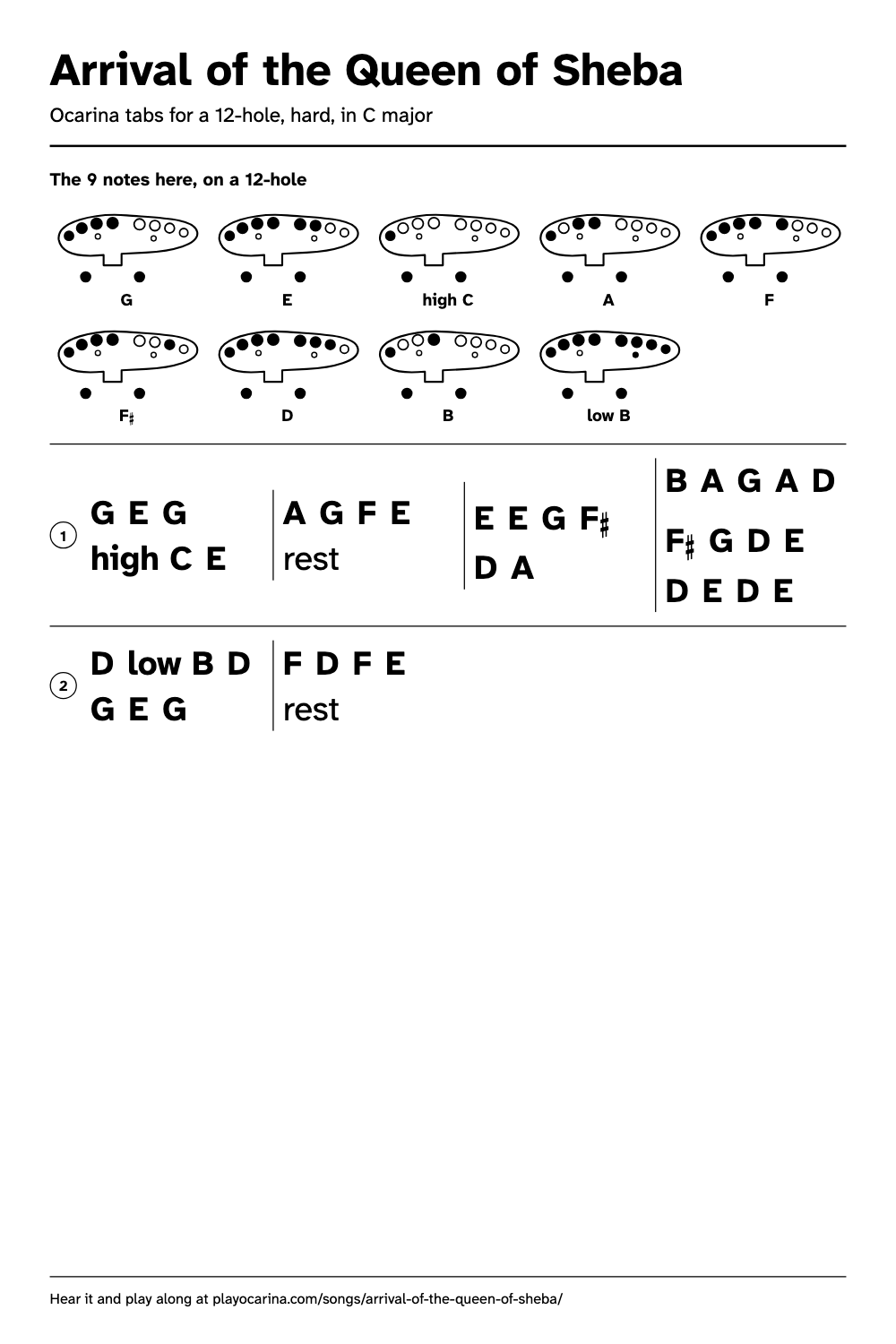
On a 12-hole. Read left to right, a line at a time.
- GEGhigh CEAGFErestTricky spot:EEGF♯DABAGADF♯GDEDEDE
- Dlow BDGEGFDFErest
The Arrival of the Queen of Sheba starts on a long G, then E, G in quick notes, then up to a high C and back down to E. This is the theme, not the whole piece: the first six bars of the first oboe's line, ending on the rest in bar 6. The printing is in B-flat major; it is moved up a whole step to C major here, so it runs from low B to high C, which puts it on a 12-hole ocarina. Its low B needs a sub-hole, so it does not fit a 6-hole or a 4-hole. The strings, the second oboe and the rest of the piece are left out.
What is the tricky spot in the Arrival of the Queen of Sheba?
The end of the third bar, where a quick D leaps up a fifth to A in a sixteenth note, straight into the run of sixteenths that opens the next bar. On a 12-hole, the Arrival of the Queen of Sheba goes from D to A: you lift the left ring, right index, right middle and right ring.
Almost every bar is a long dotted note followed by quick sixteenths, so the work is in the quick notes, not the long ones. Practise bar 3 and bar 4 alone and slowly: the long F♯, then D, then A, and on into B, A, G, A. Keep the air steady across the leap and let your fingers do the changing; do not push the A. The end of bar 4 alternates D and E three times in a row, six sixteenths: tongue each one lightly with a "du" and keep them even, which is easier at half speed first. Low B in bar 5 is the only sub-hole note, so seal it before you blow.
Where do you breathe in the Arrival of the Queen of Sheba?
Bar 2 ends with a one-beat rest and so does the last bar, so breathe there. Bars 3 to 6 have no rest between them: if that is too long for one breath, cut the long dotted D that starts bar 5 a little short and take a quick breath before the sixteenths.
Which ocarina can play the Arrival of the Queen of Sheba?
A 6-hole or 4-hole ocarina cannot reach low B, so play the Arrival of the Queen of Sheba in this key on a 12-hole ocarina in C. On an ocarina in G or F, use the same fingerings: the tune sounds in a different key, which is fine when you play alone. The linked chart has every fingering, and you can check your notes with a tuner such as our free ocarina tuner.
The 9 notes here, on a 12-holeHoles in words, with a picture
| Note | Holes to cover | Picture |
|---|---|---|
| G | Cover every main hole but the right index, right middle, right ring and right pinky | |
| E | Cover every main hole but the right ring and right pinky | |
| high C | Cover the left pinky, left thumb and right thumb | |
| A | Cover the left pinky, left middle, left index, left thumb and right thumb | |
| F | Cover every main hole but the right middle, right ring and right pinky | |
| F♯ | Cover every main hole but the right index, right middle and right pinky | |
| D | Cover every main hole but the right pinky | |
| B | Cover the left pinky, left index, left thumb and right thumb | |
| low B | Cover every main hole, plus the right sub-hole |
Drawn as you see it while playing: mouthpiece towards you, left hand on the left.
Who named the Arrival of the Queen of Sheba?
Not Handel. Handel composed Solomon between 5 May and 13 June 1748, and in the Handel Society's printing the piece is headed only "Act III. Sinfonia", a plain instrumental opening to the third act; the title is a later one, and Wikipedia says Sir Thomas Beecham is believed to have given it, in a 1933 recording or in 1955. Our tabs follow the Sinfonia as the Handel Society printed it, edited by Friedrich Chrysander, with a preface dated 1867: the first oboe's line for six bars, moved from B-flat to C. It is written for two oboes and strings, and the oboe has the tune. Music: George Frideric Handel (1685-1759), the Sinfonia that opens Act III of his oratorio Solomon, 1748.