Night on Bald Mountain on the ocarina
On a 12-hole it starts E, F, E, D. Hard, 63 notes, in D minor.
Goes up to high D, so it does not fit a 4-hole. Goes down to low A, so it does not fit a 6-hole.
Night on Bald Mountain
Bar 1 of 13
What are the notes for Night on Bald Mountain?
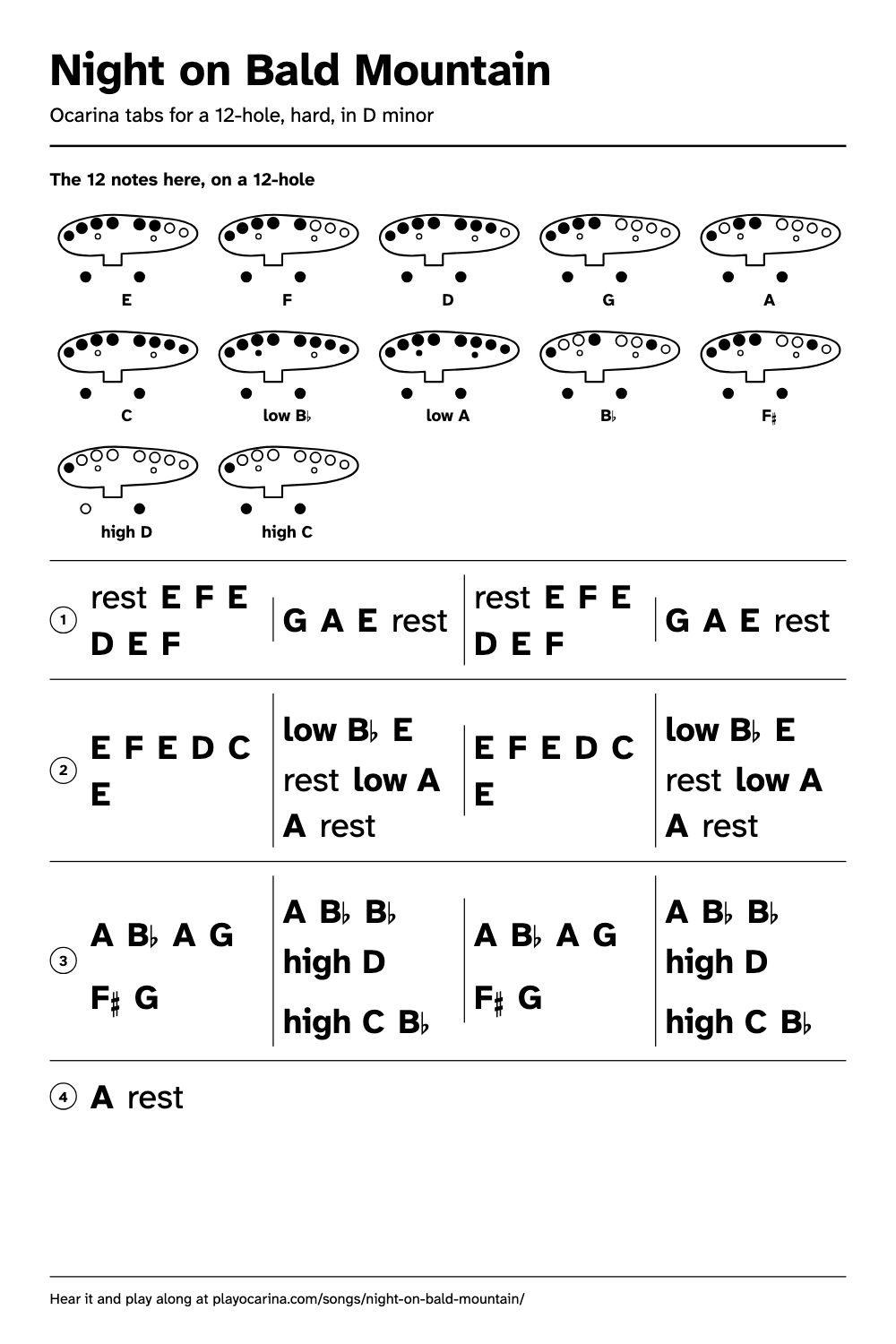
On a 12-hole. Read left to right, a line at a time.
- restEFEDEFGAErestrestEFEDEFGAErest
- EFEDCETricky spot:low B♭Erestlow AArestEFEDCElow B♭Erestlow AArest
- AB♭AGF♯GAB♭B♭high Dhigh CB♭AB♭AGF♯GAB♭B♭high Dhigh CB♭
- Arest
Night on Bald Mountain, the witches' sabbath piece, opens its first big tune with a stomping figure: E, F, E, D, E, F, then G, A and a long E. This is that theme from the 1886 score, not the whole piece: 13 bars of 2/2 in D minor, from low A up to high D, which puts it on a 12-hole ocarina. The stomping phrase comes first, and a quiet, rising tune follows it.
What is the tricky spot in Night on Bald Mountain?
The jump in bars 6 and 8, from a quarter-note low A up a full octave to a short high A, which is followed at once by a rest. On a 12-hole, Night on Bald Mountain goes from low A to A: you lift the left ring, right index, right middle, right ring, right pinky, left sub-hole and right sub-hole.
Low A needs both sub-holes sealed, so check them before you blow, then switch to the open high A and give it a quick, firm breath: the note is only half a beat long, and the eighth rest after it is your moment to reset. The low B♭ at the start of the same bar is the other low note to practise: the bar runs B♭, E, A, A, so play it slowly until the sub-holes land together. The quiet tune at the end has no rest for four bars, and its F♯ and B♭ are fingerings worth drilling before the tempo goes up.
Where do you breathe in Night on Bald Mountain?
Breathe in the rests: the whole beat of rest where bars 2 and 3 meet, and again after bars 4, 6 and 8. The quiet tune in bars 9 to 12 has no rests at all, so take one soft breath after the long A in bar 10 and another after bar 11, and keep the air gentle throughout.
Which ocarina can play Night on Bald Mountain?
A 6-hole ocarina cannot reach low A and low B♭, and a 4-hole ocarina cannot reach low A, low B♭ and high D, so play Night on Bald Mountain in this key on a 12-hole ocarina in C. On an ocarina in G or F, use the same fingerings: the tune sounds in a different key, which is fine when you play alone. The linked chart has every fingering, and you can check your notes with a tuner such as our free ocarina tuner.
The 12 notes here, on a 12-holeHoles in words, with a picture
| Note | Holes to cover | Picture |
|---|---|---|
| E | Cover every main hole but the right ring and right pinky | |
| F | Cover every main hole but the right middle, right ring and right pinky | |
| D | Cover every main hole but the right pinky | |
| G | Cover every main hole but the right index, right middle, right ring and right pinky | |
| A | Cover the left pinky, left middle, left index, left thumb and right thumb | |
| C | Cover every main hole | |
| low B♭ | Cover every main hole, plus the left sub-hole | |
| low A | Cover every main hole, plus the left sub-hole and right sub-hole | |
| B♭ | Cover the left pinky, left index, right ring, left thumb and right thumb | |
| F♯ | Cover every main hole but the right index, right middle and right pinky | |
| high D | Cover the left pinky and right thumb | |
| high C | Cover the left pinky, left thumb and right thumb |
Drawn as you see it while playing: mouthpiece towards you, left hand on the left.
Did Mussorgsky write the Night on Bald Mountain that everyone knows?
Mostly Rimsky-Korsakov did. Mussorgsky finished a tone poem about a witches' sabbath on St. John's Eve, 23 June 1867, but nobody played it while he lived, and he died in 1881. In 1886 Rimsky-Korsakov published his own orchestral version through Bessel in St. Petersburg, and its title page calls the piece a posthumous work, finished and orchestrated by him; Mussorgsky's own score was not printed until 1968. Our tabs follow the first violins in that 1886 score, from the letter D marked Allegro feroce, and no later arrangement. The woodwinds and brass answer with chords, which we leave out, and so we do the grace notes in bars 10 and 12. Rimsky-Korsakov died in 1908. Music: Modest Mussorgsky (1839-1881), finished and orchestrated by Nikolai Rimsky-Korsakov (1844-1908), published 1886.