Ave Maria (Bach/Gounod) on the ocarina
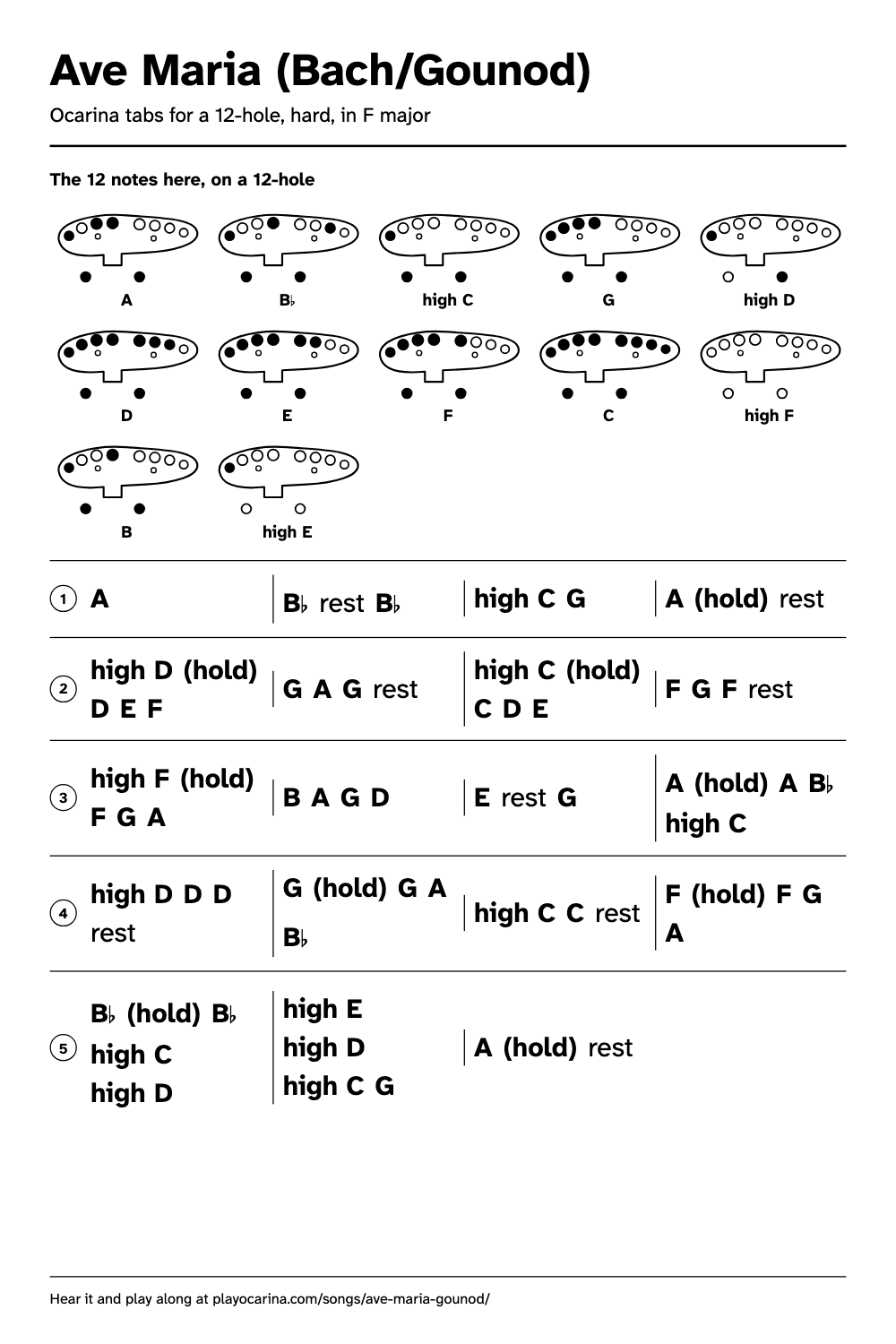
On a 12-hole it starts A, B♭, B♭, high C. Hard, 56 notes, in F major.
Goes up to high F, so it does not fit a 6-hole or 4-hole.
Ave Maria (Bach/Gounod)
Bar 1 of 19
What are the notes for the Bach/Gounod Ave Maria?
On a 12-hole. Read left to right, a line at a time.
- AB♭restB♭high CGA(hold)rest
- high D(hold)DEFGAGresthigh C(hold)CDEFGFrest
- Tricky spot:high F(hold)FGABAGDErestGA(hold)AB♭high C
- high DDDrestG(hold)GAB♭high CCrestF(hold)FGA
- B♭(hold)B♭high Chigh Dhigh Ehigh Dhigh CGA(hold)rest
The Bach/Gounod Ave Maria opens on a long A, then B flat, C and G, floating slowly over a rippling accompaniment. Here is the first half of Gounod's melody, 19 bars in F major up to the end of its first sentence, as the voice part of a Schott edition of about 1870 prints it. The whole tune spans more than an ocarina has, so we stop where the first half settles on a long A.
What is the hardest jump in the Bach/Gounod Ave Maria?
The ninth bar, where the tune holds high F, the top note of a 12-hole, and then drops a full octave to F before climbing again. On a 12-hole, the Bach/Gounod Ave Maria goes from high F to F: you cover the left pinky, left ring, left middle, left index, right index, left thumb and right thumb.
High F is played with every hole open and needs fast, firm air; the F an octave below needs much less. Let the breath relax as the fingers come down, or the low F will crack upward. The same kind of octave drop comes again and again in this half of the tune: from high D in bar 5, high C in bar 7, high F in bar 9 and high D in bar 13, most of them followed by three quick notes that climb back. Practise those bars on their own. Bar 10 has the one B natural, right after B flats, so watch the fingering there.
Which ocarina can play the Bach/Gounod Ave Maria?
A 6-hole ocarina cannot reach high F, and a 4-hole ocarina cannot reach high D, high E and high F, so play the Bach/Gounod Ave Maria in this key on a 12-hole ocarina in C. On an ocarina in G or F, use the same fingerings: the tune sounds in a different key, which is fine when you play alone. The linked chart has every fingering, and you can check your notes with a tuner such as our free ocarina tuner.
The 12 notes here, on a 12-holeHoles in words, with a picture
| Note | Holes to cover | Picture |
|---|---|---|
| A | Cover the left pinky, left middle, left index, left thumb and right thumb | |
| B♭ | Cover the left pinky, left index, right ring, left thumb and right thumb | |
| high C | Cover the left pinky, left thumb and right thumb | |
| G | Cover every main hole but the right index, right middle, right ring and right pinky | |
| high D | Cover the left pinky and right thumb | |
| D | Cover every main hole but the right pinky | |
| E | Cover every main hole but the right ring and right pinky | |
| F | Cover every main hole but the right middle, right ring and right pinky | |
| C | Cover every main hole | |
| high F | All holes open | |
| B | Cover the left pinky, left index, left thumb and right thumb | |
| high E | Cover the left pinky |
Drawn as you see it while playing: mouthpiece towards you, left hand on the left.
Is the Ave Maria by Bach or by Gounod?
The tune is Gounod's. He wrote it over Bach's Prelude in C from the Well-Tempered Clavier, changing the prelude only very slightly, and first published it in 1853 as a Méditation for solo violin; you can see that violin part in the Paris first edition. It was the 1859 version for voice, sung to the Latin prayer, that became famous. Our tabs follow the voice in a Schott edition for mezzo-soprano from about 1870, in its F major and an octave higher, and stop after the first 19 bars. The prelude underneath is Bach's, but nothing of it is in our tabs. Gounod died in 1893. This is a different song from Schubert's Ave Maria. We show the melody only. Music: Charles Gounod (1818-1893), melody over J. S. Bach's Prelude in C.