Badinerie on the ocarina
On a 12-hole it starts high D, high F, high D, A. Hard, 93 notes, in D minor.
Goes up to high F, so it does not fit a 6-hole or 4-hole.
Badinerie
Bar 1 of 16
What are the notes for Bach's Badinerie?
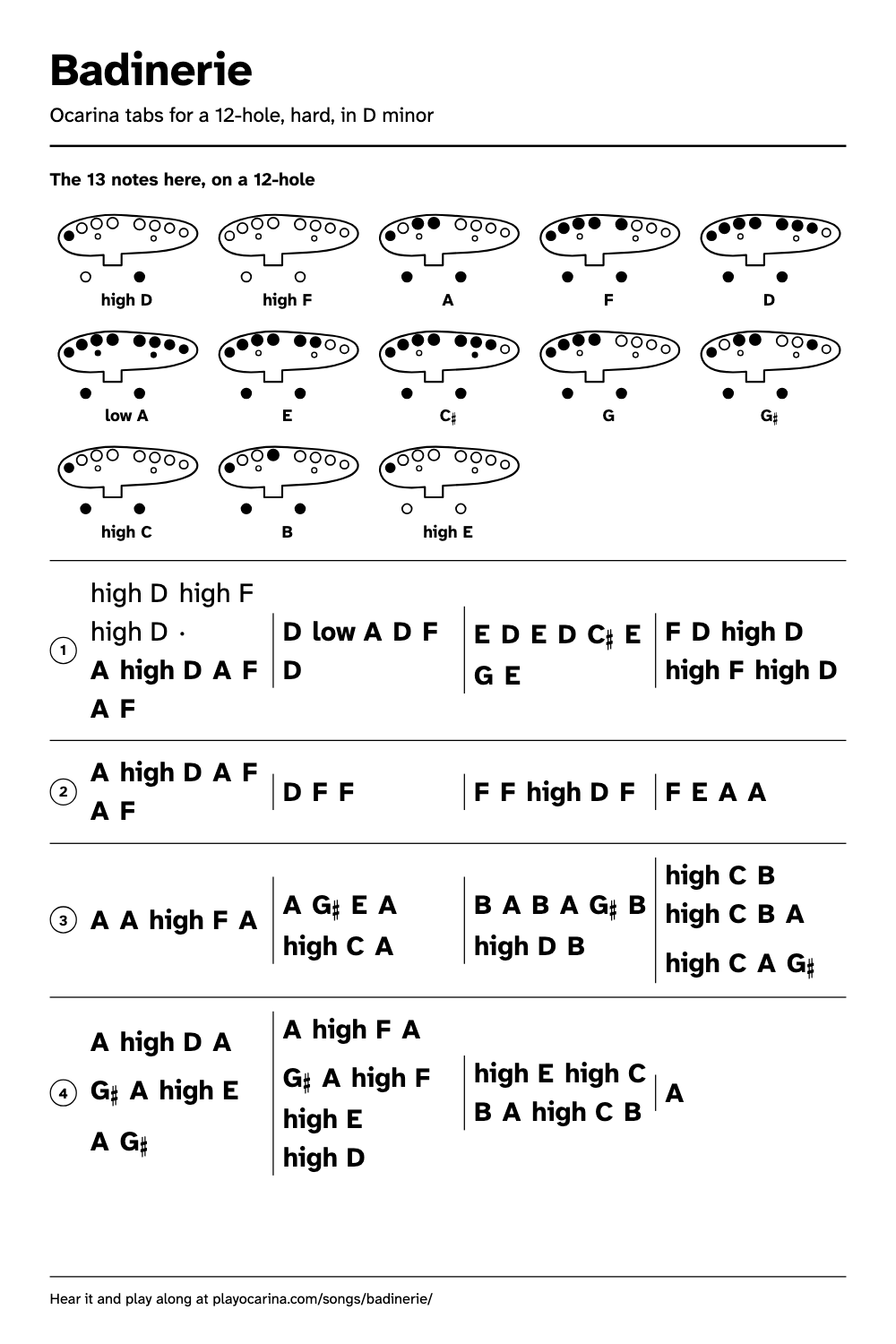
On a 12-hole. Read left to right, a line at a time.
- high Dhigh Fhigh D Ahigh DAFAFDlow ADFDEDEDC♯EGEFDhigh Dhigh Fhigh D
- Ahigh DAFAFDFFFFhigh DFFEAA
- Tricky spot:AAhigh FAAG♯EAhigh CABABAG♯Bhigh DBhigh CBhigh CBAhigh CAG♯
- Ahigh DAG♯Ahigh EAG♯Ahigh FAG♯Ahigh Fhigh Ehigh Dhigh Ehigh CBAhigh CBA
The Badinerie opens with a flick from high D up to high F and back, then tumbles down through A and F to a low D in quick, bouncing notes. It is the fast flute finale of Bach's Orchestral Suite No. 2, played here at a slow practice tempo. Here is its first section in D minor, a pickup and 16 bars of 2/4, from low A to high F, so it needs a 12-hole ocarina.
How do you play the fast notes in the Badinerie?
The second half of the section circles around A: short notes that keep coming back to it and reach up each time, to high D, high E and twice to high F, the top note of a 12-hole ocarina. On a 12-hole, Bach's Badinerie goes from A to high F: you lift the left pinky, left middle, left index, left thumb and right thumb.
Learn those bars slowly, in groups of four notes, and only speed up once every leap from A lands cleanly. High F wants more air than the notes around it, so push a little more breath into each top note and relax again on the A that follows. G sharp keeps falling between the A's, so practise A, G sharp, A on its own until that half-step change is quick. Tongue every note lightly; the flute plays the opening bars short and detached, and the ocarina sounds best that way too. Our player starts at 60 beats a minute, far below concert speed, and that is the right place to begin.
Where do you breathe in Bach's Badinerie?
There are no rests in the section. Breathe at the quarter-note D in the second and the sixth bar, the only longer notes, and if you need one more, take a quick sip after the high F in bar 9, shortening the A that follows.
Which ocarina can play Bach's Badinerie?
A 6-hole ocarina cannot reach low A and high F, and a 4-hole ocarina cannot reach low A, high D, high E and high F, so play Bach's Badinerie in this key on a 12-hole ocarina in C. On an ocarina in G or F, use the same fingerings: the tune sounds in a different key, which is fine when you play alone. The linked chart has every fingering, and you can check your notes with a tuner such as our free ocarina tuner.
The 13 notes here, on a 12-holeHoles in words, with a picture
| Note | Holes to cover | Picture |
|---|---|---|
| high D | Cover the left pinky and right thumb | |
| high F | All holes open | |
| A | Cover the left pinky, left middle, left index, left thumb and right thumb | |
| F | Cover every main hole but the right middle, right ring and right pinky | |
| D | Cover every main hole but the right pinky | |
| low A | Cover every main hole, plus the left sub-hole and right sub-hole | |
| E | Cover every main hole but the right ring and right pinky | |
| C♯ | Cover every main hole but the right pinky, plus the right sub-hole | |
| G | Cover every main hole but the right index, right middle, right ring and right pinky | |
| G♯ | Cover every main hole but the left ring, right index, right middle and right pinky | |
| high C | Cover the left pinky, left thumb and right thumb | |
| B | Cover the left pinky, left index, left thumb and right thumb | |
| high E | Cover the left pinky |
Drawn as you see it while playing: mouthpiece towards you, left hand on the left.
What is Bach's Badinerie?
It is the last movement of Bach's Orchestral Suite No. 2 in B minor, a quick dance for solo flute and strings. The word means jesting, and the movement has become a showpiece for flute players because of its speed. The oldest source is a set of parts from Leipzig, 1738 to 1739, partly in Bach's own hand. Our tabs follow the flute line in the Bach-Gesellschaft edition of 1885, edited by Alfred Dörffel, and teach the first section, up to the repeat sign, moved from B minor up to D minor and without the trills. Bach died in 1750. We show the melody only. Music: Johann Sebastian Bach (1685-1750), the last movement of his Orchestral Suite No. 2 in B minor, BWV 1067.