Vivaldi Winter on the ocarina
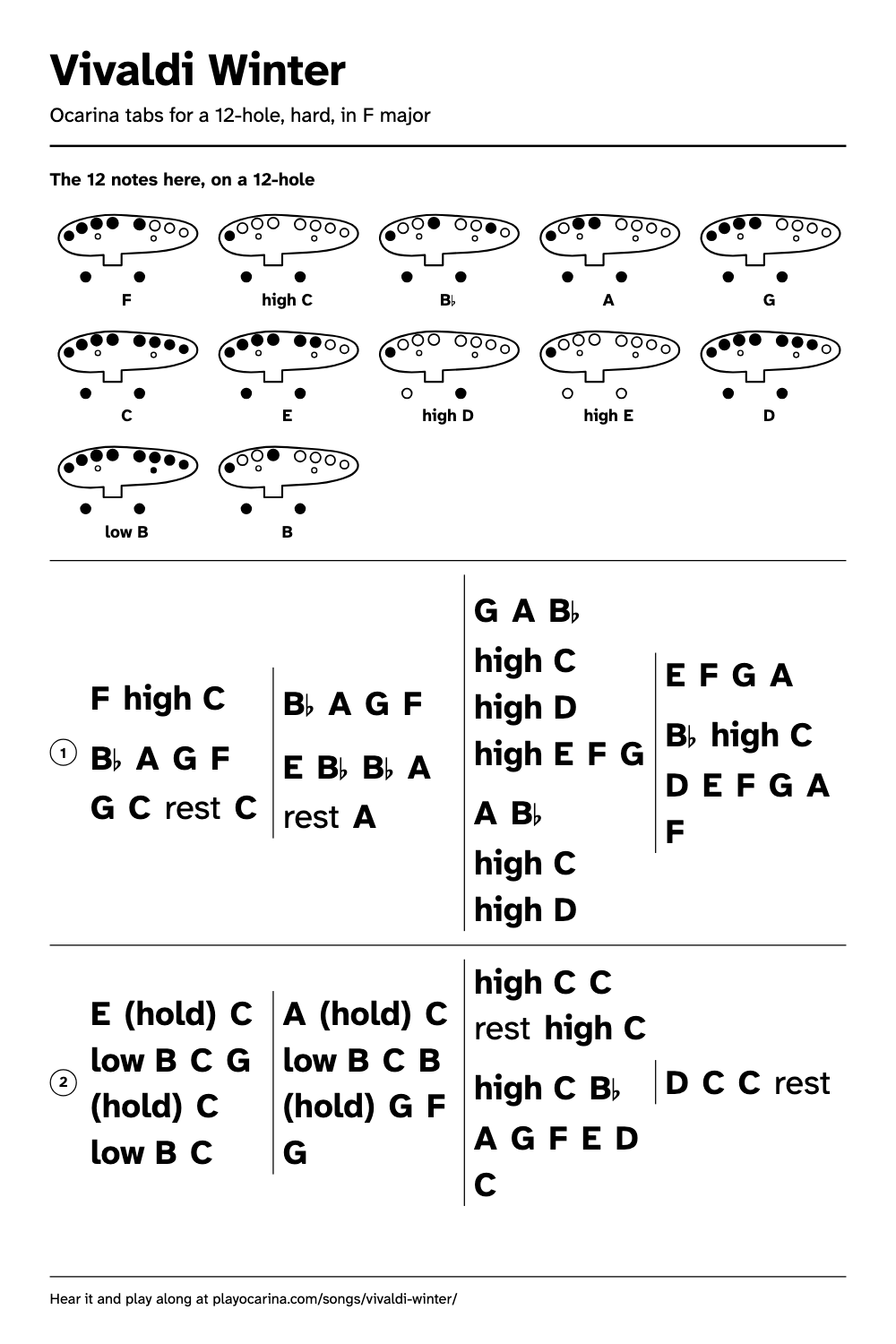
On a 12-hole it starts F, high C, B♭, A. Hard, 72 notes, in F major.
Goes up to high E, so it does not fit a 4-hole. Goes down to low B, so it does not fit a 6-hole.
Vivaldi Winter
Bar 1 of 8
What are the notes for Vivaldi Winter?
On a 12-hole. Read left to right, a line at a time.
- Fhigh CB♭AGFGCrestCB♭AGFEB♭B♭ArestAGAB♭high Chigh Dhigh EFGAB♭high Chigh DEFGAB♭high CDEFGAF
- E(hold)Clow BCG(hold)Clow BCA(hold)Clow BCB(hold)GFGTricky spot:high CCresthigh Chigh CB♭AGFEDCDCCrest
The Winter Largo is the slow middle movement of Vivaldi's Winter: a calm solo violin tune that starts on F, flicks up to high C and steps back down through B flat, A and G. The first movement opens with shivering repeated notes rather than a tune, so this is the Winter melody an ocarina can sing. Here are its first 8 bars in F major, the first half of the melody, ending on C. It runs from low B to high E, so it needs a 12-hole ocarina.
What is the tricky spot in Vivaldi Winter?
The octave drop at the start of the seventh bar, high C straight down to C, before the tune climbs back to high C and runs down eight quick notes to C again. On a 12-hole, Vivaldi Winter goes from high C to C: you cover the left ring, left middle, left index, right index, right middle, right ring and right pinky.
Keep the air soft for the low C: a lower note needs less breath, and pushing makes it sharp. The fifth and sixth bars hold a long note, then dip to C, low B and C in quick notes; low B is the one note that needs the right sub-hole, so set that finger down while the long note sounds. Count slowly, four even beats a bar, and let the quick notes fit inside the beat rather than rushing them. The printing marks a trill on the D in the last bar; leave it out until the rest is smooth.
Which ocarina can play Vivaldi Winter?
A 6-hole ocarina cannot reach low B, and a 4-hole ocarina cannot reach low B, high D and high E, so play Vivaldi Winter in this key on a 12-hole ocarina in C. On an ocarina in G or F, use the same fingerings: the tune sounds in a different key, which is fine when you play alone. The linked chart has every fingering, and you can check your notes with a tuner such as our free ocarina tuner.
The 12 notes here, on a 12-holeHoles in words, with a picture
| Note | Holes to cover | Picture |
|---|---|---|
| F | Cover every main hole but the right middle, right ring and right pinky | |
| high C | Cover the left pinky, left thumb and right thumb | |
| B♭ | Cover the left pinky, left index, right ring, left thumb and right thumb | |
| A | Cover the left pinky, left middle, left index, left thumb and right thumb | |
| G | Cover every main hole but the right index, right middle, right ring and right pinky | |
| C | Cover every main hole | |
| E | Cover every main hole but the right ring and right pinky | |
| high D | Cover the left pinky and right thumb | |
| high E | Cover the left pinky | |
| D | Cover every main hole but the right pinky | |
| low B | Cover every main hole, plus the right sub-hole | |
| B | Cover the left pinky, left index, left thumb and right thumb |
Drawn as you see it while playing: mouthpiece towards you, left hand on the left.
Which part of Vivaldi's Winter is this?
The Largo, the second of Winter's three movements. Vivaldi published The Four Seasons in 1725, in Amsterdam, as the first four concertos of his Opus 8, and set each one to a sonnet: in the solo violin's part the Largo carries the sonnet's lines about quiet, contented days by the fire while the rain falls outside. Our tabs follow that part's first 8 bars, moved from E flat major to F major so the low notes stay on the ocarina. Vivaldi died in Vienna in 1741. We show the melody only. Music: Antonio Vivaldi (1678-1741), the Largo of Winter, the fourth concerto of The Four Seasons, published 1725.