Barcarolle on the ocarina
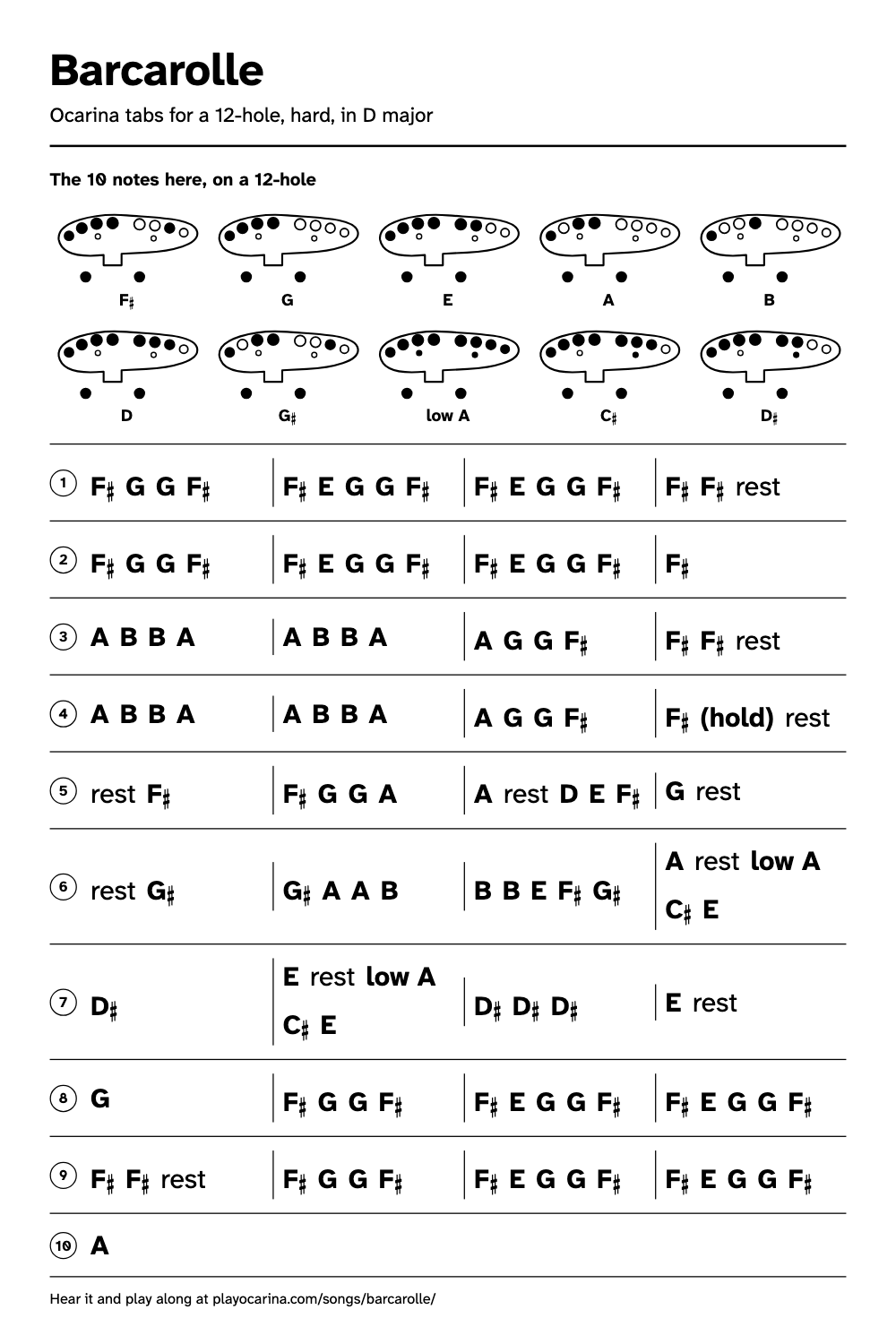
On a 12-hole it starts F♯, G, G, F♯. Hard, 123 notes, in D major.
Goes down to low A, so it does not fit a 6-hole or 4-hole.
Barcarolle
Bar 1 of 37
What are the notes for Barcarolle?
On a 12-hole. Read left to right, a line at a time.
- F♯GGF♯F♯EGGF♯F♯EGGF♯F♯F♯rest
- F♯GGF♯F♯EGGF♯F♯EGGF♯F♯
- ABBAABBAAGGF♯F♯F♯rest
- ABBAABBAAGGF♯F♯(hold)rest
- restF♯F♯GGAArestDEF♯Grest
- restG♯G♯AABBBEF♯G♯Tricky spot:Arestlow AC♯E
- D♯Erestlow AC♯ED♯D♯D♯Erest
- GF♯GGF♯F♯EGGF♯F♯EGGF♯
- F♯F♯restF♯GGF♯F♯EGGF♯F♯EGGF♯
- A
The Barcarolle, the boat song from Offenbach's opera The Tales of Hoffmann, opens on F♯, steps up to G, repeats it and falls back to F♯, over a rocking 6/8. This is the whole sung tune in 37 bars, from the first note of the printing to the return of the opening tune. It stays in the printing's key of D major, an octave higher, which puts it on a 12-hole ocarina from low A to high B. The first eight bars come back as the last eight, with only the final note raised from F♯ to A, so much of the song is one tune heard twice.
What is the tricky spot in Barcarolle?
Bar 24, where the tune drops a full octave from A to low A and then climbs by thirds, A, C♯, E; bar 26 does it again from E. On a 12-hole, Barcarolle goes from A to low A: you cover the left ring, right index, right middle, right ring, right pinky, left sub-hole and right sub-hole.
Low A sits below the all-covered C, so both sub-holes must be sealed before you blow, and the drop needs a gentle breath. The half-beat rest before it is your time to move the fingers, so use it and do not rush the three quick notes after it. C♯ is cross-fingered, so practise A, C♯, E on their own, slowly, until the middle note is steady. The bridge, bars 17 to 28, also leaves D major: G♯ in bars 21 to 23 and D♯ in bars 25 and 27 are cross-fingered too, and each comes in a short run, so learn those bars in one-bar pieces. The rhythm is a long note, a short one, a long one and a short one, so tongue the short notes lightly and let the long ones sing.
Where do you breathe in Barcarolle?
In the rests the printing gives you. Bars 4, 12 and 16 end on a half-beat rest, enough for a quick breath, and bars 17, 20, 21 and 28 have two beats or more, which is the time to breathe fully before the next run. The long notes in bars 8, 25, 29 and 37 are also good places.
Which ocarina can play Barcarolle?
A 6-hole or 4-hole ocarina cannot reach low A, so play Barcarolle in this key on a 12-hole ocarina in C. On an ocarina in G or F, use the same fingerings: the tune sounds in a different key, which is fine when you play alone. The linked chart has every fingering, and you can check your notes with a tuner such as our free ocarina tuner.
The 10 notes here, on a 12-holeHoles in words, with a picture
| Note | Holes to cover | Picture |
|---|---|---|
| F♯ | Cover every main hole but the right index, right middle and right pinky | |
| G | Cover every main hole but the right index, right middle, right ring and right pinky | |
| E | Cover every main hole but the right ring and right pinky | |
| A | Cover the left pinky, left middle, left index, left thumb and right thumb | |
| B | Cover the left pinky, left index, left thumb and right thumb | |
| D | Cover every main hole but the right pinky | |
| G♯ | Cover every main hole but the left ring, right index, right middle and right pinky | |
| low A | Cover every main hole, plus the left sub-hole and right sub-hole | |
| C♯ | Cover every main hole but the right pinky, plus the right sub-hole | |
| D♯ | Cover every main hole but the right ring and right pinky, plus the right sub-hole |
Drawn as you see it while playing: mouthpiece towards you, left hand on the left.
Was the Barcarolle written for The Tales of Hoffmann?
No. Offenbach first wrote the tune in 1864 for another opera, Die Rheinnixen, where a chorus of elves sings it. He gave it to The Tales of Hoffmann, his last work: he died in October 1880, four months before the first night, and Ernest Guiraud finished the scoring. The first performance was at the Opéra-Comique in Paris on 10 February 1881, without the Venetian act, but the duet stayed, in the act with Antonia, which was moved to Venice so that it could. Our tabs follow the Choudens piano and voice score, which prints it as No. 13, marked Moderato, for two voices and chorus, straight after Antonia's romance. The tune here is the second voice's line, which opens the number alone, kept in the printing's key of D major, an octave higher. We stop where the opening tune returns. The printing then goes on to a closing phrase in which the two voices part, and to the chorus's long wordless notes, so those are left out. Music: Jacques Offenbach (1819-1880), from The Tales of Hoffmann, first performed in 1881; words by Jules Barbier (1825-1901).