Va, pensiero on the ocarina
On a 12-hole it starts F♯, E, D, low A. Hard, 48 notes, in D major.
Goes down to low A, so it does not fit a 6-hole or 4-hole.
Va, pensiero
Bar 1 of 8
What are the notes for Va, pensiero?
On a 12-hole. Read left to right, a line at a time.
- Tricky spot:F♯E Dlow ArestAAF♯DDC♯EGrestlow Alow Alow ADF♯F♯EF♯EDC♯restF♯E
- Dlow AAAF♯DDC♯EGrestlow Alow Alow ADF♯AGEDC♯F♯EDrest
Va, pensiero, the chorus of the Hebrew slaves from Verdi's opera Nabucco, opens with two quick notes, F♯ and E, that fall onto a long D. This is the whole first verse of the tune: a two-note lead-in and eight slow bars of 4/4, from low A up to high A. The printing has six sharps; here it is moved to D major, which puts it on a 12-hole ocarina with F♯ and C♯ as the only sharps. Ornaments are left out.
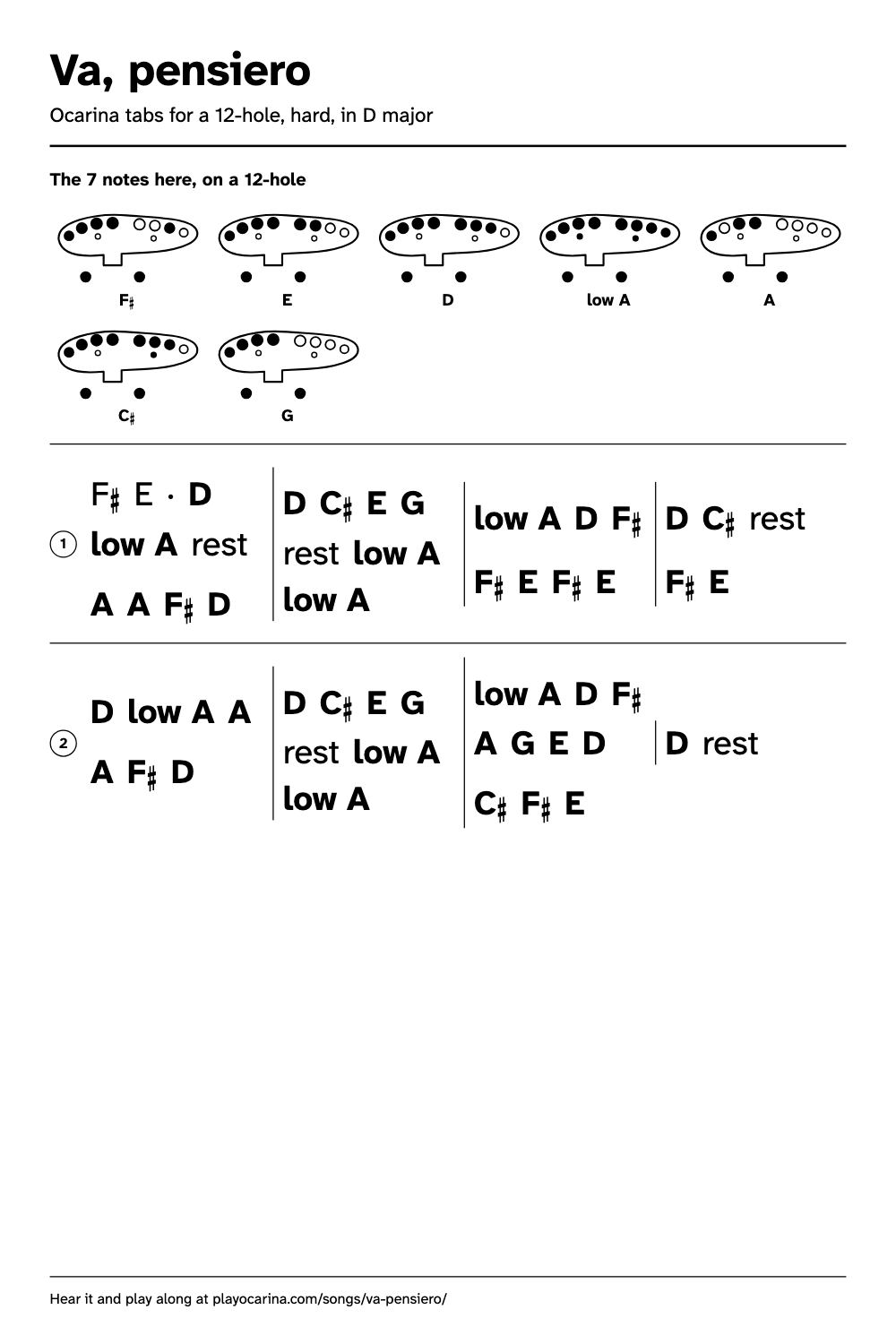
What is the hardest jump in Va, pensiero?
The leap of an octave from low A up to high A in bars 1 and 5, with a sixteenth rest between them in bar 1 and none in bar 5. On a 12-hole, Va, pensiero goes from low A to A: you lift the left ring, right index, right middle, right ring, right pinky, left sub-hole and right sub-hole.
Low A is a sub-hole note, so seal both sub-holes before the bar starts and let the note be soft and short, then give the high A a quicker, firmer breath as it arrives. Practise the pair alone and slowly, low A and then high A, until the leap lands cleanly, then add the D before it and the F♯ and D after it. The other things to settle are F♯ and C♯: F♯ comes in nearly every bar and C♯ in bars 2, 4, 6 and 7, so make both fingerings secure first. Bars 2, 6 and 7 have eighth-note triplets, three even notes in one beat: keep them smooth and do not rush the third note into the long G.
Where do you breathe in Va, pensiero?
Breathe in the quarter rests of bars 2, 4 and 6, which each come just before a lead-in of a dotted eighth and a sixteenth, and after the long D that ends the verse. The lead-ins are quick, so take the breath in the rest, not after it.
Which ocarina can play Va, pensiero?
A 6-hole or 4-hole ocarina cannot reach low A, so play Va, pensiero in this key on a 12-hole ocarina in C. On an ocarina in G or F, use the same fingerings: the tune sounds in a different key, which is fine when you play alone. The linked chart has every fingering, and you can check your notes with a tuner such as our free ocarina tuner.
The 7 notes here, on a 12-holeHoles in words, with a picture
| Note | Holes to cover | Picture |
|---|---|---|
| F♯ | Cover every main hole but the right index, right middle and right pinky | |
| E | Cover every main hole but the right ring and right pinky | |
| D | Cover every main hole but the right pinky | |
| low A | Cover every main hole, plus the left sub-hole and right sub-hole | |
| A | Cover the left pinky, left middle, left index, left thumb and right thumb | |
| C♯ | Cover every main hole but the right pinky, plus the right sub-hole | |
| G | Cover every main hole but the right index, right middle, right ring and right pinky |
Drawn as you see it while playing: mouthpiece towards you, left hand on the left.
Did Verdi write Va, pensiero as a song for Italian patriots?
Scholars disagree. Some have thought the chorus was meant as an anthem for Italians seeking unity and freedom from foreign control, and some modern scholars reject that idea. What is on record comes later: when Verdi died, onlookers in Milan's streets began singing it as his funeral procession passed, and a month later Arturo Toscanini conducted a choir of 820 singing it at his reburial. Verdi died on 27 January 1901. Our tabs follow the Ricordi vocal score, where all the chorus voices open together, softly and in the same rhythm, and we take the top line of its first verse. An earlier Paris printing by Schonenberger opens the same way. The tune is moved from the six sharps of the printing to D major for a 12-hole ocarina. We show the melody only. Music: Giuseppe Verdi (1813-1901), the chorus of the Hebrew slaves from his opera Nabucco, 1842.