Beautiful Dreamer on the ocarina
On a 12-hole it starts high C, B, high C, G. Medium, 86 notes, in C major.
Goes up to high D, so it does not fit a 4-hole. Goes down to low B, so it does not fit a 6-hole.
Beautiful Dreamer
Bar 1 of 18
What are the notes for Beautiful Dreamer?
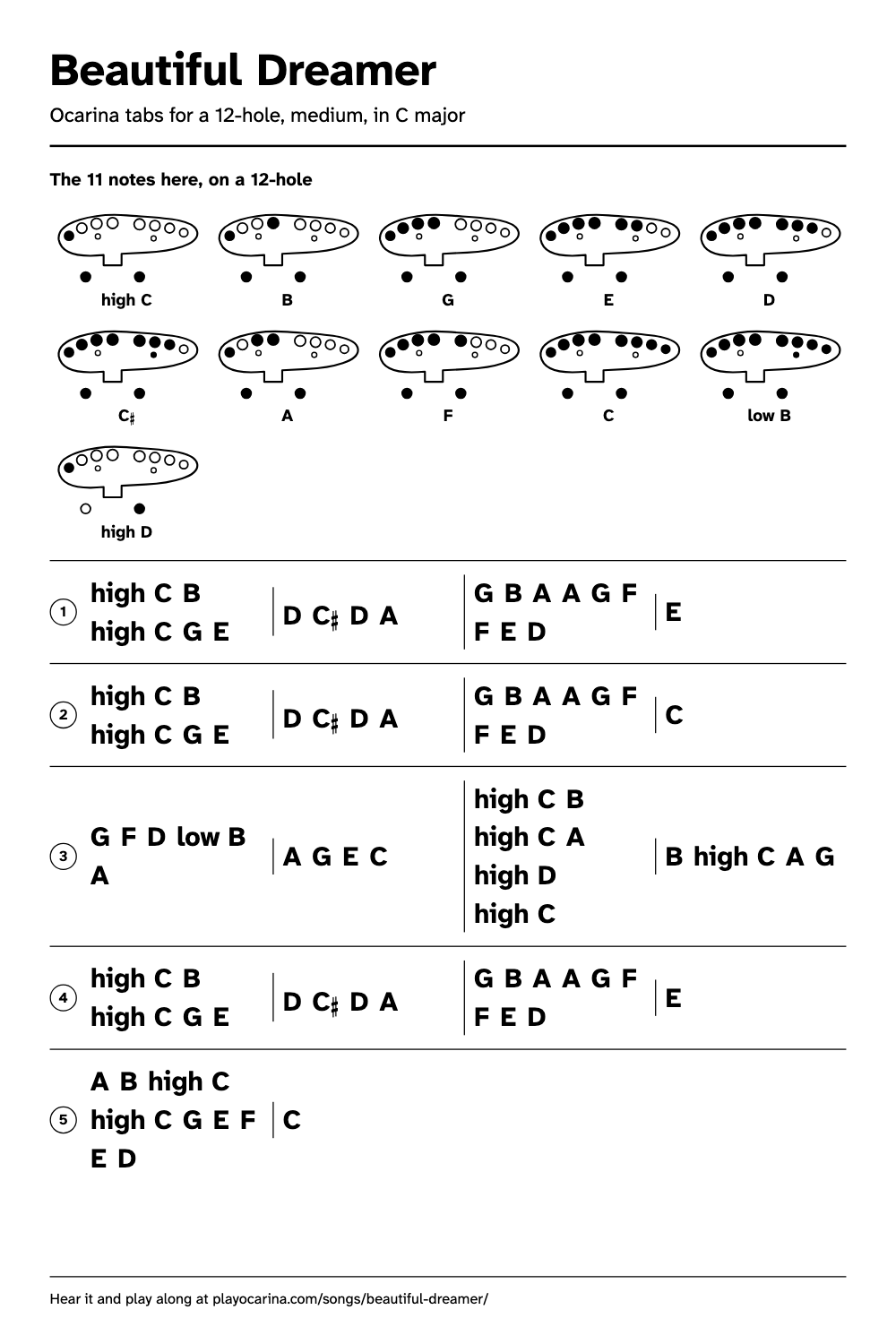
On a 12-hole. Read left to right, a line at a time.
- high CBhigh CGEDC♯DAGBAAGFFEDE
- high CBhigh CGEDC♯DAGBAAGFFEDC
- Tricky spot:GFDlow BAAGEChigh CBhigh CAhigh Dhigh CBhigh CAG
- high CBhigh CGEDC♯DAGBAAGFFEDE
- ABhigh Chigh CGEFEDC
Beautiful Dreamer rocks along in 9/8: nine short beats to a bar, felt as three slow ones. Here it is in C major, 18 bars from low B up to high D, with C♯ as the only sharp, in the little step down and up that follows the first line. The first eight bars are the verse tune and the last ten are the second part, which opens with the leap up from low B.
What is the tricky spot in Beautiful Dreamer?
The leap at the start of the second part, from the lowest note in the song, low B, up a seventh to A. On a 12-hole, Beautiful Dreamer goes from low B to A: you lift the left ring, right index, right middle, right ring, right pinky and right sub-hole.
Low B is all ten main holes covered plus the right small hole. The A is played with only five holes covered (left pinky, left middle, left index and both thumbs), so most of your fingers lift together. The leap follows three quick falling notes, G, F and D, and the low B lasts a beat and a half: use that time to lift the fingers in one move, not one by one. Practise the pair alone and slowly, and keep the breath steady: blowing harder for the leap pushes the A sharp.
Where do you breathe in Beautiful Dreamer?
The tune has no rests, so the long notes are your breaths: the held E that ends the fourth bar, the C that ends the verse, the held E near the end, and the final C, which lasts four and a half beats. Start each of them a little early and let it die away softly rather than cutting it off.
Which ocarina can play Beautiful Dreamer?
A 6-hole ocarina cannot reach low B, and a 4-hole ocarina cannot reach low B and high D, so play Beautiful Dreamer in this key on a 12-hole ocarina in C. On an ocarina in G or F, use the same fingerings: the tune sounds in a different key, which is fine when you play alone. The linked chart has every fingering, and you can check your notes with a tuner such as our free ocarina tuner.
The 11 notes here, on a 12-holeHoles in words, with a picture
| Note | Holes to cover | Picture |
|---|---|---|
| high C | Cover the left pinky, left thumb and right thumb | |
| B | Cover the left pinky, left index, left thumb and right thumb | |
| G | Cover every main hole but the right index, right middle, right ring and right pinky | |
| E | Cover every main hole but the right ring and right pinky | |
| D | Cover every main hole but the right pinky | |
| C♯ | Cover every main hole but the right pinky, plus the right sub-hole | |
| A | Cover the left pinky, left middle, left index, left thumb and right thumb | |
| F | Cover every main hole but the right middle, right ring and right pinky | |
| C | Cover every main hole | |
| low B | Cover every main hole, plus the right sub-hole | |
| high D | Cover the left pinky and right thumb |
Drawn as you see it while playing: mouthpiece towards you, left hand on the left.
Was Beautiful Dreamer really Stephen Foster's last song?
Probably not. Foster died on 13 January 1864, and the song came out after his death, in March 1864, from William A. Pond in New York. The copy we follow calls it "one of the latest songs" of his, "composed a short time before his death". Wikipedia says the first edition went further and called it his last, yet its copyright was dated 1862, and at least twenty songs claim to be his final one. Our tabs follow the 1864 Pond edition, which is in E flat and counts nine eighth notes to a bar; we move it up to C major. We show the melody only. Music: Stephen C. Foster (1826-1864), words and music, 1864.