Oh My Darling, Clementine on the ocarina
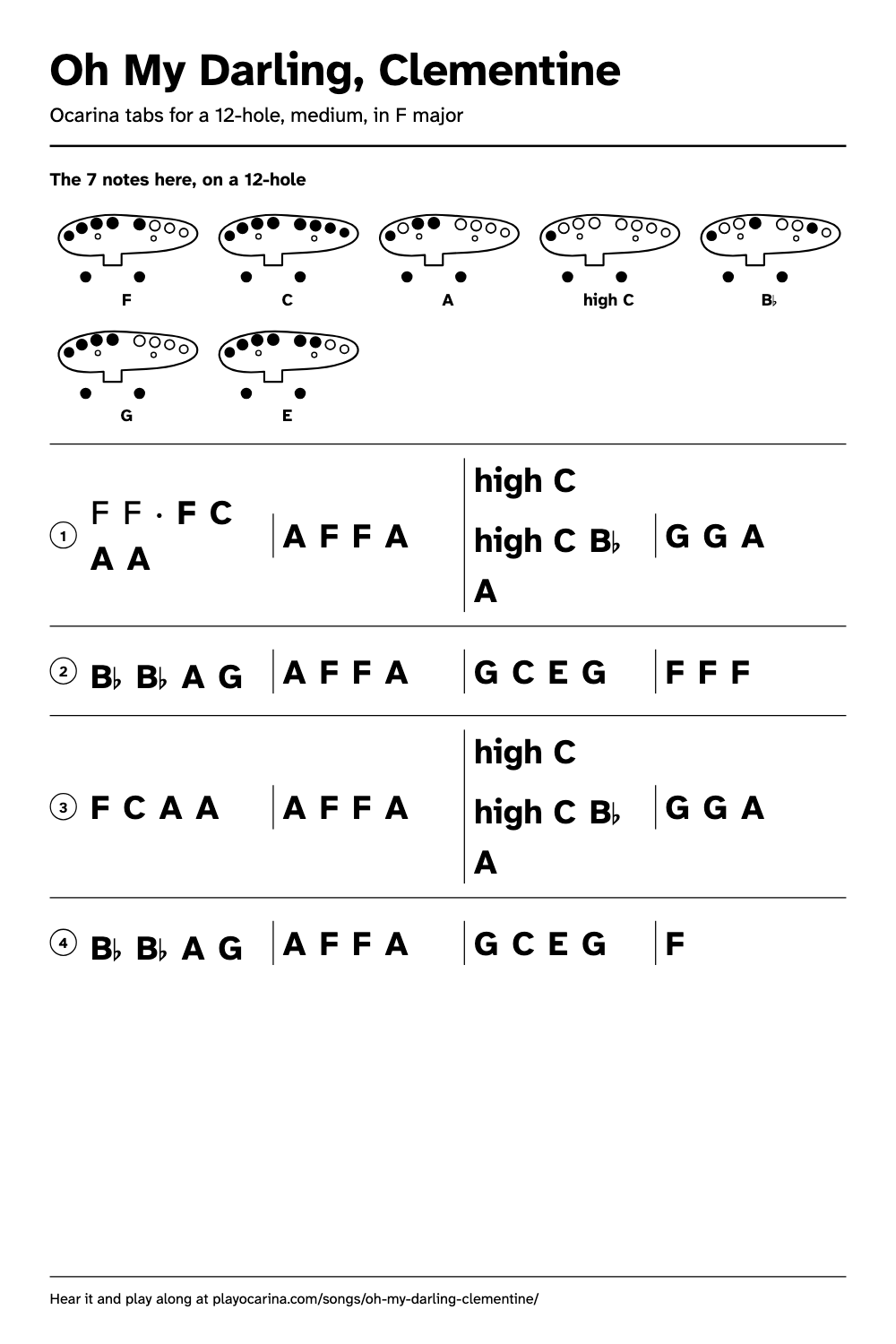
On a 12-hole it starts F, F, F, C. Medium, 60 notes, in F major.
Oh My Darling, Clementine
Bar 1 of 16
What are the notes for Oh My Darling, Clementine?
On a 12-hole. Read left to right, a line at a time.
- FF FCAAAFFATricky spot:high Chigh CB♭AGGA
- B♭B♭AGAFFAGCEGFFF
- FCAAAFFAhigh Chigh CB♭AGGA
- B♭B♭AGAFFAGCEGF
Clementine is a waltz-time song, here in F major: a tune of 16 bars (the verse, then the chorus) that never goes below C or above high C, so it fits a 4-hole, a 6-hole and a 12-hole ocarina. Most of it moves by step, with two jumps down, a fourth in the first bar and a fifth in the seventh, and B♭ is the only flat. The old songbook page marks it waltz time, and the quick dotted pairs give it its swing.
What is the tricky spot in Oh My Darling, Clementine?
High C down to B♭ in the third bar, then on to A: the only flat in the song, and it comes again in the fifth bar and in the chorus. On a 12-hole, Oh My Darling, Clementine goes from high C to B♭: you cover the left index and right ring. On a 6-hole or 4-hole, you cover the right index.
On a 12-hole, B♭ is a cross-fingering: starting from high C (left little finger and both thumbs down), add the left index finger and the right ring finger. The next note, A, takes the right ring finger off again and puts the left middle finger down, so practise C, B♭, A slowly, with the fingers moving together, before you add the rhythm. On a 4-hole or 6-hole, B♭ is just high C with the right index finger added. The pairs of repeated notes in these bars (C, C and B♭, B♭) are tongued: keep the fingers still and start each note with a soft "tu".
Where do you breathe in Oh My Darling, Clementine?
The long notes are the places to breathe: the two-beat G that ends the first four bars, the two-beat F that follows, then the long G and the final F of the chorus. Take a short breath in each long note, not in the quick notes right after it.
Which ocarina can play Oh My Darling, Clementine?
Any 12-hole, 6-hole or 4-hole ocarina in C plays Oh My Darling, Clementine in this key. On an ocarina in G or F, use the same fingerings: the tune sounds in a different key, which is fine when you play alone. Each linked chart has every fingering for its ocarina, and you can check your notes with a tuner such as our free ocarina tuner.
The 7 notes here, on a 12-holeHoles in words, with a picture
| Note | Holes to cover | Picture |
|---|---|---|
| F | Cover every main hole but the right middle, right ring and right pinky | |
| C | Cover every main hole | |
| A | Cover the left pinky, left middle, left index, left thumb and right thumb | |
| high C | Cover the left pinky, left thumb and right thumb | |
| B♭ | Cover the left pinky, left index, right ring, left thumb and right thumb | |
| G | Cover every main hole but the right index, right middle, right ring and right pinky | |
| E | Cover every main hole but the right ring and right pinky |
Drawn as you see it while playing: mouthpiece towards you, left hand on the left.
| Note | Holes to cover | Picture |
|---|---|---|
| F | Cover every hole but the right middle and right index | |
| C | Cover every hole | |
| A | Cover the left index, left thumb and right thumb | |
| high C | Cover the left thumb and right thumb | |
| B♭ | Cover the right index, left thumb and right thumb | |
| G | Cover every hole but the left middle and right middle | |
| E | Cover every hole but the right index |
Drawn as you see it while playing: mouthpiece towards you, left hand on the left.
| Note | Holes to cover | Picture |
|---|---|---|
| F | Cover the left middle and left index | |
| C | Cover every hole | |
| A | Cover the left index | |
| high C | All holes open | |
| B♭ | Cover the right index | |
| G | Cover the left index and right index | |
| E | Cover every hole but the right index |
Drawn as you see it while playing: mouthpiece towards you, left hand on the left.
Who wrote Oh My Darling, Clementine?
Nobody has settled it. Wikipedia says the song came out as sheet music from Oliver Ditson of Boston in 1884 with words by Percy Montrose, that it follows an earlier song printed in 1863, and that where the melody began is unknown; one writer suggests an old Spanish ballad. Our tabs follow a 1915 songbook, which prints the song under the name P. Montrose. College Songs, a Ditson book of 1887, prints the same name with the line "Words and Music by Percy Montrose" and an 1884 copyright date, and its verse has the same notes. A different setting of 1885 puts Barker Bradford's name on a song called Clementine, with its own verses. We could not find when either man lived. We show the melody only. Music: credited to Percy Montrose, first printed 1884; who he was, and where the tune began, is not settled.