Beethoven's Symphony No. 5 on the ocarina
On a 12-hole it starts E, E, E, C. Medium, 44 notes, in A minor.
Goes up to high E, so it does not fit a 4-hole. Goes down to low B, so it does not fit a 6-hole.
Beethoven's Symphony No. 5
Bar 1 of 21
What are the notes for Beethoven's Fifth?
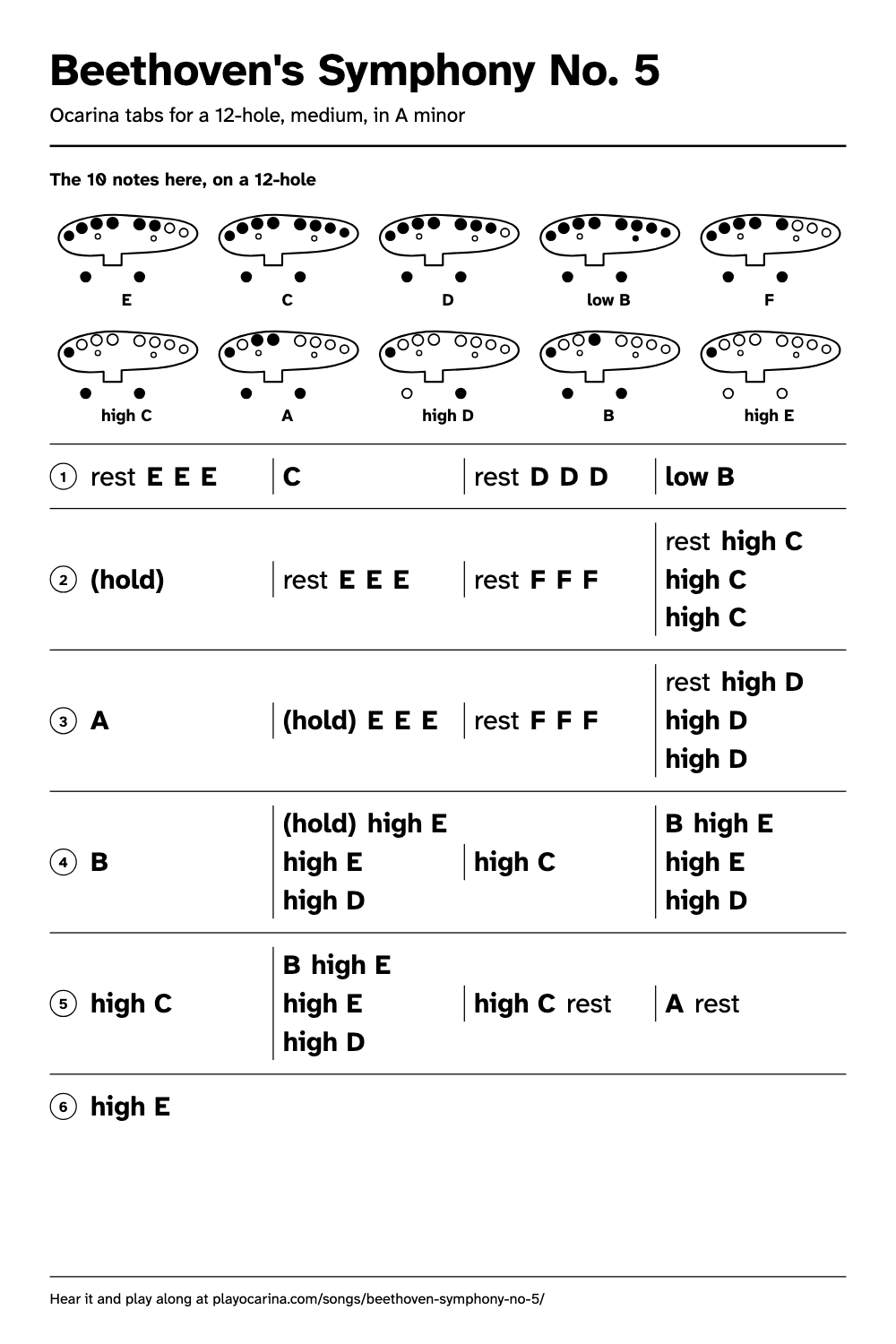
On a 12-hole. Read left to right, a line at a time.
- restEEECrestDDDlow B
- (hold)restEEErestFFFresthigh Chigh Chigh C
- A(hold)EEErestFFFresthigh Dhigh Dhigh D
- BTricky spot:(hold)high Ehigh Ehigh Dhigh CBhigh Ehigh Ehigh D
- high CBhigh Ehigh Ehigh Dhigh CrestArest
- high E
Beethoven's Fifth opens with three short notes and a long one, then the same a step lower: the "short-short-short-long" motif often described as fate knocking at the door. This is the main theme, the first 21 bars of the first movement, in A minor and in the rhythm of the printing, from B up to high E with no sharps or flats. After the two long notes the short-short-short figure climbs bar by bar, turns into three falling figures and stops on a long high E.
Why is the start of Beethoven's Fifth hard to play in time?
Each group of three short notes starts after a short rest, so you come in just after the beat, and in the second half the tune leaps from B up to high E three times in a row. On a 12-hole, Beethoven's Fifth goes from B to high E: you lift the left index, left thumb and right thumb.
Count the rest out loud at first, "and-1-2-3", and tongue the three short notes on "2-3-4" so they land together, not rushed. The two long notes at the start carry a pause sign in the printing: our tabs give them their written length, two beats and then four, and in a performance you can hold them longer. For the leaps to high E, finger the B firmly, then blow a little faster for the E and ease off as the line falls to D and C.
Which ocarina can play Beethoven's Fifth?
A 6-hole ocarina cannot reach low B, and a 4-hole ocarina cannot reach low B, high D and high E, so play Beethoven's Fifth in this key on a 12-hole ocarina in C. On an ocarina in G or F, use the same fingerings: the tune sounds in a different key, which is fine when you play alone. The linked chart has every fingering, and you can check your notes with a tuner such as our free ocarina tuner.
The 10 notes here, on a 12-holeHoles in words, with a picture
| Note | Holes to cover | Picture |
|---|---|---|
| E | Cover every main hole but the right ring and right pinky | |
| C | Cover every main hole | |
| D | Cover every main hole but the right pinky | |
| low B | Cover every main hole, plus the right sub-hole | |
| F | Cover every main hole but the right middle, right ring and right pinky | |
| high C | Cover the left pinky, left thumb and right thumb | |
| A | Cover the left pinky, left middle, left index, left thumb and right thumb | |
| high D | Cover the left pinky and right thumb | |
| B | Cover the left pinky, left index, left thumb and right thumb | |
| high E | Cover the left pinky |
Drawn as you see it while playing: mouthpiece towards you, left hand on the left.
Where do our tabs for Beethoven's Fifth come from?
Beethoven worked on the Fifth Symphony from 1804 to 1808, and it was first played in Vienna on 22 December 1808. Its famous opening passes between the string sections, one group after another, so no single orchestral part has the whole tune. Our tabs follow the top line of Franz Liszt's piano transcription, in the Breitkopf & Härtel edition of 1922, which gathers those entries into one hand; we moved it from C minor to A minor. The first violin part, printed in 1809, shows the other strings' entries as small cue notes, and in that first printing the second long note lasts one bar, where Liszt holds it for two. Beethoven died in 1827 and Liszt in 1886. Music: Ludwig van Beethoven (1770-1827), the opening of the first movement of his Symphony No. 5, 1808, as Franz Liszt (1811-1886) set it for piano.