Boléro on the ocarina
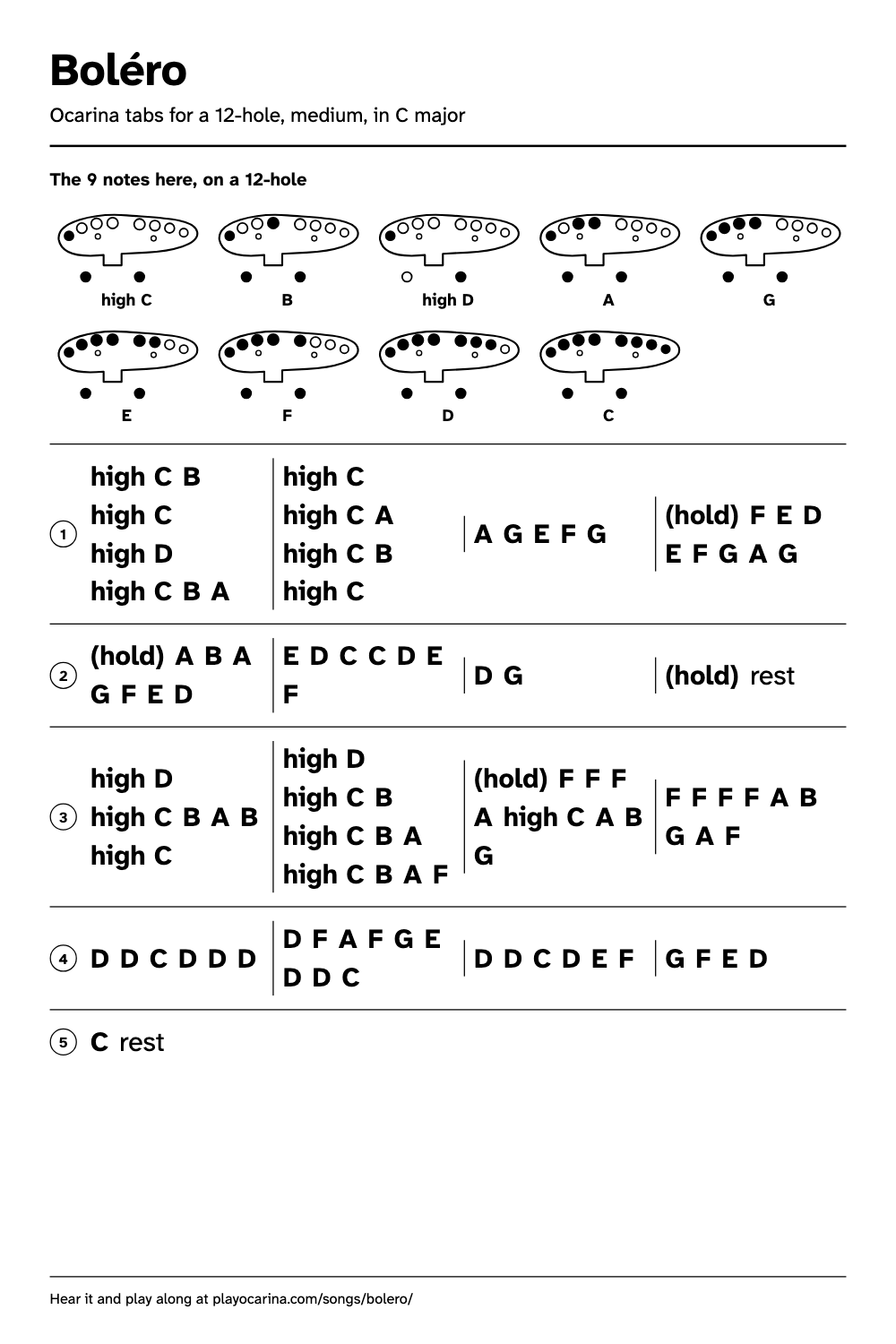
On a 12-hole it starts high C, B, high C, high D. Medium, 101 notes, in C major.
Goes up to high D, so it does not fit a 4-hole.
Boléro
Bar 1 of 17
What are the notes for Ravel's Boléro?
On a 12-hole. Read left to right, a line at a time.
- Tricky spot:high CBhigh Chigh Dhigh CBAhigh Chigh CAhigh CBhigh CAGEFG(hold)FEDEFGAG
- (hold)ABAGFEDEDCCDEFDG(hold)rest
- high Dhigh CBABhigh Chigh Dhigh CBhigh CBAhigh CBAF(hold)FFFAhigh CABGFFFFABGAF
- DDCDDDDFAFGEDDCDDCDEFGFED
- Crest
Ravel's Boléro is built from one slow, curling tune passed from instrument to instrument over a snare drum. This is its main theme, the first of its two tunes, as the solo flute plays it in bars 5 to 21 of the 1929 score, in the printed rhythm: a long C that turns through B, C, D and back, then runs of sixteenths and long tied notes. We play it an octave higher, in C major, from C to high D, so it fits a 6-hole as well as a 12-hole.
What is the hardest part of Boléro on the ocarina?
The quick turn in the first bar: after the long high C, four sixteenths, B, C, high D, C, then B and A, all inside one beat and a half. On a 12-hole, Ravel's Boléro goes from high C to high D: you lift the left thumb. On a 6-hole, you lift the right thumb.
Play the turn slowly first, one note to a beat, then speed it up; on a 12-hole and a 6-hole high D is a thumb lift, so keep the other fingers still and let only the thumbs move. The harder part is counting: phrase after phrase ends on a G tied over the bar line, across bars 3 and 4, again across bars 4 and 5, and longest of all, four and a half beats, across bars 7 and 8. Count three slow beats in every bar and hold each tied note its full length; the snare drum in a recording makes a good metronome.
Where do you breathe in Ravel's Boléro?
The first half has a single rest, the eighth rest at the end of bar 8, after the long G; take a full breath there. Everywhere else, sneak a breath at the end of a tied note, cutting it a little short, never in the middle of a run.
Which ocarina can play Ravel's Boléro?
A 4-hole ocarina cannot reach high D, so play Ravel's Boléro in this key on a 12-hole or 6-hole ocarina in C. On an ocarina in G or F, use the same fingerings: the tune sounds in a different key, which is fine when you play alone. Each linked chart has every fingering for its ocarina, and you can check your notes with a tuner such as our free ocarina tuner.
The 9 notes here, on a 12-holeHoles in words, with a picture
| Note | Holes to cover | Picture |
|---|---|---|
| high C | Cover the left pinky, left thumb and right thumb | |
| B | Cover the left pinky, left index, left thumb and right thumb | |
| high D | Cover the left pinky and right thumb | |
| A | Cover the left pinky, left middle, left index, left thumb and right thumb | |
| G | Cover every main hole but the right index, right middle, right ring and right pinky | |
| E | Cover every main hole but the right ring and right pinky | |
| F | Cover every main hole but the right middle, right ring and right pinky | |
| D | Cover every main hole but the right pinky | |
| C | Cover every main hole |
Drawn as you see it while playing: mouthpiece towards you, left hand on the left.
| Note | Holes to cover | Picture |
|---|---|---|
| high C | Cover the left thumb and right thumb | |
| B | Cover the right middle, left thumb and right thumb | |
| high D | Cover the left thumb | |
| A | Cover the left index, left thumb and right thumb | |
| G | Cover every hole but the left middle and right middle | |
| E | Cover every hole but the right index | |
| F | Cover every hole but the right middle and right index | |
| D | Cover every hole but the right middle | |
| C | Cover every hole |
Drawn as you see it while playing: mouthpiece towards you, left hand on the left.
Why does Boléro repeat the same tune?
Ravel wrote Boléro in 1928 as a ballet score for the dancer Ida Rubinstein, and it was first danced at the Paris Opéra that November. The whole piece is two tunes, each played again and again by a new instrument or group, over a snare drum rhythm that never changes, growing from very quiet to very loud. The flute plays the first tune first. Our tabs follow that flute solo in the full score Durand printed in Paris in 1929, Ravel's own copy, headed "à Ida Rubinstein" and marked Tempo di Bolero, moderato assai; we play it an octave higher. Ravel died in 1937. Music: Maurice Ravel (1875-1937), the first theme of his Boléro for orchestra, 1928.