Blessed Assurance on the ocarina
On a 12-hole it starts F♯, E, D, A. Hard, 73 notes, in D major.
Goes up to high E, so it does not fit a 4-hole.
Blessed Assurance
Bar 1 of 16
What are the notes for Blessed Assurance?
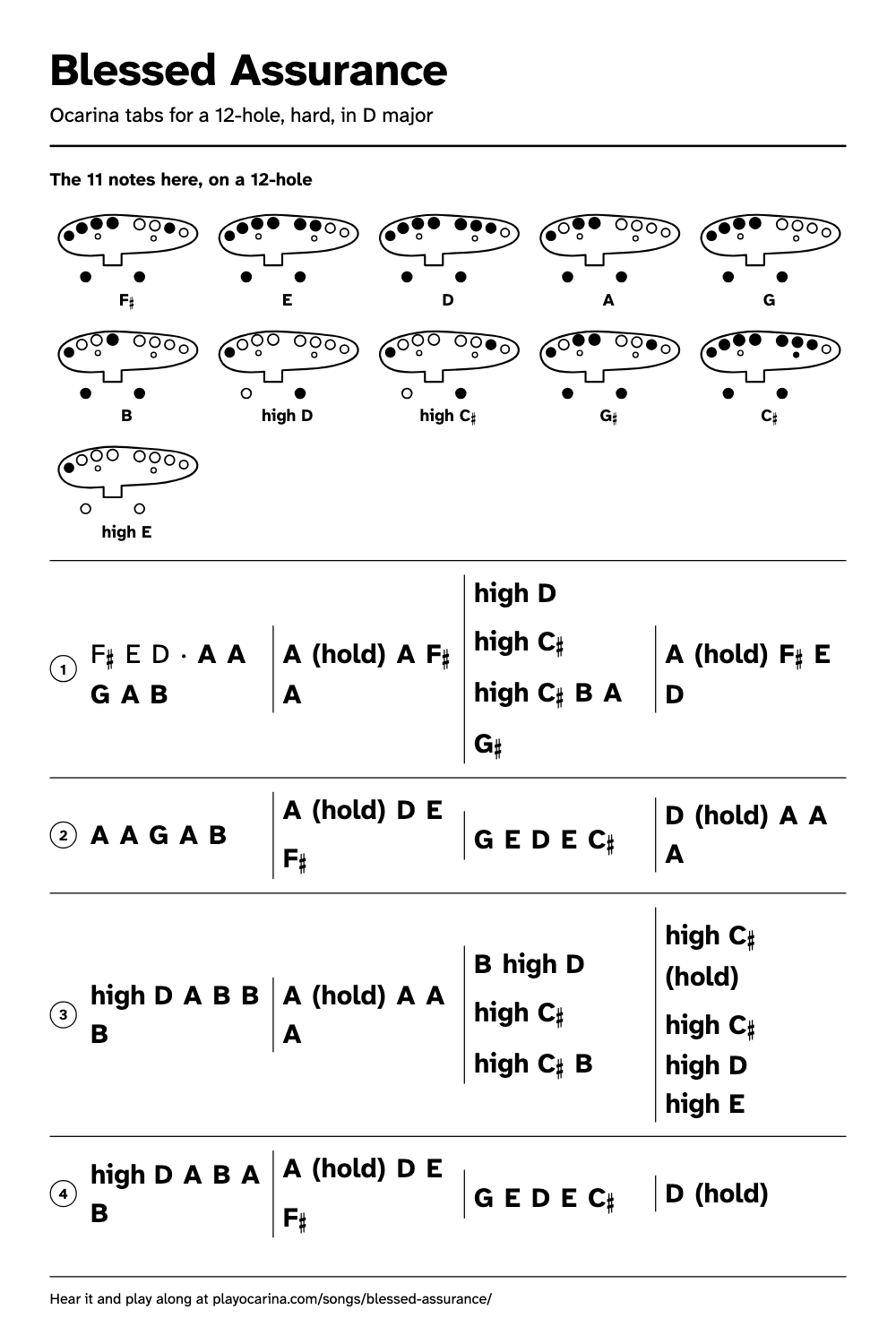
On a 12-hole. Read left to right, a line at a time.
- F♯ED AAGABA(hold)AF♯Ahigh Dhigh C♯high C♯BAG♯A(hold)F♯ED
- AAGABA(hold)DEF♯GEDEC♯D(hold)AAA
- high DABBBA(hold)AAABhigh Dhigh C♯high C♯BTricky spot:high C♯(hold)high C♯high Dhigh E
- high DABABA(hold)DEF♯GEDEC♯D(hold)
Blessed Assurance opens with three quick notes falling F♯, E, D, then a jump up to two long A's. It is in 9/8, so every bar is three groups of three eighth notes, and the tune keeps that slow lilt from start to finish. Here are the verse and the refrain in D major, from C♯ up to high E, which fits a 12-hole and a 6-hole ocarina in C.
What is the tricky spot in Blessed Assurance?
The climb near the end of the refrain, high C♯, high D and high E in three quick eighths, the highest notes in the song. On a 12-hole, Blessed Assurance goes from high D to high E: you lift the right thumb. On a 6-hole, you lift the left thumb.
High E needs a firmer, faster breath than the A's around it, and high C♯ just before it is a cross-fingering on a 12-hole, so the three notes ask for a new fingering and more air at once. Practise them slowly, then drop straight back to high D on the next long note without letting it go sharp. The G♯ in the third bar is the other note to learn on its own: it lasts half a beat and leads up to a long A, so play G♯, A a few times until the G♯ sits in tune.
Where do you breathe in Blessed Assurance?
Most phrases end on a note held for two whole groups of three, then three quick eighths lead into the next one. Let the held note go a little early and breathe there, never inside the three eighths. Take a fuller breath before the refrain's second half, which starts on high C♯ and climbs to high E.
Which ocarina can play Blessed Assurance?
A 4-hole ocarina cannot reach high C♯, high D and high E, so play Blessed Assurance in this key on a 12-hole or 6-hole ocarina in C. On an ocarina in G or F, use the same fingerings: the tune sounds in a different key, which is fine when you play alone. Each linked chart has every fingering for its ocarina, and you can check your notes with a tuner such as our free ocarina tuner.
The 11 notes here, on a 12-holeHoles in words, with a picture
| Note | Holes to cover | Picture |
|---|---|---|
| F♯ | Cover every main hole but the right index, right middle and right pinky | |
| E | Cover every main hole but the right ring and right pinky | |
| D | Cover every main hole but the right pinky | |
| A | Cover the left pinky, left middle, left index, left thumb and right thumb | |
| G | Cover every main hole but the right index, right middle, right ring and right pinky | |
| B | Cover the left pinky, left index, left thumb and right thumb | |
| high D | Cover the left pinky and right thumb | |
| high C♯ | Cover the left pinky, right ring and right thumb | |
| G♯ | Cover every main hole but the left ring, right index, right middle and right pinky | |
| C♯ | Cover every main hole but the right pinky, plus the right sub-hole | |
| high E | Cover the left pinky |
Drawn as you see it while playing: mouthpiece towards you, left hand on the left.
| Note | Holes to cover | Picture |
|---|---|---|
| F♯ | Cover every hole but the left middle | |
| E | Cover every hole but the right index | |
| D | Cover every hole but the right middle | |
| A | Cover the left index, left thumb and right thumb | |
| G | Cover every hole but the left middle and right middle | |
| B | Cover the right middle, left thumb and right thumb | |
| high D | Cover the left thumb | |
| high C♯ | Cover the right middle and left thumb | |
| G♯ | Cover every hole but the left middle and right index | |
| C♯ | Cover the left middle, left index, right index, left thumb and right thumb; half-cover the right middle | |
| high E | All holes open |
Drawn as you see it while playing: mouthpiece towards you, left hand on the left.
Who wrote the tune of Blessed Assurance?
Phoebe Knapp wrote the melody in 1873 and played it on the piano to her friend Fanny Crosby, who wrote the words to it the same year; the tune is now called by the hymn's name. Our tabs follow The Methodist Hymnal of 1905, hymn 548, which credits the music to "Mrs. Joseph F. Knapp" and prints it in 9/8 with its refrain, the top line of four parts. The verse and the refrain end the same way, falling from G through E and D to a short C♯ before the last D; in the hymnal the refrain's ending swings that fall, a dotted D and a quick E where the verse has three even notes. Knapp died in 1908 and Crosby in 1915. We show the melody only. Music: Phoebe Knapp (1839-1908), words by Fanny Crosby (1820-1915).