Rhapsody in Blue on the ocarina
On a 12-hole it starts B, high C♯, high E♭, E♭. Hard, 28 notes, in G major.
Goes up to high E♭, so it does not fit a 4-hole.
Rhapsody in Blue
Bar 1 of 8
What are the notes for Rhapsody in Blue?
On a 12-hole. Read left to right, a line at a time.
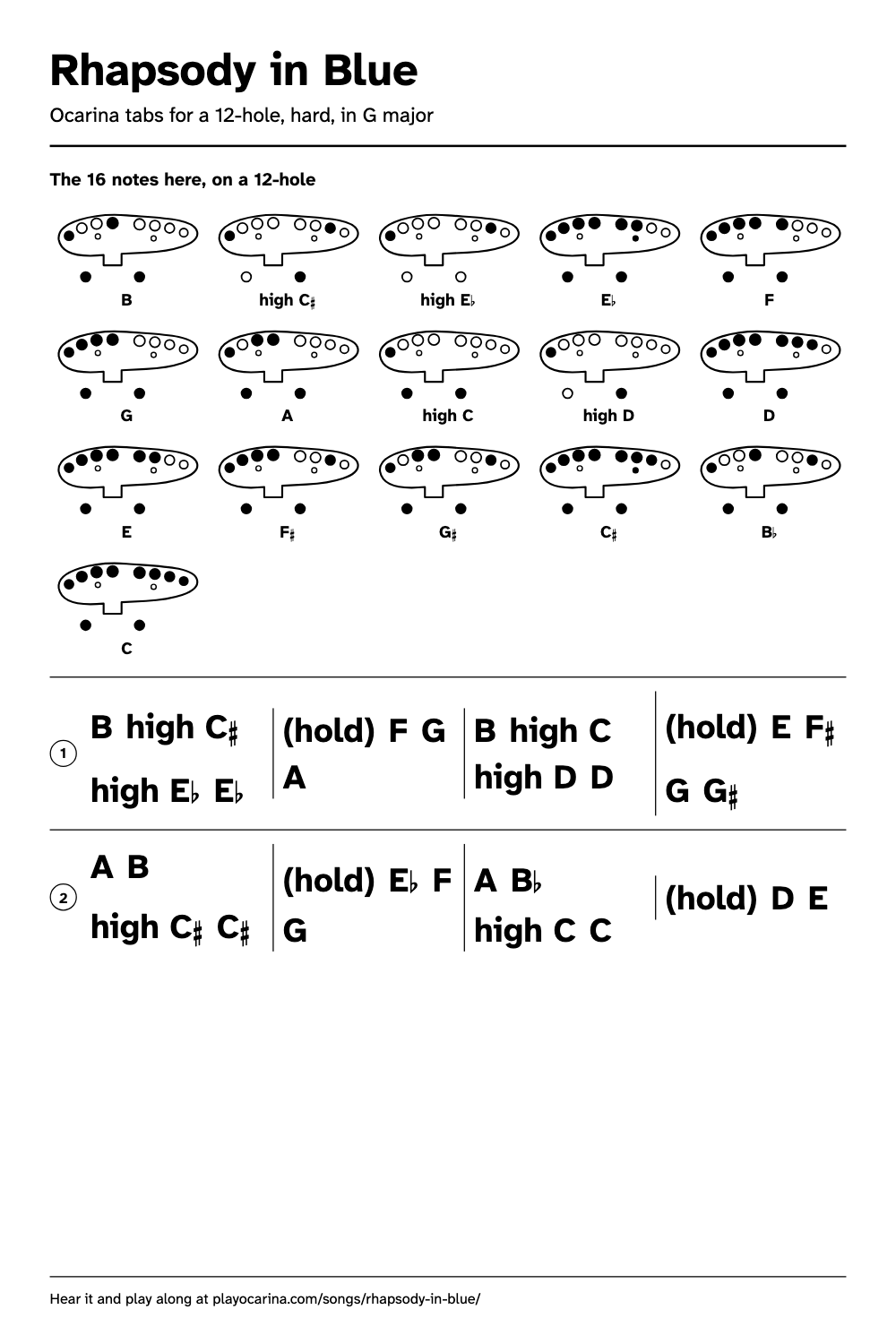
- Tricky spot:Bhigh C♯high E♭E♭(hold)FGABhigh Chigh DD(hold)EF♯GG♯
- ABhigh C♯C♯(hold)E♭FGAB♭high CC(hold)DE
This is one theme from Rhapsody in Blue, not the whole piece: the slow, singing tune from the middle of Gershwin's 1924 work for piano and jazz band. The clarinet slide that opens the piece cannot be played on an ocarina, so we took this tune instead. Each phrase climbs three steps, drops an octave and climbs again. Here it is in G major, the eight bars of one statement of it, from low C up to high E♭.
What is the hardest part of the Rhapsody in Blue theme?
The drop of an octave on the fourth beat of the first bar, from high E♭ down to the E♭ below it, and the same drop at the end of bars 3, 5 and 7. On a 12-hole, Rhapsody in Blue goes from high E♭ to E♭: you lift the right ring and cover the left ring, left middle, left index, right index, right middle, left thumb, right thumb and right sub-hole. On a 6-hole, you cover the left middle, left index, left thumb and right thumb.
The two notes have the same name, so it is easy to forget that they use quite different fingerings. Practise just the last two notes of bar 1 on their own: climb the three steps, then drop, and hold the low note for two beats, since it is tied across the barline. Do it slowly, several times, until the low note speaks cleanly on the fourth beat. The same drop comes again on D, C♯ and C, so once it is secure the whole tune is easier. In bar 4 the last two notes, G and G♯, are only a quarter of a beat each: let them lead you quickly into the next bar.
Where do you breathe in Rhapsody in Blue?
After each long low note: the E♭, D, C♯ and C at the start of bars 2, 4, 6 and 8 are held for two beats because they are tied across the barline, so let each one go a little early and breathe before the next climb. The climbs themselves are short, so one breath each is plenty.
Which ocarina can play Rhapsody in Blue?
A 4-hole ocarina cannot reach high C♯, high D and high E♭, so play Rhapsody in Blue in this key on a 12-hole or 6-hole ocarina in C. On an ocarina in G or F, use the same fingerings: the tune sounds in a different key, which is fine when you play alone. Each linked chart has every fingering for its ocarina, and you can check your notes with a tuner such as our free ocarina tuner.
The 16 notes here, on a 12-holeHoles in words, with a picture
| Note | Holes to cover | Picture |
|---|---|---|
| B | Cover the left pinky, left index, left thumb and right thumb | |
| high C♯ | Cover the left pinky, right ring and right thumb | |
| high E♭ | Cover the left pinky and right ring | |
| E♭ | Cover every main hole but the right ring and right pinky, plus the right sub-hole | |
| F | Cover every main hole but the right middle, right ring and right pinky | |
| G | Cover every main hole but the right index, right middle, right ring and right pinky | |
| A | Cover the left pinky, left middle, left index, left thumb and right thumb | |
| high C | Cover the left pinky, left thumb and right thumb | |
| high D | Cover the left pinky and right thumb | |
| D | Cover every main hole but the right pinky | |
| E | Cover every main hole but the right ring and right pinky | |
| F♯ | Cover every main hole but the right index, right middle and right pinky | |
| G♯ | Cover every main hole but the left ring, right index, right middle and right pinky | |
| C♯ | Cover every main hole but the right pinky, plus the right sub-hole | |
| B♭ | Cover the left pinky, left index, right ring, left thumb and right thumb | |
| C | Cover every main hole |
Drawn as you see it while playing: mouthpiece towards you, left hand on the left.
| Note | Holes to cover | Picture |
|---|---|---|
| B | Cover the right middle, left thumb and right thumb | |
| high C♯ | Cover the right middle and left thumb | |
| high E♭ | Cover the right middle | |
| E♭ | Cover the left middle, right middle, left index, left thumb and right thumb; half-cover the right index | |
| F | Cover every hole but the right middle and right index | |
| G | Cover every hole but the left middle and right middle | |
| A | Cover the left index, left thumb and right thumb | |
| high C | Cover the left thumb and right thumb | |
| high D | Cover the left thumb | |
| D | Cover every hole but the right middle | |
| E | Cover every hole but the right index | |
| F♯ | Cover every hole but the left middle | |
| G♯ | Cover every hole but the left middle and right index | |
| C♯ | Cover the left middle, left index, right index, left thumb and right thumb; half-cover the right middle | |
| B♭ | Cover the right index, left thumb and right thumb | |
| C | Cover every hole |
Drawn as you see it while playing: mouthpiece towards you, left hand on the left.
Is this the whole of Rhapsody in Blue?
No: it is one theme, the slow tune in E major from the middle of Rhapsody in Blue, which Gershwin wrote for Paul Whiteman's concert at Aeolian Hall on 12 February 1924. Ferde Grofé orchestrated the piece, and we do not use his scoring. Our tabs follow the two-piano score Harms published in 1924, where one piano plays the part of the orchestra, moved from E major up to G; a 1924 copyright catalogue lists that score with the date 31 December 1924. Gershwin died in 1937. We show the melody only. Music: George Gershwin (1898-1937), one theme from Rhapsody in Blue, 1924.