Panis Angelicus on the ocarina
On a 12-hole it starts B, B, A, A. Medium, 57 notes, in G major.
Goes up to high E, so it does not fit a 4-hole.
Panis Angelicus
Bar 1 of 20
What are the notes for Panis Angelicus?
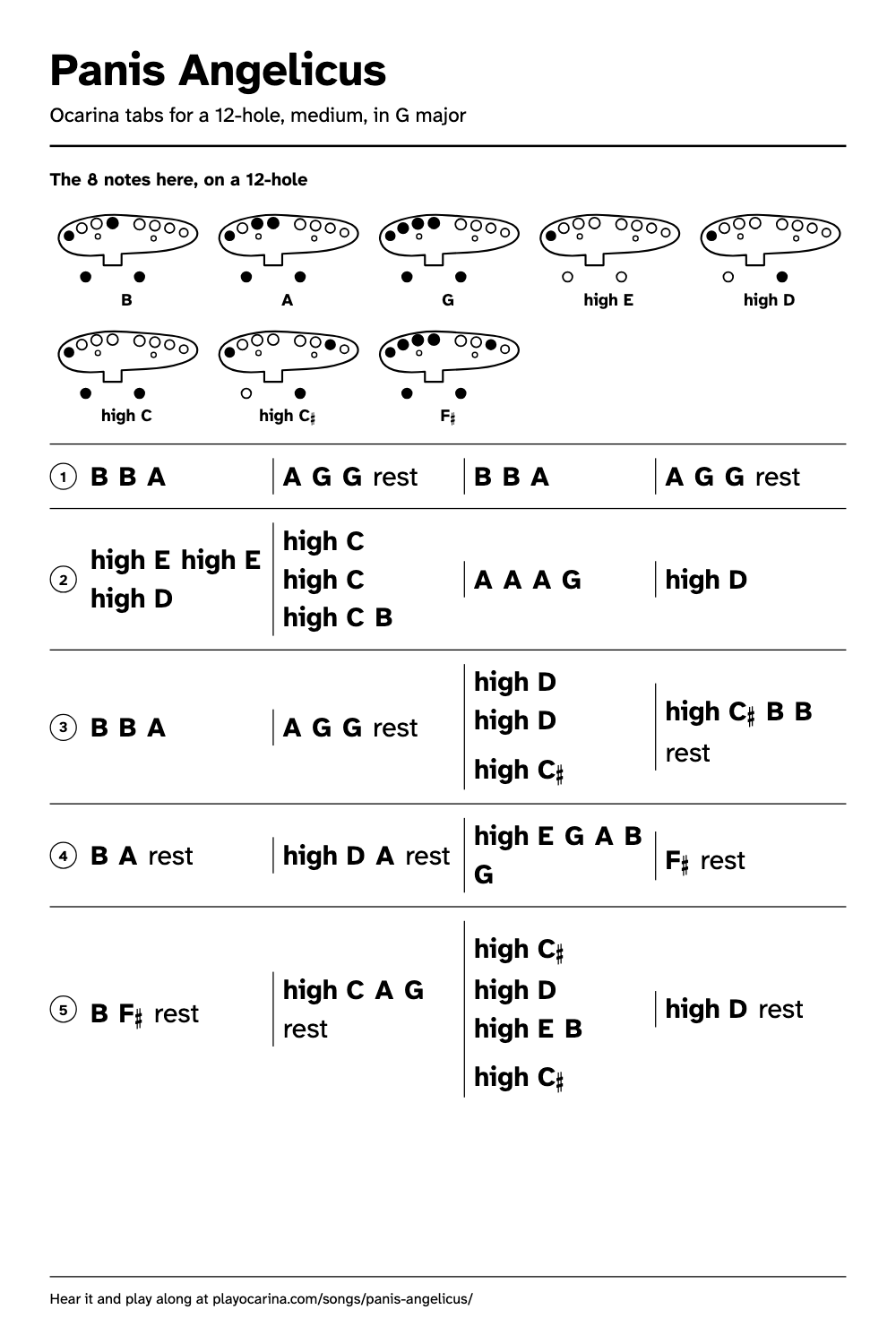
On a 12-hole. Read left to right, a line at a time.
- BBAAGGrestBBAAGGrest
- high Ehigh Ehigh Dhigh Chigh Chigh CBAAAGhigh D
- BBAAGGresthigh Dhigh Dhigh C♯high C♯BBrest
- BAresthigh DAresthigh EGABGF♯rest
- BF♯restTricky spot:high CAGresthigh C♯high Dhigh EBhigh C♯high Drest
Panis Angelicus starts on a long B, then B, A, and a short A and G: a slow, rocking phrase that comes back three times. Here is the whole first verse of Franck's setting, 20 bars in G major from F♯ up to high E, as it was printed in Paris around 1890. It is unhurried, with a rest after almost every phrase, which makes it a good first slow song.
Which bar of Panis Angelicus needs the most care?
Near the end, where the tune stops on G, rests for a beat and jumps up to C sharp, just after a long C natural. The two Cs, a bar apart, are easy to mix up. On a 12-hole, Panis Angelicus goes from G to high C♯: you swap hands: lift the left ring, left middle, left index and left thumb and cover the right ring. On a 6-hole, you lift the left index, right index and right thumb and cover the right middle.
Practise the last three bars slowly. The bar before has a long C natural sliding down to A and G; then comes C sharp, which on a 12-hole is a cross-fingering, and the run D, E, B to C sharp again before the final D. Say the sharp to yourself as you rest, so your fingers are ready. Elsewhere the tune repeats one rhythm: a half note, two quarters, then a short dotted figure, A and a quick G. Give the dotted note its full length and keep the quick note light, as the printing writes it, rather than two even halves.
Where do you breathe in Panis Angelicus?
The printing gives you a rest after nearly every phrase: two beats after each short phrase in the first half, and a beat after each pair of long notes in the second. Breathe in every one, even when you do not need to, because the long notes that follow need a steady stream of air.
Which ocarina can play Panis Angelicus?
A 4-hole ocarina cannot reach high C♯, high D and high E, so play Panis Angelicus in this key on a 12-hole or 6-hole ocarina in C. On an ocarina in G or F, use the same fingerings: the tune sounds in a different key, which is fine when you play alone. Each linked chart has every fingering for its ocarina, and you can check your notes with a tuner such as our free ocarina tuner.
The 8 notes here, on a 12-holeHoles in words, with a picture
| Note | Holes to cover | Picture |
|---|---|---|
| B | Cover the left pinky, left index, left thumb and right thumb | |
| A | Cover the left pinky, left middle, left index, left thumb and right thumb | |
| G | Cover every main hole but the right index, right middle, right ring and right pinky | |
| high E | Cover the left pinky | |
| high D | Cover the left pinky and right thumb | |
| high C | Cover the left pinky, left thumb and right thumb | |
| high C♯ | Cover the left pinky, right ring and right thumb | |
| F♯ | Cover every main hole but the right index, right middle and right pinky |
Drawn as you see it while playing: mouthpiece towards you, left hand on the left.
| Note | Holes to cover | Picture |
|---|---|---|
| B | Cover the right middle, left thumb and right thumb | |
| A | Cover the left index, left thumb and right thumb | |
| G | Cover every hole but the left middle and right middle | |
| high E | All holes open | |
| high D | Cover the left thumb | |
| high C | Cover the left thumb and right thumb | |
| high C♯ | Cover the right middle and left thumb | |
| F♯ | Cover every hole but the left middle |
Drawn as you see it while playing: mouthpiece towards you, left hand on the left.
Where does Franck's Panis Angelicus come from?
The words are a verse of a hymn Saint Thomas Aquinas wrote for the feast of Corpus Christi, and César Franck set that verse in 1872 for tenor, harp, cello and organ, then put it into his Messe à trois voix. Our tabs follow the voice in the Paris edition of his publisher Bornemann, printed around 1890 for baritone or mezzo-soprano, an octave higher and in the same G major. A Boston edition of 1908 prints the same tune in the same key. Franck was organist of the church of Sainte-Clotilde from 1859 until he died in 1890. We show the melody only. Music: César Franck (1822-1890), his 1872 setting of the Panis angelicus, later part of his Messe à trois voix.