Carol of the Bells on the ocarina
On a 12-hole it starts F, E, F, D. Medium, 144 notes, in D minor.
Goes up to high D, so it does not fit a 4-hole. Goes down to low A, so it does not fit a 6-hole.
Carol of the Bells
Bar 1 of 37
What are the notes for Carol of the Bells?
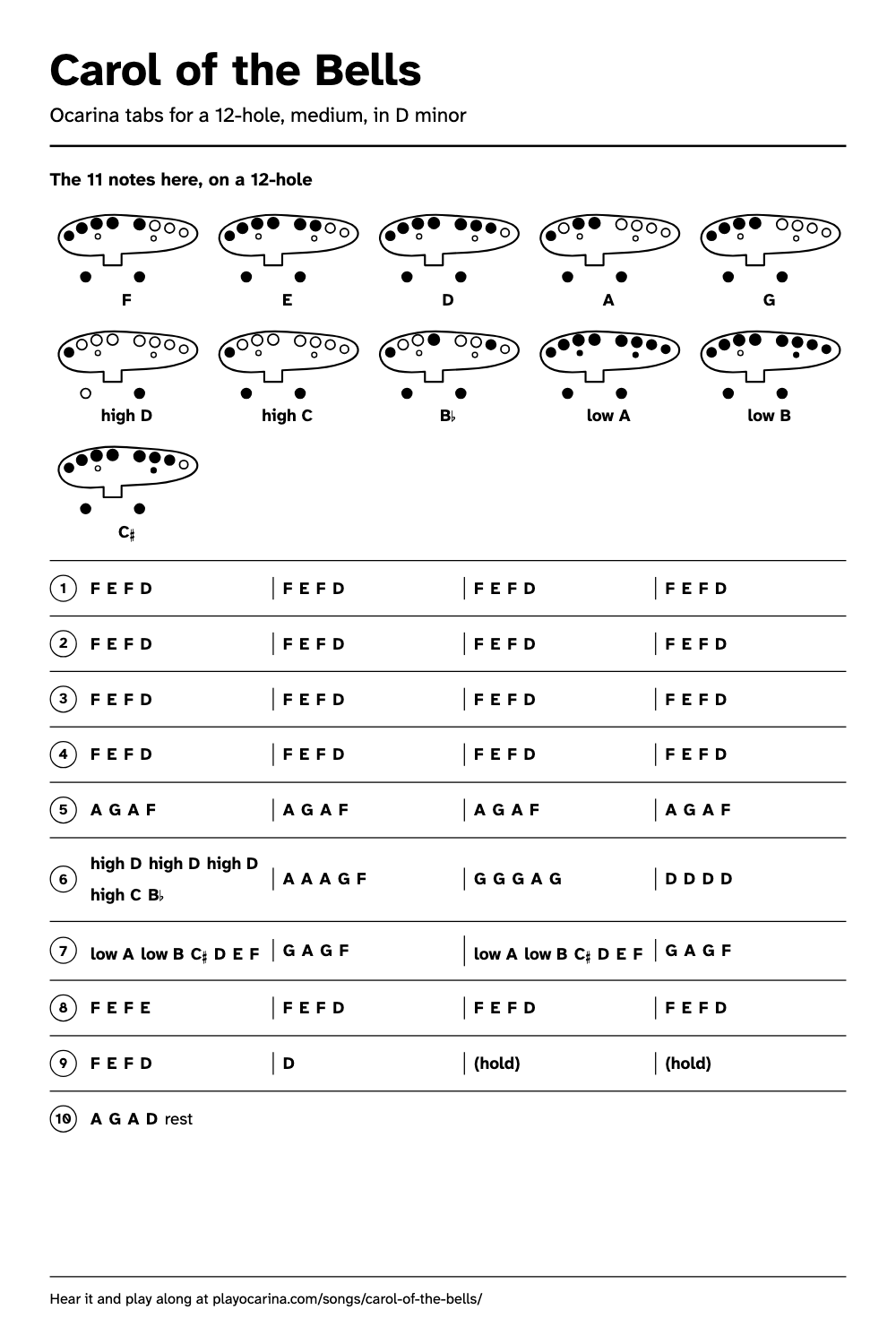
On a 12-hole. Read left to right, a line at a time.
- FEFDFEFDFEFDFEFD
- FEFDFEFDFEFDFEFD
- FEFDFEFDFEFDFEFD
- FEFDFEFDFEFDFEFD
- AGAFAGAFAGAFAGAF
- high Dhigh Dhigh Dhigh CB♭AAAGFGGGAGTricky spot:DDDD
- low Alow BC♯DEFGAGFlow Alow BC♯DEFGAGF
- FEFEFEFDFEFDFEFD
- FEFDD(hold)(hold)
- AGADrest
Carol of the Bells is built on one four-note figure, F, E, F, D: a long note, two quick ones and a long one, like a bell ringing. That figure is the tune. Here it fills the first sixteen bars, moves up to A, G, A, F, gives way to a brighter middle with two climbing runs, and comes back to end the carol. We follow the top voice of Leontovych's choir, in D minor.
What is the tricky spot in Carol of the Bells?
The drop from D to low A that starts the first climbing run, A, B, C sharp, D, E, F in quick notes. On a 12-hole, Carol of the Bells goes from D to low A: you cover the right pinky, left sub-hole and right sub-hole.
Low A and B need the small holes on a 12-hole and C sharp is a cross-fingering, so learn the run slowly, one note to a beat, then bring it up to two notes a beat. It comes twice, each time answered by G, A, G, F. Everywhere else the test is stamina, not fingers: the four-note figure repeats bar after bar, so keep the two quick notes light and even, "tu-du", and do not let the tempo creep up.
Where do you breathe in Carol of the Bells?
There are almost no rests: the four-note figure runs on. Take a quick breath by clipping the last D of every fourth bar, and a fuller one before the D held across three bars near the end.
Which ocarina can play Carol of the Bells?
A 6-hole ocarina cannot reach low A and low B, and a 4-hole ocarina cannot reach low A, low B and high D, so play Carol of the Bells in this key on a 12-hole ocarina in C. On an ocarina in G or F, use the same fingerings: the tune sounds in a different key, which is fine when you play alone. The linked chart has every fingering, and you can check your notes with a tuner such as our free ocarina tuner.
The 11 notes here, on a 12-holeHoles in words, with a picture
| Note | Holes to cover | Picture |
|---|---|---|
| F | Cover every main hole but the right middle, right ring and right pinky | |
| E | Cover every main hole but the right ring and right pinky | |
| D | Cover every main hole but the right pinky | |
| A | Cover the left pinky, left middle, left index, left thumb and right thumb | |
| G | Cover every main hole but the right index, right middle, right ring and right pinky | |
| high D | Cover the left pinky and right thumb | |
| high C | Cover the left pinky, left thumb and right thumb | |
| B♭ | Cover the left pinky, left index, right ring, left thumb and right thumb | |
| low A | Cover every main hole, plus the left sub-hole and right sub-hole | |
| low B | Cover every main hole, plus the right sub-hole | |
| C♯ | Cover every main hole but the right pinky, plus the right sub-hole |
Drawn as you see it while playing: mouthpiece towards you, left hand on the left.
Where does Carol of the Bells come from?
From Ukraine. It began as "Shchedryk", a New Year song about a swallow, which Mykola Leontovych arranged for choir. Students at Kyiv University first sang it in December 1916, and a Ukrainian choir brought it to Carnegie Hall in New York in October 1922; the English words came in 1936, from Peter Wilhousky. Our tabs follow an edition printed in Kharkiv in 1921, taking the choir's top voice from start to end. That printing marks the song to be sung twice; we play it once. Leontovych died in 1921, the year that edition came out. We show the melody only, with no words. Music: Mykola Leontovych (1877-1921), "Shchedryk", his choral setting of a Ukrainian New Year song.