Clair de Lune on the ocarina
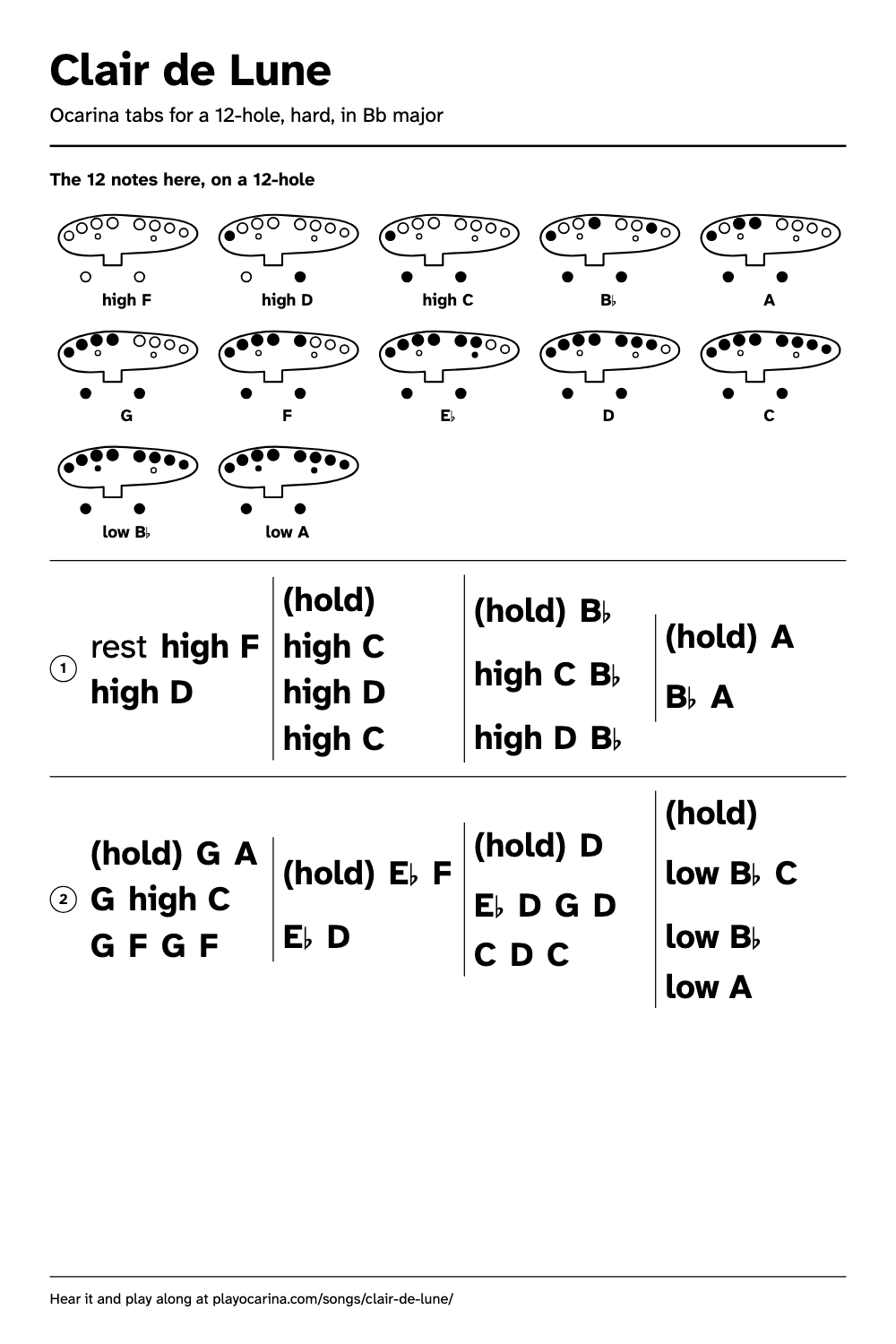
On a 12-hole it starts high F, high D, high C, high D. Hard, 37 notes, in Bb major.
Goes up to high F, so it does not fit a 6-hole or 4-hole.
Clair de Lune
Bar 1 of 8
What are the notes for Clair de Lune?
On a 12-hole. Read left to right, a line at a time.
- Tricky spot:resthigh Fhigh D(hold)high Chigh Dhigh C(hold)B♭high CB♭high DB♭(hold)AB♭A
- (hold)GAGhigh CGFGF(hold)E♭FE♭D(hold)DE♭DGDCDC(hold)low B♭Clow B♭low A
Clair de Lune opens on a high F held for two beats, falls to D, then rocks gently between D and C: Debussy marked it "Andante très expressif", at a walking pace and very expressive. Here is its opening melody, the first 8 bars, in B-flat major and 9/8, three slow beats of three eighths each. From the high F at the start it sinks bar by bar to a low A, so it needs a 12-hole ocarina and all of its range, both sub-holes included.
What is the tricky spot in Clair de Lune?
The very first note, a high F, the top note of a 12-hole ocarina, which the piece asks you to play softly. On a 12-hole, Clair de Lune goes from high F to high D: you cover the left pinky and right thumb.
High F wants a lot of air, and Debussy marks the opening pp, very quiet, so aim for a steady, gentle stream rather than a push, and land on D without a bump. Play the first two bars slowly a few times before you go on. In bar 3 two pairs of notes share the time of three eighths, a duplet: play them evenly, a little slower than the eighths around them. The last two bars sit low, ending on B flat and A with the sub-holes covered, so blow softer as the tune sinks.
Where do you breathe in Clair de Lune?
Take a full breath before the first note and a quick one at the end of the long A in bar 4; the second half then runs down to the low A in one breath.
Which ocarina can play Clair de Lune?
A 6-hole ocarina cannot reach low A, low B♭ and high F, and a 4-hole ocarina cannot reach low A, low B♭, high D and high F, so play Clair de Lune in this key on a 12-hole ocarina in C. On an ocarina in G or F, use the same fingerings: the tune sounds in a different key, which is fine when you play alone. The linked chart has every fingering, and you can check your notes with a tuner such as our free ocarina tuner.
The 12 notes here, on a 12-holeHoles in words, with a picture
| Note | Holes to cover | Picture |
|---|---|---|
| high F | All holes open | |
| high D | Cover the left pinky and right thumb | |
| high C | Cover the left pinky, left thumb and right thumb | |
| B♭ | Cover the left pinky, left index, right ring, left thumb and right thumb | |
| A | Cover the left pinky, left middle, left index, left thumb and right thumb | |
| G | Cover every main hole but the right index, right middle, right ring and right pinky | |
| F | Cover every main hole but the right middle, right ring and right pinky | |
| E♭ | Cover every main hole but the right ring and right pinky, plus the right sub-hole | |
| D | Cover every main hole but the right pinky | |
| C | Cover every main hole | |
| low B♭ | Cover every main hole, plus the left sub-hole | |
| low A | Cover every main hole, plus the left sub-hole and right sub-hole |
Drawn as you see it while playing: mouthpiece towards you, left hand on the left.
When did Debussy write Clair de Lune?
Debussy began the Suite bergamasque around 1890 and revised it just before it was published in 1905. Clair de lune, its third movement, was first called Promenade sentimentale, and its final title comes from a poem by Paul Verlaine. Our tabs follow the first edition, published by E. Fromont in Paris in 1905, whose title page reads "Copyright by E. Fromont, MCMV". It prints the piece in D-flat major; our tabs move the top line of the right hand up to B-flat major for a C ocarina, and they are its opening melody. Debussy died in 1918. We show the melody only. Music: Claude Debussy (1862-1918), the third movement of his Suite bergamasque, published in 1905.