Turkish March on the ocarina
On a 12-hole it starts E, D, C♯, D. Hard, 110 notes, in D minor.
Goes up to high F, so it does not fit a 6-hole or 4-hole.
Turkish March
Bar 1 of 24
What are the notes for the Turkish March?
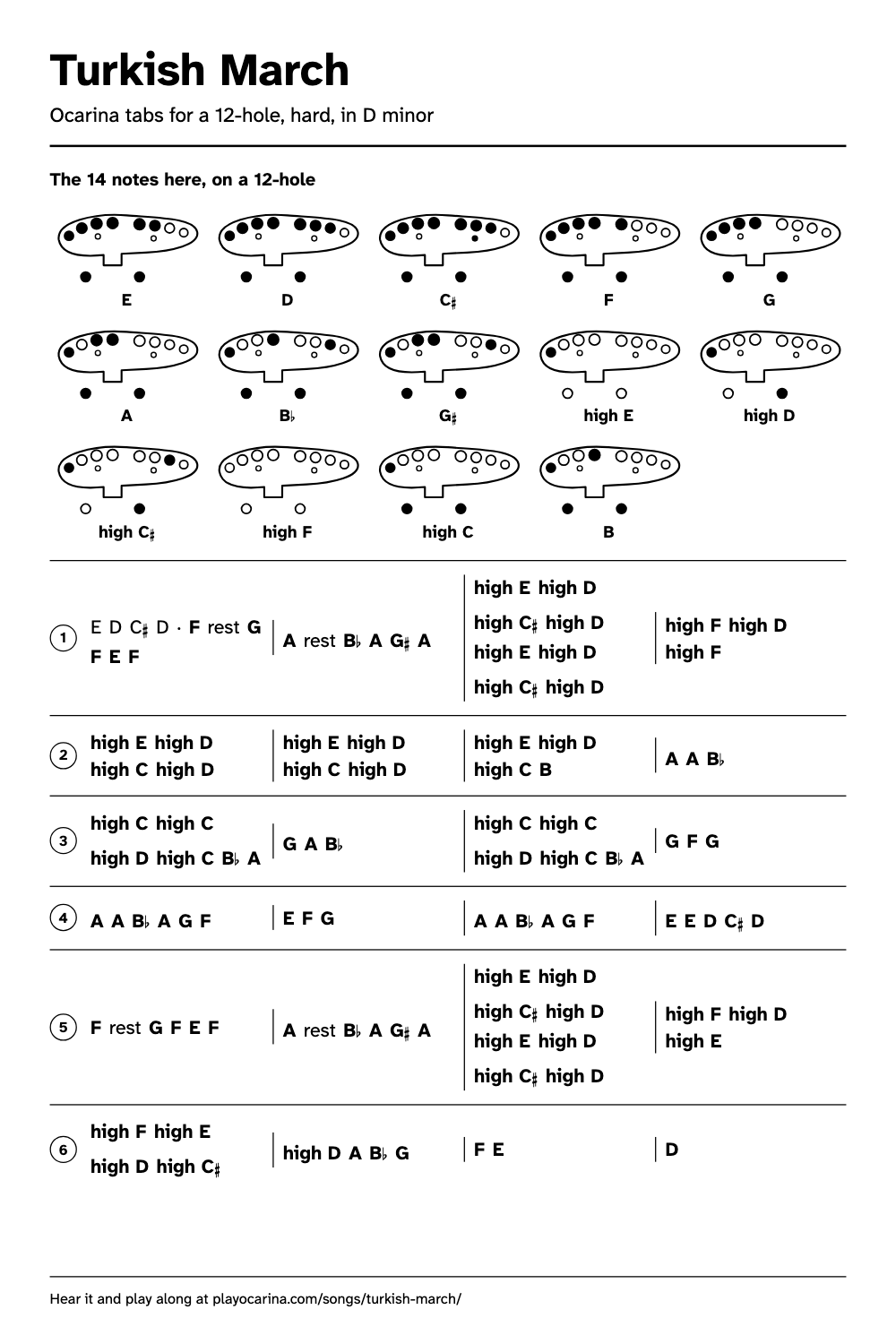
On a 12-hole. Read left to right, a line at a time.
- EDC♯D FrestGFEFTricky spot:ArestB♭AG♯Ahigh Ehigh Dhigh C♯high Dhigh Ehigh Dhigh C♯high Dhigh Fhigh Dhigh F
- high Ehigh Dhigh Chigh Dhigh Ehigh Dhigh Chigh Dhigh Ehigh Dhigh CBAAB♭
- high Chigh Chigh Dhigh CB♭AGAB♭high Chigh Chigh Dhigh CB♭AGFG
- AAB♭AGFEFGAAB♭AGFEEDC♯D
- FrestGFEFArestB♭AG♯Ahigh Ehigh Dhigh C♯high Dhigh Ehigh Dhigh C♯high Dhigh Fhigh Dhigh E
- high Fhigh Ehigh Dhigh C♯high DAB♭GFED
The Turkish March opens with a quick curl around D, the notes E, D, C♯, D, then answers it on F and on A, and leaps up to the same curl an octave higher before landing on high F. It is the last movement of a Mozart piano sonata. Here is its whole opening section in D minor, a pickup and 24 bars of 2/4, from C♯ up to high F, so it needs a 12-hole ocarina. The small sub-holes are never used.
What is the tricky spot in the Turkish March?
The jump from A up to high E that starts the fast run in the fourth bar, and again near the end. On a 12-hole, the Turkish March goes from A to high E: you lift the left middle, left index, left thumb and right thumb.
That run sits at the very top of the ocarina: E, D, C♯, D twice, then a high F. Practise it slowly on its own first, four notes to a beat, until the C♯ cross-fingering feels automatic. High notes need more breath pressure and less air, so firm up your blowing as you leap from A, and do not let the pitch go flat on the F. The middle eight bars sit lower and are mostly plain eighth notes, which gives your breath a rest before the run comes back. Start at half speed and only raise the tempo when every sixteenth is even.
Which ocarina can play the Turkish March?
A 6-hole ocarina cannot reach high F, and a 4-hole ocarina cannot reach high C♯, high D, high E and high F, so play the Turkish March in this key on a 12-hole ocarina in C. On an ocarina in G or F, use the same fingerings: the tune sounds in a different key, which is fine when you play alone. The linked chart has every fingering, and you can check your notes with a tuner such as our free ocarina tuner.
The 14 notes here, on a 12-holeHoles in words, with a picture
| Note | Holes to cover | Picture |
|---|---|---|
| E | Cover every main hole but the right ring and right pinky | |
| D | Cover every main hole but the right pinky | |
| C♯ | Cover every main hole but the right pinky, plus the right sub-hole | |
| F | Cover every main hole but the right middle, right ring and right pinky | |
| G | Cover every main hole but the right index, right middle, right ring and right pinky | |
| A | Cover the left pinky, left middle, left index, left thumb and right thumb | |
| B♭ | Cover the left pinky, left index, right ring, left thumb and right thumb | |
| G♯ | Cover every main hole but the left ring, right index, right middle and right pinky | |
| high E | Cover the left pinky | |
| high D | Cover the left pinky and right thumb | |
| high C♯ | Cover the left pinky, right ring and right thumb | |
| high F | All holes open | |
| high C | Cover the left pinky, left thumb and right thumb | |
| B | Cover the left pinky, left index, left thumb and right thumb |
Drawn as you see it while playing: mouthpiece towards you, left hand on the left.
When did Mozart publish the Turkish March?
In 1784. The Viennese firm Artaria published the sonata in 1784, with two others, and the march is its third and last movement. Mozart himself titled the movement "Alla turca", in the Turkish style. Our tabs follow Artaria's first edition, whose title page reads "Trois Sonates pour le Clavecin ou Pianoforte" and whose tempo word is "Allegrino"; the Breitkopf & Härtel complete edition of 1878 prints the same tune and calls it "Allegretto". We teach the A minor opening section, moved up to D minor, playing the upper line where the piano splits into two voices and leaving out the grace notes and the trill near the end. Mozart died in 1791. We show the melody only. Music: Wolfgang Amadeus Mozart (1756-1791), the last movement of his Piano Sonata No. 11, K. 331, published 1784.