Rêverie (Debussy) on the ocarina
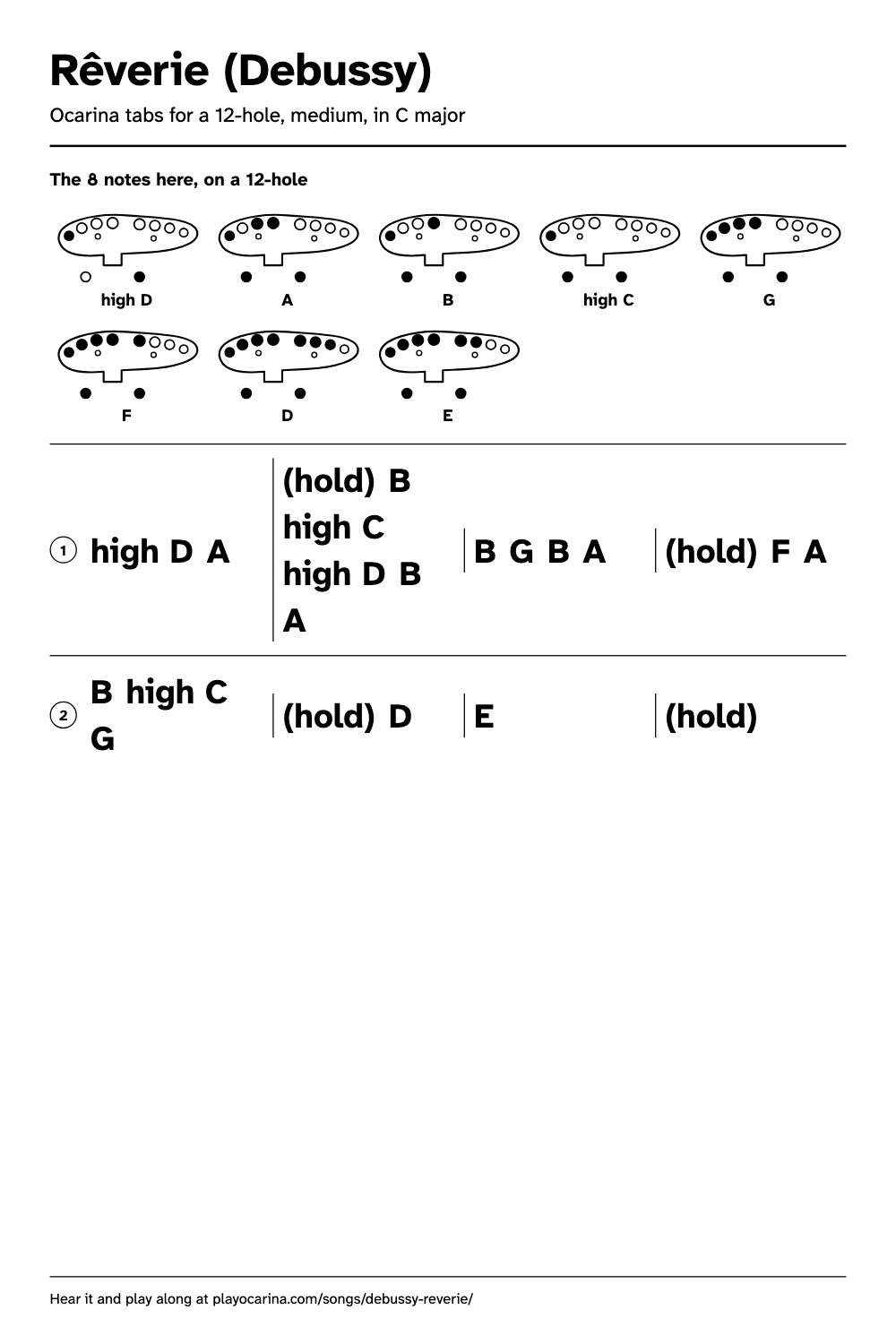
On a 12-hole it starts high D, A, B, high C. Medium, 18 notes, in C major.
Goes up to high D, so it does not fit a 4-hole.
Rêverie (Debussy)
Bar 1 of 8
What are the notes for Rêverie (Debussy)?
On a 12-hole. Read left to right, a line at a time.
- high DA(hold)Bhigh Chigh DBATricky spot:BGBA(hold)FA
- Bhigh CG(hold)DE(hold)
Debussy's Rêverie sings its main theme high and slow over a rocking accompaniment: a long high D falls to A, then the line turns up through B, C and D and settles back. Here is that theme, bars 3 to 10 of the piano piece, in the printing's own rhythm, moved from F major to C major so it needs no sharps or flats. It runs from D up to high D, and ends on a long E held for two whole bars.
How do you play the triplet in Debussy's Rêverie?
The third bar of the tabs, where three quarter notes, B, G and B, share the time of two before a long A: the one triplet in the theme. On a 12-hole, Rêverie (Debussy) goes from B to G: you cover the left ring and left middle. On a 6-hole, you lift the right middle and cover the left index and right index.
Count the bar in two halves: the triplet fills the first half, B, G, B evenly spread, and the A, tied over the bar line, fills the second half and the first half of the next bar. Practise it slowly against a steady two, saying 'tri-pl-et, A-a' until the three notes stop bunching at the front. The rest of the theme is plain halves, quarters and eighths, and most of its length is in held notes: the high D and A of the first bar, the tied G near the end, and the closing E, held for eight beats. Keep the breath even through those, without letting the pitch sag as the note goes on.
Which ocarina can play Rêverie (Debussy)?
A 4-hole ocarina cannot reach high D, so play Rêverie (Debussy) in this key on a 12-hole or 6-hole ocarina in C. On an ocarina in G or F, use the same fingerings: the tune sounds in a different key, which is fine when you play alone. Each linked chart has every fingering for its ocarina, and you can check your notes with a tuner such as our free ocarina tuner.
The 8 notes here, on a 12-holeHoles in words, with a picture
| Note | Holes to cover | Picture |
|---|---|---|
| high D | Cover the left pinky and right thumb | |
| A | Cover the left pinky, left middle, left index, left thumb and right thumb | |
| B | Cover the left pinky, left index, left thumb and right thumb | |
| high C | Cover the left pinky, left thumb and right thumb | |
| G | Cover every main hole but the right index, right middle, right ring and right pinky | |
| F | Cover every main hole but the right middle, right ring and right pinky | |
| D | Cover every main hole but the right pinky | |
| E | Cover every main hole but the right ring and right pinky |
Drawn as you see it while playing: mouthpiece towards you, left hand on the left.
| Note | Holes to cover | Picture |
|---|---|---|
| high D | Cover the left thumb | |
| A | Cover the left index, left thumb and right thumb | |
| B | Cover the right middle, left thumb and right thumb | |
| high C | Cover the left thumb and right thumb | |
| G | Cover every hole but the left middle and right middle | |
| F | Cover every hole but the right middle and right index | |
| D | Cover every hole but the right middle | |
| E | Cover every hole but the right index |
Drawn as you see it while playing: mouthpiece towards you, left hand on the left.
Did Debussy like his Rêverie?
No. Debussy wrote it in 1890 and, when Fromont brought it out in 1905, wrote to Madame Fromont that it was a thing of no importance, made very quickly as a favour, and in two words, bad. It became famous all the same. Our tabs follow the right hand in Fromont's edition, plate E. 1403 F., which IMSLP's catalogue dates to 1905; the theme enters in the third bar, after two bars of the accompaniment alone. Debussy died in 1918. The piece has no words. Music: Claude Debussy (1862-1918), the opening theme of his Rêverie for piano, written in 1890.