Deep River on the ocarina
On a 12-hole it starts A, G, F, G. Medium, 29 notes, in F major.
Goes up to high F, so it does not fit a 6-hole or 4-hole.
Deep River
Bar 1 of 8
What are the notes for Deep River?
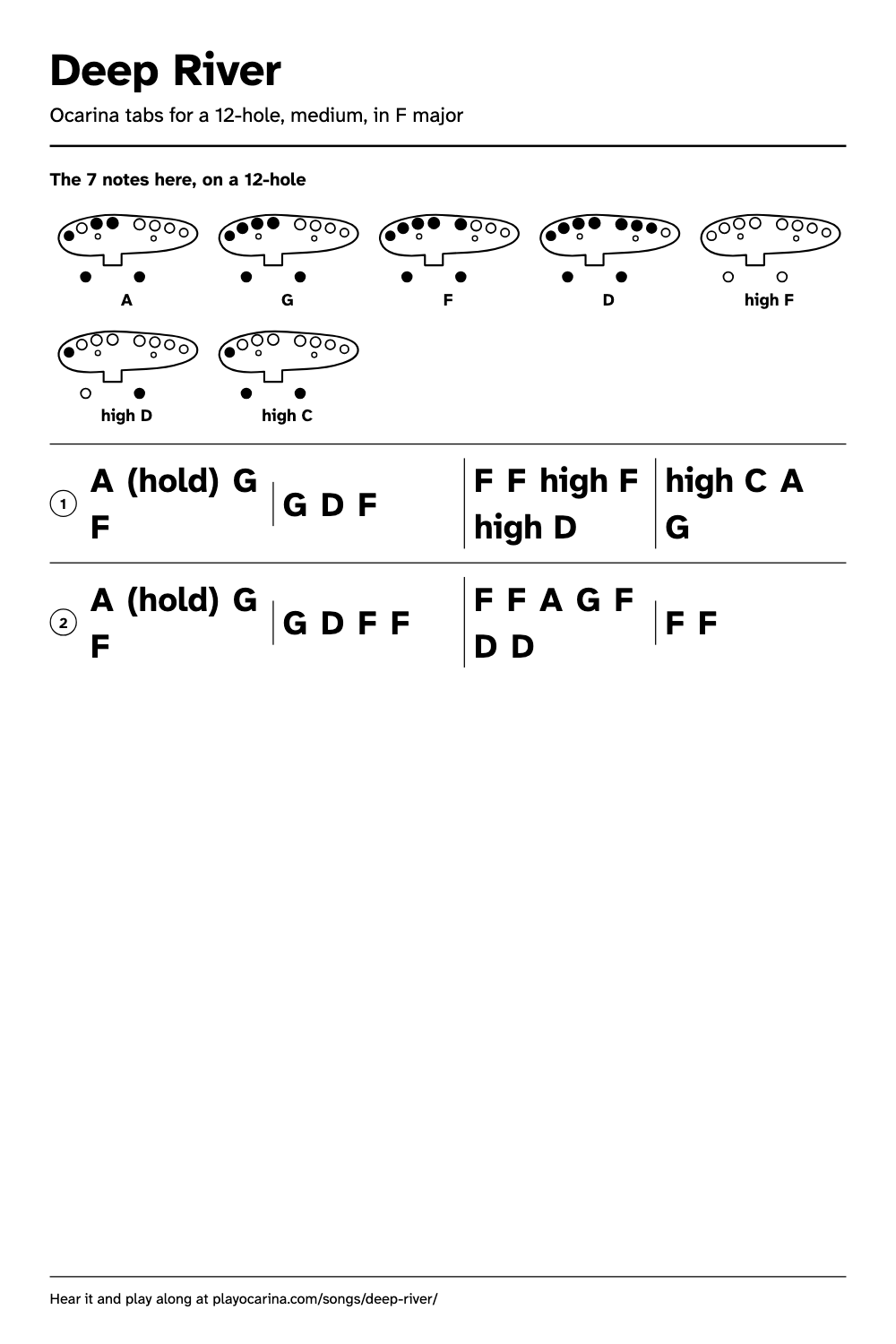
On a 12-hole. Read left to right, a line at a time.
- A(hold)GFGDFTricky spot:FFhigh Fhigh Dhigh CAG
- A(hold)GFGDFFFFAGFDDFF
Deep River is a slow, prayerful spiritual: a long A that falls through G to F, then a leap up to a high F in the third bar. This is the eight-bar verse in F major, seven notes from D up to the high F, with no sharps or flats. The 1917 sheet music marks it Lento, so give each long note its full length and let the tune breathe.
What is the tricky spot in Deep River?
The leap in the third bar, from F up to the high F an octave above, which then lasts a beat and a half before a quick D: the only big jump in the song. On a 12-hole, Deep River goes from F to high F: you lift the left pinky, left ring, left middle, left index, right index, left thumb and right thumb.
On a 12-hole, F has seven of the ten finger and thumb holes covered and the high F has every hole open, so lift all your fingers together on the jump and keep the air gentle: blow harder for the high F and it turns sharp and shrill. Practise the two F's on their own, a quiet low one, a breath, then the high one, until it speaks first time. Then hold the high F for its beat and a half and let the D after it drop in softly.
Where do you breathe in Deep River?
Breathe after the long D in the second bar, after the G that ends the fourth bar and after the F that ends the fifth. Bars six to eight run on as one line, with a pause mark on the long F in the sixth bar to give you time to refill if you need it.
Which ocarina can play Deep River?
A 6-hole ocarina cannot reach high F, and a 4-hole ocarina cannot reach high D and high F, so play Deep River in this key on a 12-hole ocarina in C. On an ocarina in G or F, use the same fingerings: the tune sounds in a different key, which is fine when you play alone. The linked chart has every fingering, and you can check your notes with a tuner such as our free ocarina tuner.
The 7 notes here, on a 12-holeHoles in words, with a picture
| Note | Holes to cover | Picture |
|---|---|---|
| A | Cover the left pinky, left middle, left index, left thumb and right thumb | |
| G | Cover every main hole but the right index, right middle, right ring and right pinky | |
| F | Cover every main hole but the right middle, right ring and right pinky | |
| D | Cover every main hole but the right pinky | |
| high F | All holes open | |
| high D | Cover the left pinky and right thumb | |
| high C | Cover the left pinky, left thumb and right thumb |
Drawn as you see it while playing: mouthpiece towards you, left hand on the left.
Where does Deep River come from?
The tune is an anonymous spiritual, and Wikipedia says it was first mentioned in print in 1876, in the book about the Fisk Jubilee Singers. That book, in its sixth edition, prints it as number 77 in E major with quick dotted runs, and its "Lord, I want to cross over" line is not note for note the same as Harry Burleigh's. Our tabs follow Burleigh's solo setting of 1917, headed "Old Negro melody", whose preface says spirituals were never "composed" but sprang up in camp meetings and revivals: we keep its key, move it up an octave and take the first eight bars of the voice, not the piano. Coleridge-Taylor headed his 1905 piano piece 'From "Jubilee Songs"'. Burleigh died in 1949 and Theodore Seward, whose name signs the 1876 book's music preface, in 1902. We show the melody only. Music: Traditional African American spiritual, in H. T. Burleigh's (1866-1949) solo setting for voice, 1917.