Ecossaise on the ocarina
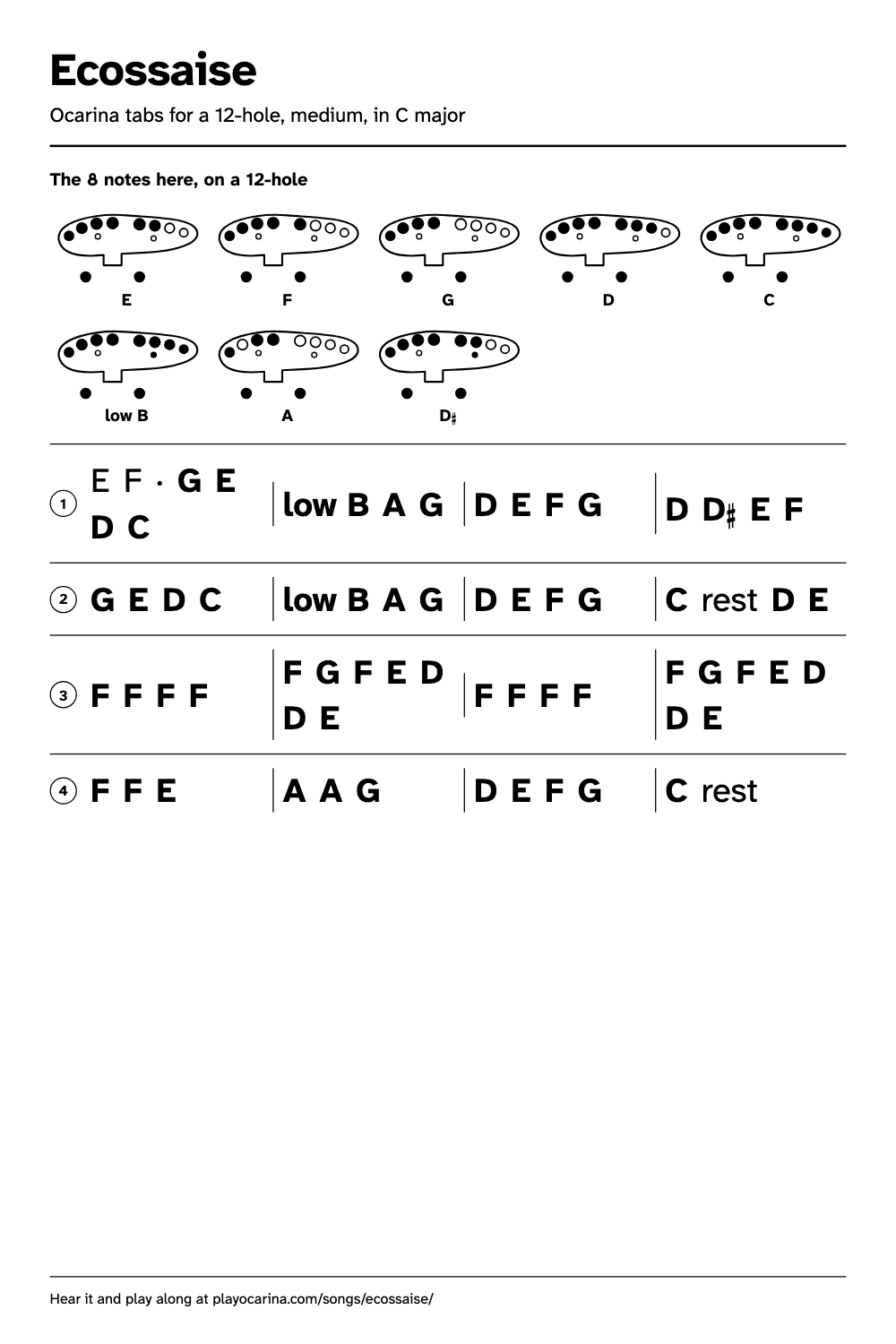
On a 12-hole it starts E, F, G, E. Medium, 64 notes, in C major.
Goes down to low B, so it does not fit a 6-hole or 4-hole.
Ecossaise
Bar 1 of 16
What are the notes for Ecossaise?
On a 12-hole. Read left to right, a line at a time.
- EF GEDCTricky spot:low BAGDEFGDD♯EF
- GEDClow BAGDEFGCrestDE
- FFFFFGFEDDEFFFFFGFEDDE
- FFEAAGDEFGCrest
The Ecossaise starts with two quick notes, then falls from G to E, D and C, on down to a low B, and leaps up to a long high A. It is moved here from G major up to C major, so it fits a 12-hole ocarina, from low B to high A, with D♯ the only sharp. Both halves of the dance are played once, 16 bars, without their repeats.
What is the tricky spot in Ecossaise?
The second bar and again the sixth, where the tune leaps from a half-beat low B up to a longer high A, the lowest and the highest notes of the whole tune. On a 12-hole, Ecossaise goes from low B to A: you lift the left ring, right index, right middle, right ring, right pinky and right sub-hole.
The low B lasts half a beat and the high A a full beat, so the jump is a change of breath as much as of fingers: play the B softly and have the air ready for the A, which needs a firmer breath. Practise B, A and then the G that follows by themselves, slowly, until the A speaks cleanly without a squeak. The other thing to loosen up is bar 4, where the tune goes D, D♯, E, F: the D♯ is the one note outside C major, held for a whole beat before the quick E and F. Check the D♯ fingering on the 12-hole chart before you play it in time. In the second half, the F is repeated four times in bars 9 and 11: tongue each one with a soft "du" and keep your fingers still. The pairs of sixteenth notes (E and F before the first bar, D and E before bar 9) are a quick short-short step into the next bar, so land the next note on the beat rather than rushing it.
Where do you breathe in Ecossaise?
The best place is the rest in bar 8, after the C that ends the first half: it is a full beat, so take a proper breath before the second half begins. In the second half, a quick breath after the G in bar 14 helps before the last climb, D, E, F, G.
Which ocarina can play Ecossaise?
A 6-hole or 4-hole ocarina cannot reach low B, so play Ecossaise in this key on a 12-hole ocarina in C. On an ocarina in G or F, use the same fingerings: the tune sounds in a different key, which is fine when you play alone. The linked chart has every fingering, and you can check your notes with a tuner such as our free ocarina tuner.
The 8 notes here, on a 12-holeHoles in words, with a picture
| Note | Holes to cover | Picture |
|---|---|---|
| E | Cover every main hole but the right ring and right pinky | |
| F | Cover every main hole but the right middle, right ring and right pinky | |
| G | Cover every main hole but the right index, right middle, right ring and right pinky | |
| D | Cover every main hole but the right pinky | |
| C | Cover every main hole | |
| low B | Cover every main hole, plus the right sub-hole | |
| A | Cover the left pinky, left middle, left index, left thumb and right thumb | |
| D♯ | Cover every main hole but the right ring and right pinky, plus the right sub-hole |
Drawn as you see it while playing: mouthpiece towards you, left hand on the left.
Did Beethoven write the Ecossaise for the piano?
Not originally. Beethoven wrote it around 1810 for a military band, and that version is lost; what survives is a piano arrangement by Carl Czerny, printed in Vienna in 1834 in Czerny's Musikalisches Pfennig-Magazin. Czerny, who died in 1857, was one of Beethoven's best-known pupils. Our tabs follow the Breitkopf & Härtel complete edition of Beethoven's works, which prints the piano version on one page headed "Ecossaise für das Pianoforte von L. van Beethoven", with no date; IMSLP catalogues it between 1862 and 1890. An écossaise, French for "Scottish", is a country dance in 2/4 that was popular in France and Britain around 1800. This one has two strains of eight bars, each printed with a repeat. We play each strain once and leave out the left hand and the chord notes under the tune in the second strain. We show the melody only. Music: Ludwig van Beethoven (1770-1827), WoO 23; piano arrangement by Carl Czerny (1791-1857).