La donna è mobile on the ocarina
On a 12-hole it starts F♯, F♯, F♯, A. Medium, 48 notes, in D major.
Goes down to low A, so it does not fit a 6-hole or 4-hole.
La donna è mobile
Bar 1 of 16
What are the notes for La donna è mobile?
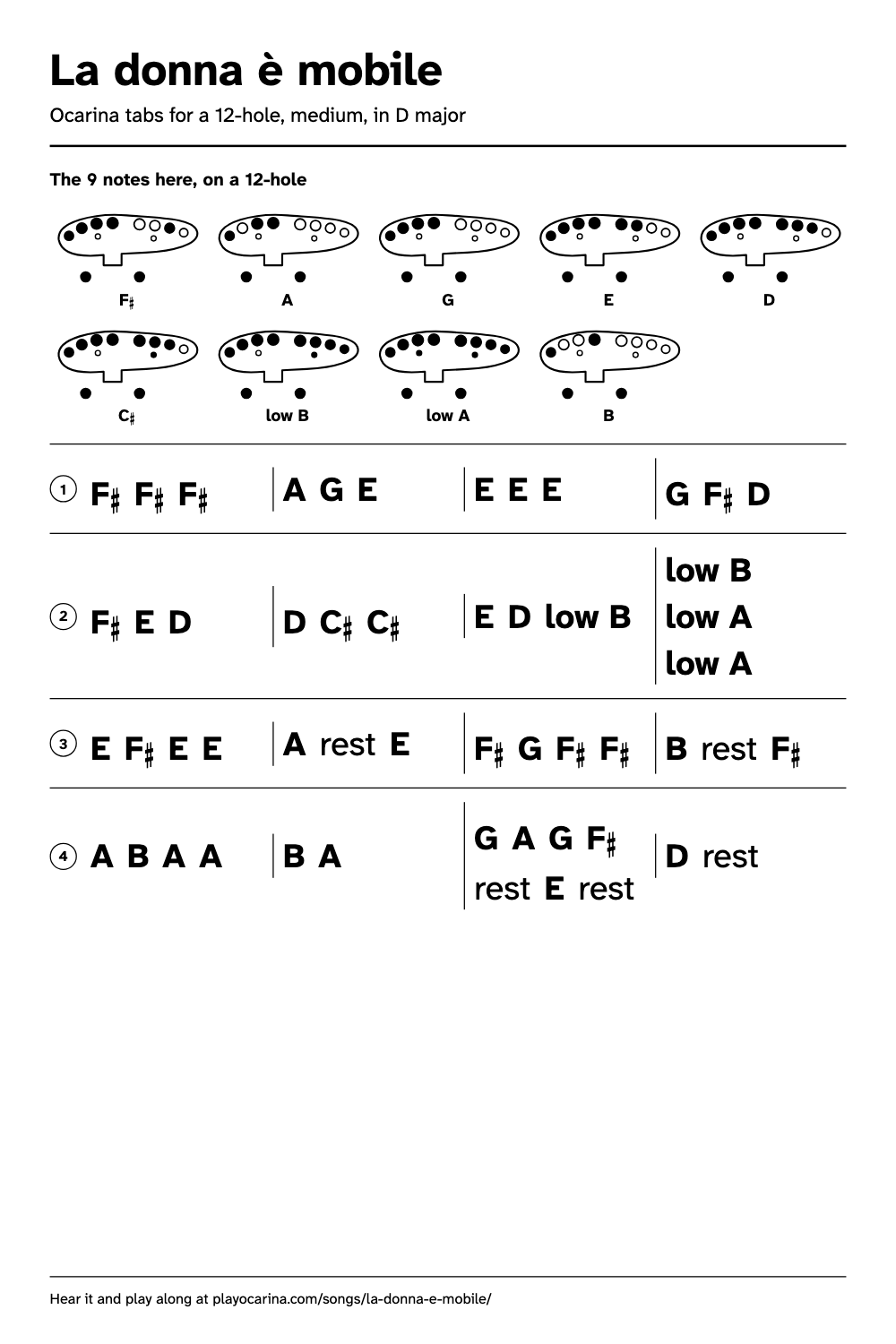
On a 12-hole. Read left to right, a line at a time.
- F♯F♯F♯AGEEEEGF♯D
- F♯EDDC♯C♯EDlow Blow Blow Alow A
- EF♯EEArestETricky spot:F♯GF♯F♯BrestF♯
- ABAABAGAGF♯restErestDrest
La donna è mobile is the Duke's song from Rigoletto: three even notes on one pitch, then a quick pair that tumbles down to a longer note, over a light three-in-a-bar bounce. It is moved here from B major to D major, so it runs from low A up to high B, which puts it on a 12-hole ocarina. This is the first verse once, eight bars, then the refrain that follows it, eight bars more, 16 in all. The printing gives each quick pair a dotted-sixteenth-and-thirty-second rhythm, too fine for our beat grid, so the tabs play each pair as two even sixteenths; its grace notes are left out.
What is the tricky spot in La donna è mobile?
The twelfth bar, where the tune leaps up from F♯ to the top note of the page, B, for a single sixteenth before a short rest. On a 12-hole, La donna è mobile goes from F♯ to B: you lift the left ring, left middle and right ring.
The B comes in as the tune climbs through the refrain, so it is worth a firm, quick breath, then ease off for the F♯ that follows. Set your fingers for the leap before you play it: practise F♯ up to B on its own, slowly, until the B speaks cleanly, then add the sixteenth rest after it, which is there to let the sound stop. The same pattern, short notes then one long note, comes back in bars 2, 4, 10 and 12, so once it is under your fingers it repeats. The last bars of the verse go down to low B and A, which take the sub-holes: cover them fully and play those long A notes gently.
Where do you breathe in La donna è mobile?
After the quarter note that ends each pair of bars: the E, D, C♯ and A in the verse and the E and F♯ in the refrain. If you want fewer breaths, take them after bars 4 and 8, then after bars 12 and 16.
Which ocarina can play La donna è mobile?
A 6-hole or 4-hole ocarina cannot reach low A and low B, so play La donna è mobile in this key on a 12-hole ocarina in C. On an ocarina in G or F, use the same fingerings: the tune sounds in a different key, which is fine when you play alone. The linked chart has every fingering, and you can check your notes with a tuner such as our free ocarina tuner.
The 9 notes here, on a 12-holeHoles in words, with a picture
| Note | Holes to cover | Picture |
|---|---|---|
| F♯ | Cover every main hole but the right index, right middle and right pinky | |
| A | Cover the left pinky, left middle, left index, left thumb and right thumb | |
| G | Cover every main hole but the right index, right middle, right ring and right pinky | |
| E | Cover every main hole but the right ring and right pinky | |
| D | Cover every main hole but the right pinky | |
| C♯ | Cover every main hole but the right pinky, plus the right sub-hole | |
| low B | Cover every main hole, plus the right sub-hole | |
| low A | Cover every main hole, plus the left sub-hole and right sub-hole | |
| B | Cover the left pinky, left index, left thumb and right thumb |
Drawn as you see it while playing: mouthpiece towards you, left hand on the left.
Why did Verdi make the tenor promise not to whistle it?
Verdi gave the aria to the tenor, Raffaele Mirate, only shortly before the 1851 premiere in Venice, and had him promise not to sing or whistle it outside rehearsals. He knew it was catchy: people were singing it in the streets the day after the premiere. Schirmer's vocal score shows how simple it is under the dance: the eight bars of the first verse are printed again, with the same notes, for the second verse, and the refrain that follows is built from the same shapes, climbing higher. Our tabs follow that score: the Duke's vocal line only, moved from B major to D major. A second Schirmer printing, of 1913, has the same tune in the same key and gives Verdi's dates as 1813 to 1901. Music: Giuseppe Verdi (1813-1901), the Duke's canzone in Act III of his opera Rigoletto, first performed in Venice in 1851.