Eine kleine Nachtmusik on the ocarina
On a 12-hole it starts F, C, F, C. Medium, 57 notes, in F major.
Eine kleine Nachtmusik
Bar 1 of 10
What are the notes for Eine kleine Nachtmusik?
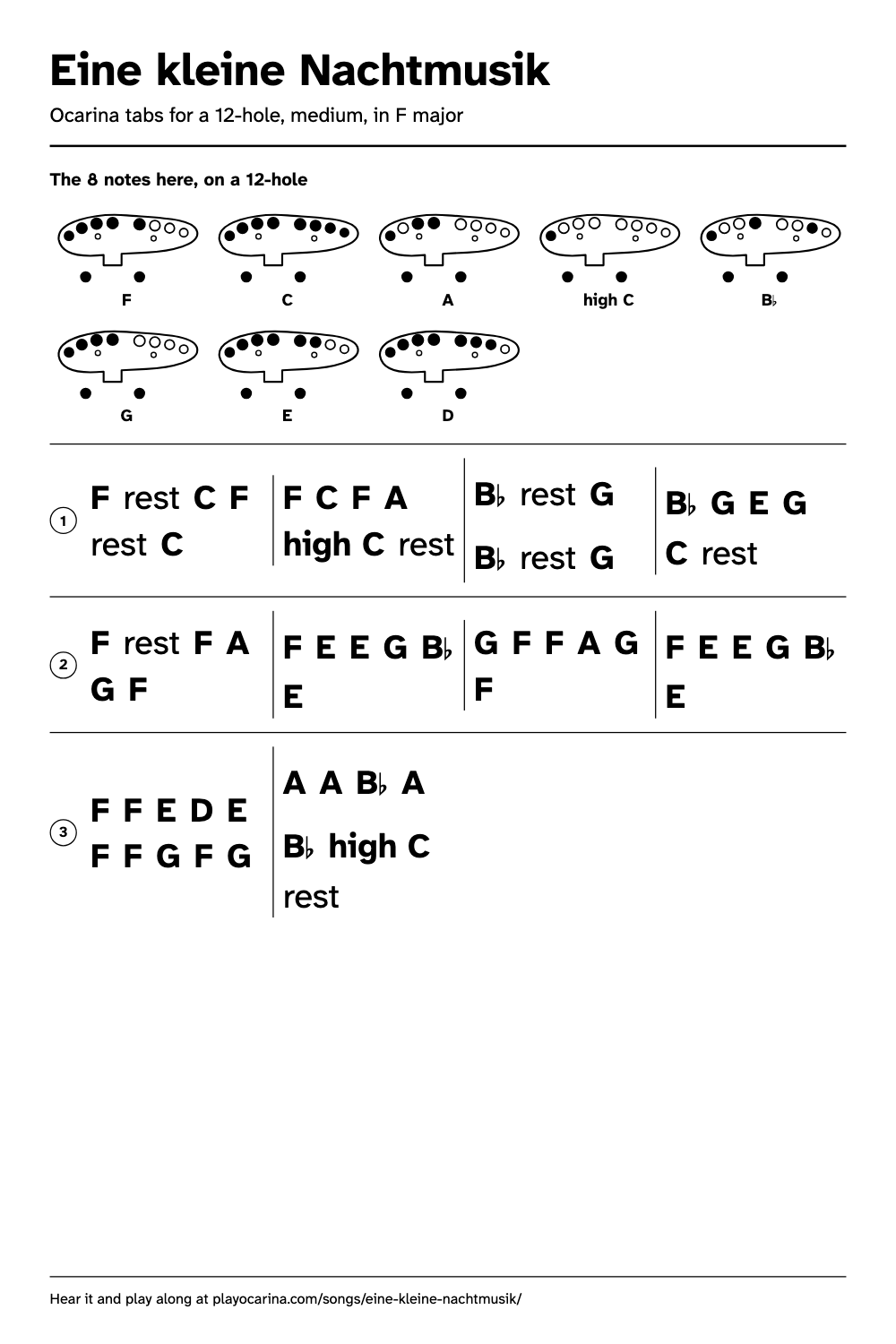
On a 12-hole. Read left to right, a line at a time.
- FrestCFrestCFCFAhigh CrestB♭restGB♭restGB♭GEGCrest
- FrestFAGFTricky spot:FEEGB♭EGFFAGFFEEGB♭E
- FFEDEFFGFGAAB♭AB♭high Crest
Eine kleine Nachtmusik opens with F, down to low C and back to F, twice, then races up F, C, F, A to high C: a rising flourish everyone recognises. The second phrase answers on B flat and G and settles on low C. Here is Mozart's opening theme in F major, ten bars of 4/4 within one octave, C to high C, so it fits a 4-hole, a 6-hole and a 12-hole ocarina.
What is the tricky spot in Eine kleine Nachtmusik?
The drop from B flat down to E at the end of bars 6 and 8, an awkward interval right after the cross-fingered B flat. On a 12-hole, Eine kleine Nachtmusik goes from B♭ to E: you lift the right ring and cover the left ring, left middle, right index and right middle. On a 6-hole or 4-hole, you lift the right index and cover the left middle, right middle and left index.
Bars 6 and 8 end G, B flat, E, three quick eighth notes that go up and then fall away. Finger the B flat cleanly, then lift straight to the E without passing through other notes; practise just those two notes back and forth until the change is one movement. The opening bars need crisp, short notes: tongue each one with a light "tu" and keep the rests silent, which is what makes the theme sound like Mozart rather than a scale. In bars 9 and 10, the pairs of sixteenths make little turns: E, D, E and G, F, G, then B flat, A, B flat; play them lightly and evenly, and slow the whole tune down until they fit.
Which ocarina can play Eine kleine Nachtmusik?
Any 12-hole, 6-hole or 4-hole ocarina in C plays Eine kleine Nachtmusik in this key. On an ocarina in G or F, use the same fingerings: the tune sounds in a different key, which is fine when you play alone. Each linked chart has every fingering for its ocarina, and you can check your notes with a tuner such as our free ocarina tuner.
The 8 notes here, on a 12-holeHoles in words, with a picture
| Note | Holes to cover | Picture |
|---|---|---|
| F | Cover every main hole but the right middle, right ring and right pinky | |
| C | Cover every main hole | |
| A | Cover the left pinky, left middle, left index, left thumb and right thumb | |
| high C | Cover the left pinky, left thumb and right thumb | |
| B♭ | Cover the left pinky, left index, right ring, left thumb and right thumb | |
| G | Cover every main hole but the right index, right middle, right ring and right pinky | |
| E | Cover every main hole but the right ring and right pinky | |
| D | Cover every main hole but the right pinky |
Drawn as you see it while playing: mouthpiece towards you, left hand on the left.
| Note | Holes to cover | Picture |
|---|---|---|
| F | Cover every hole but the right middle and right index | |
| C | Cover every hole | |
| A | Cover the left index, left thumb and right thumb | |
| high C | Cover the left thumb and right thumb | |
| B♭ | Cover the right index, left thumb and right thumb | |
| G | Cover every hole but the left middle and right middle | |
| E | Cover every hole but the right index | |
| D | Cover every hole but the right middle |
Drawn as you see it while playing: mouthpiece towards you, left hand on the left.
| Note | Holes to cover | Picture |
|---|---|---|
| F | Cover the left middle and left index | |
| C | Cover every hole | |
| A | Cover the left index | |
| high C | All holes open | |
| B♭ | Cover the right index | |
| G | Cover the left index and right index | |
| E | Cover every hole but the right index | |
| D | Cover every hole but the right middle |
Drawn as you see it while playing: mouthpiece towards you, left hand on the left.
When did Mozart write Eine kleine Nachtmusik?
In 1787. Mozart completed it in Vienna on 10 August 1787, while he was working on the second act of Don Giovanni, and the name comes from the entry he made in his own catalogue. It was not printed in his lifetime: the publisher Johann André of Offenbach brought it out around 1827, after Mozart's widow Constanze sold him a large bundle of her husband's compositions. Our tabs follow André's edition, whose title page calls it No. 2 of the posthumous works, printed from the original manuscript, in a later printing from the same plates. We teach the first violin's opening ten bars, moved down a tone from G major to F major, without the grace notes and trills. Mozart died in 1791. We show the melody only. Music: Wolfgang Amadeus Mozart (1756-1791), the opening of his Serenade No. 13 in G major, K. 525, 1787.