Entry of the Gladiators on the ocarina
On a 12-hole it starts high D, high C♯, high C, high C♯. Hard, 44 notes, in D major.
Goes up to high D, so it does not fit a 4-hole.
Entry of the Gladiators
Bar 1 of 8
What are the notes for Entry of the Gladiators?
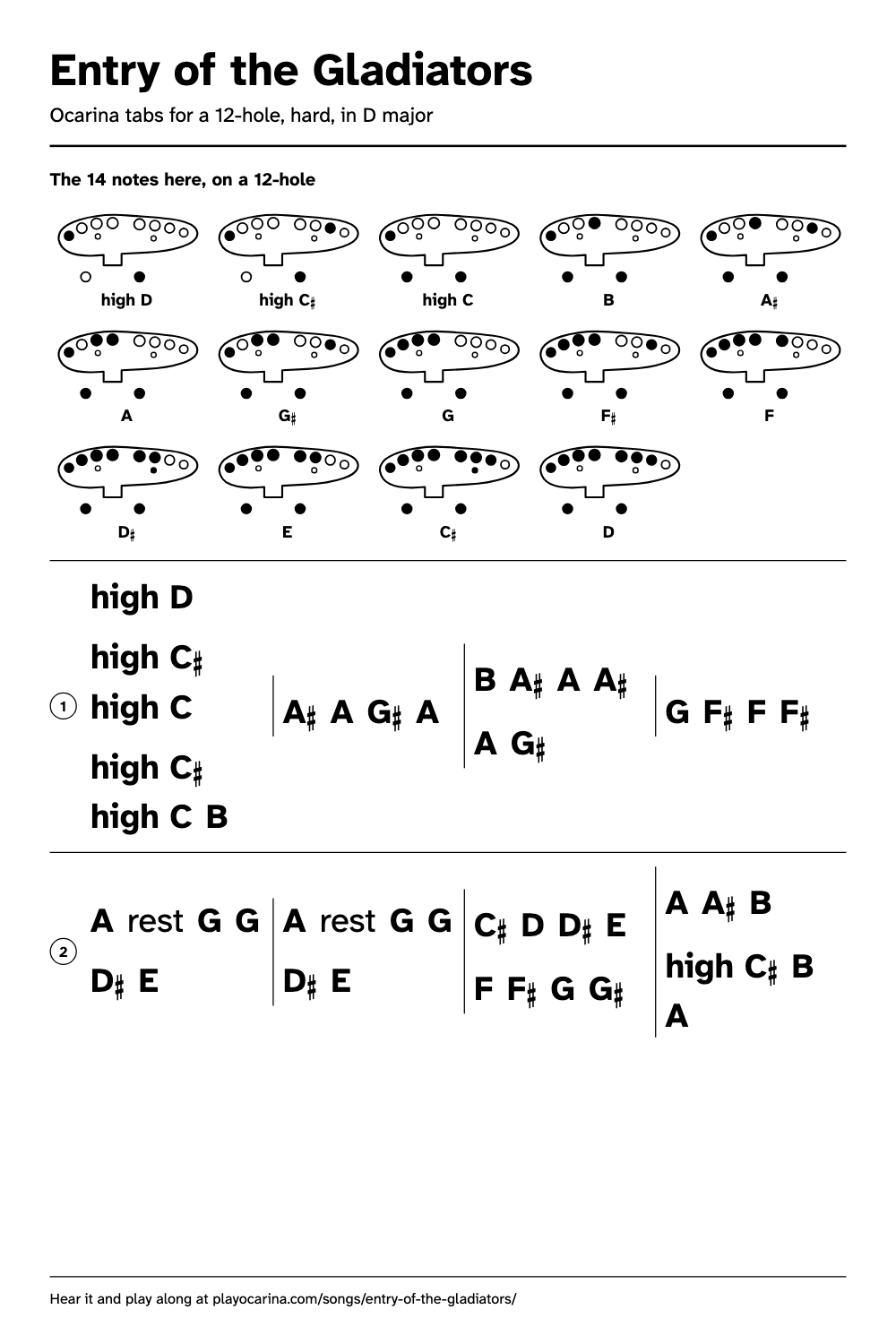
On a 12-hole. Read left to right, a line at a time.
- high Dhigh C♯high Chigh C♯high CBA♯AG♯ABA♯AA♯AG♯GF♯FF♯
- ArestGGD♯EArestGGD♯ETricky spot:C♯DD♯EFF♯GG♯AA♯Bhigh C♯BA
Entry of the Gladiators is the circus march, and this page teaches only its main theme: the first eight bars of the opening strain, in D major with many half steps, from C sharp up to high D. The tune falls by half steps, stops for two short rests, then ends in a quick chromatic climb. It is a hard one for a first tune, so start slowly.
What is the hardest part of Entry of the Gladiators?
The run in the seventh bar, eight eighth notes climbing by half steps from C sharp to G sharp, where every finger pattern changes. On a 12-hole, Entry of the Gladiators goes from C♯ to D: you lift the right sub-hole. On a 6-hole, you keep the same fingering.
Practise the run at a crawl, one note to each count, and speed up only when every note speaks cleanly. The two bars before it each have an eighth rest, so use the one in the sixth bar to take a full breath for the run. After the run the tune finishes with a quick climb to high C sharp and a fall back to A.
Where do you breathe in Entry of the Gladiators?
At the eighth rest near the start of the fifth and sixth bars, and again before the run in the seventh. The theme is short, so a breath at every rest is enough.
Which ocarina can play Entry of the Gladiators?
A 4-hole ocarina cannot reach high C♯ and high D, so play Entry of the Gladiators in this key on a 12-hole or 6-hole ocarina in C. On an ocarina in G or F, use the same fingerings: the tune sounds in a different key, which is fine when you play alone. Each linked chart has every fingering for its ocarina, and you can check your notes with a tuner such as our free ocarina tuner.
The 14 notes here, on a 12-holeHoles in words, with a picture
| Note | Holes to cover | Picture |
|---|---|---|
| high D | Cover the left pinky and right thumb | |
| high C♯ | Cover the left pinky, right ring and right thumb | |
| high C | Cover the left pinky, left thumb and right thumb | |
| B | Cover the left pinky, left index, left thumb and right thumb | |
| A♯ | Cover the left pinky, left index, right ring, left thumb and right thumb | |
| A | Cover the left pinky, left middle, left index, left thumb and right thumb | |
| G♯ | Cover every main hole but the left ring, right index, right middle and right pinky | |
| G | Cover every main hole but the right index, right middle, right ring and right pinky | |
| F♯ | Cover every main hole but the right index, right middle and right pinky | |
| F | Cover every main hole but the right middle, right ring and right pinky | |
| D♯ | Cover every main hole but the right ring and right pinky, plus the right sub-hole | |
| E | Cover every main hole but the right ring and right pinky | |
| C♯ | Cover every main hole but the right pinky, plus the right sub-hole | |
| D | Cover every main hole but the right pinky |
Drawn as you see it while playing: mouthpiece towards you, left hand on the left.
| Note | Holes to cover | Picture |
|---|---|---|
| high D | Cover the left thumb | |
| high C♯ | Cover the right middle and left thumb | |
| high C | Cover the left thumb and right thumb | |
| B | Cover the right middle, left thumb and right thumb | |
| A♯ | Cover the right index, left thumb and right thumb | |
| A | Cover the left index, left thumb and right thumb | |
| G♯ | Cover every hole but the left middle and right index | |
| G | Cover every hole but the left middle and right middle | |
| F♯ | Cover every hole but the left middle | |
| F | Cover every hole but the right middle and right index | |
| D♯ | Cover the left middle, right middle, left index, left thumb and right thumb; half-cover the right index | |
| E | Cover every hole but the right index | |
| C♯ | Cover the left middle, left index, right index, left thumb and right thumb; half-cover the right middle | |
| D | Cover every hole but the right middle |
Drawn as you see it while playing: mouthpiece towards you, left hand on the left.
Where does Entry of the Gladiators come from?
Julius Fučík wrote the march in Sarajevo on 17 October 1897, where he was an army bandmaster, and first called it Grande Marche Chromatique. He renamed it for the gladiators' entrance in the novel Quo Vadis. It is best known today as circus music, and a 1901 band arrangement gave it the name Thunder and Blazes. Our tabs follow the 1903 piano edition printed in London; IMSLP dates the first band printing to 1899. We show the melody only. Music: Julius Fučík (1872-1916), written in 1897.