Flower Duet on the ocarina
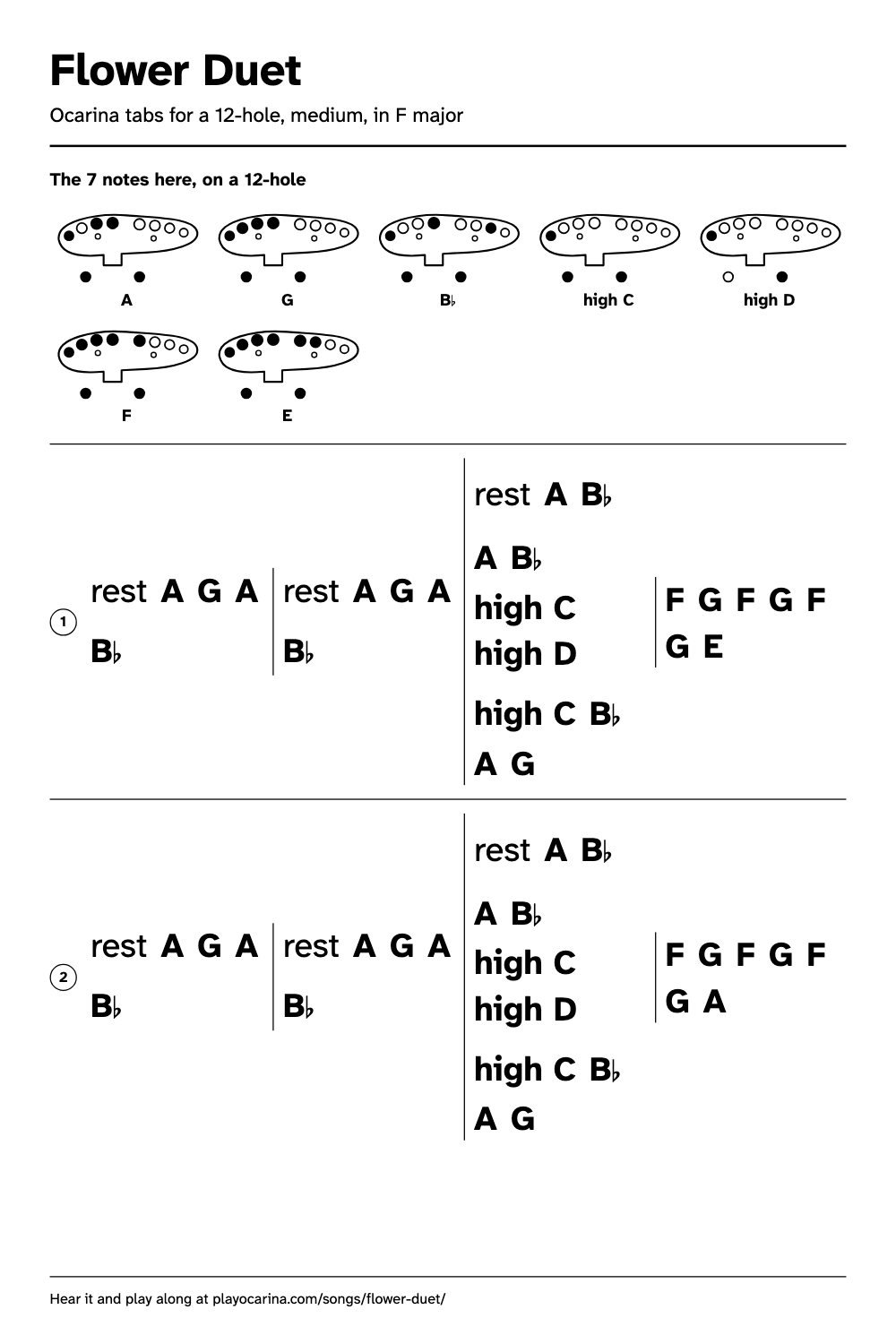
On a 12-hole it starts A, G, A, B♭. Medium, 50 notes, in F major.
Goes up to high D, so it does not fit a 4-hole.
Flower Duet
Bar 1 of 8
What are the notes for the Flower Duet?
On a 12-hole. Read left to right, a line at a time.
- Tricky spot:restAGAB♭restAGAB♭restAB♭AB♭high Chigh Dhigh CB♭AGFGFGFGE
- restAGAB♭restAGAB♭restAB♭AB♭high Chigh Dhigh CB♭AGFGFGFGA
The Flower Duet from Lakmé opens on a long A, then G, A and B♭, a gentle sway that comes twice before a quick run climbs to high D and rocks back down to a long E. Here is its opening theme, the soprano's line from the first eight bars of the main tune, in F major and 6/8, moved up from Delibes's B major so it sits between E and high D. It fits a 6-hole or a 12-hole ocarina.
What is the tricky spot in the Flower Duet?
The runs in bars 3 and 7, where the tune rocks between A and B♭ in quick notes before it climbs to high D. On a 12-hole, the Flower Duet goes from A to B♭: you swap hands: lift the left middle and cover the right ring. On a 6-hole, you swap hands: lift the left index and cover the right index.
B♭ is a cross-fingered note, so each A to B♭ change moves more than one finger at once, and in a run of quick notes that is where slips happen. Play just A, B♭, A, B♭ slowly and evenly until the fingers move together, then add C and high D on top. Keep the air steady through the run and let the long notes either side of it float.
Which ocarina can play the Flower Duet?
A 4-hole ocarina cannot reach high D, so play the Flower Duet in this key on a 12-hole or 6-hole ocarina in C. On an ocarina in G or F, use the same fingerings: the tune sounds in a different key, which is fine when you play alone. Each linked chart has every fingering for its ocarina, and you can check your notes with a tuner such as our free ocarina tuner.
The 7 notes here, on a 12-holeHoles in words, with a picture
| Note | Holes to cover | Picture |
|---|---|---|
| A | Cover the left pinky, left middle, left index, left thumb and right thumb | |
| G | Cover every main hole but the right index, right middle, right ring and right pinky | |
| B♭ | Cover the left pinky, left index, right ring, left thumb and right thumb | |
| high C | Cover the left pinky, left thumb and right thumb | |
| high D | Cover the left pinky and right thumb | |
| F | Cover every main hole but the right middle, right ring and right pinky | |
| E | Cover every main hole but the right ring and right pinky |
Drawn as you see it while playing: mouthpiece towards you, left hand on the left.
| Note | Holes to cover | Picture |
|---|---|---|
| A | Cover the left index, left thumb and right thumb | |
| G | Cover every hole but the left middle and right middle | |
| B♭ | Cover the right index, left thumb and right thumb | |
| high C | Cover the left thumb and right thumb | |
| high D | Cover the left thumb | |
| F | Cover every hole but the right middle and right index | |
| E | Cover every hole but the right index |
Drawn as you see it while playing: mouthpiece towards you, left hand on the left.
Where does the Flower Duet come from?
From Delibes's opera Lakmé, which opened at the Opéra-Comique in Paris on 14 April 1883. In the first act Lakmé, a Brahmin priest's daughter, and her servant Mallika sing it as they go to gather flowers by a river. Our tabs follow Lakmé's line on pages 22 and 23 of the 1883 Heugel vocal score, which names Marie van Zandt as Lakmé; the rippling figure under it is Mallika's part. An adaptation was used in a British Airways advertisement in 1989. Delibes died in 1891. We show the melody only. Music: Léo Delibes (1836-1891), the duet for Lakmé and Mallika in Act 1 of his opera Lakmé, 1883.