Gnossienne No. 1 on the ocarina
On a 12-hole it starts A, high C, B, A. Medium, 28 notes, in D minor.
Goes up to high D, so it does not fit a 4-hole.
Gnossienne No. 1
Bar 1 of 13
What are the notes for Gnossienne No. 1?
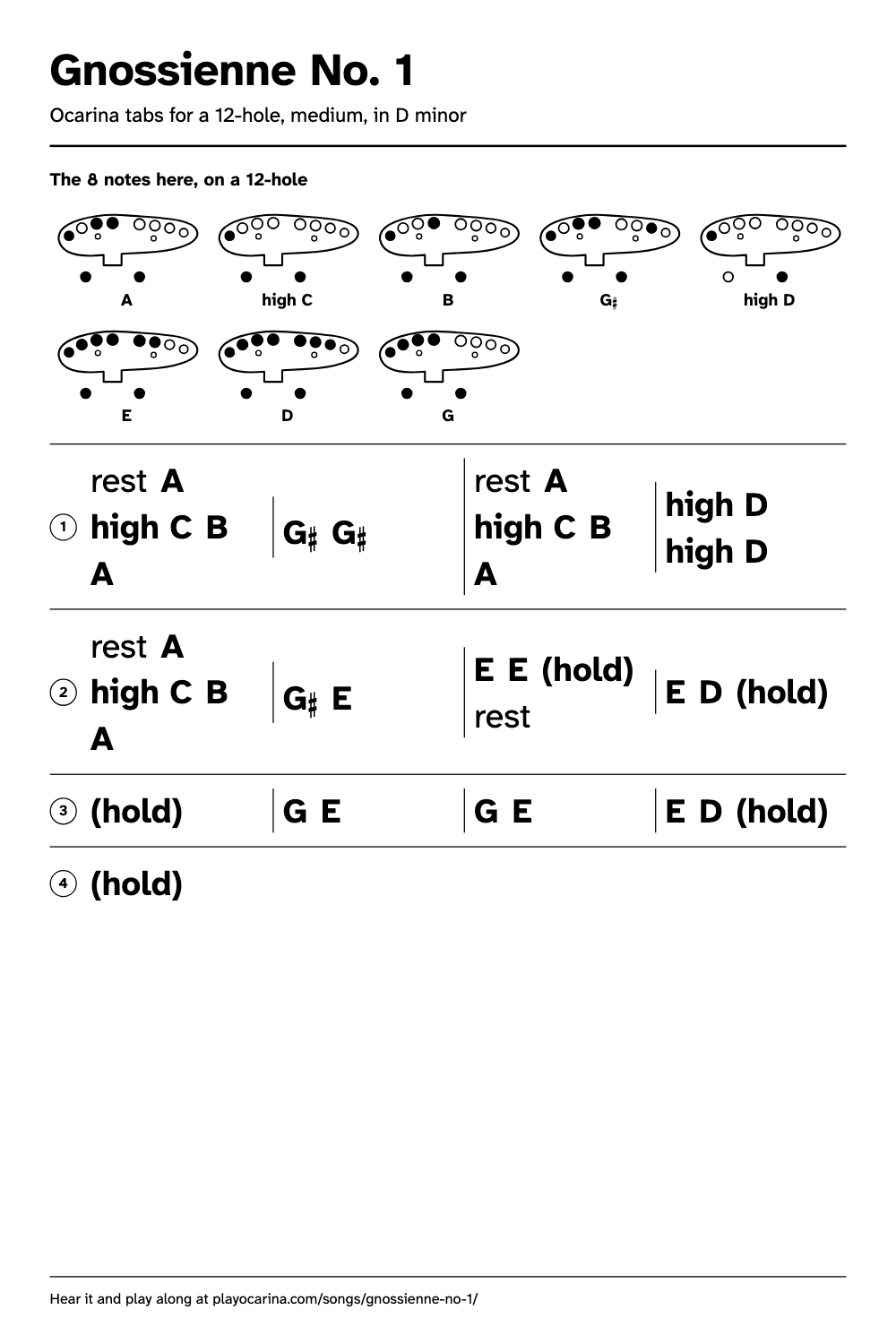
On a 12-hole. Read left to right, a line at a time.
- Tricky spot:restAhigh CBAG♯G♯restAhigh CBAhigh Dhigh D
- restAhigh CBAG♯EEE(hold)restED(hold)
- (hold)GEGEED(hold)
- (hold)
Gnossienne No. 1 starts after a rest with A and high C, steps down through B and A, and settles on a long G sharp: a slow, hovering tune Satie marked "Lent", slow. Here is its opening theme and the "Très luisant" phrase that answers it, 13 bars in D minor, from D up to high D. Satie printed it with no bar lines or time signature, so we group it in bars of four beats, one for each low F his left hand plays, and every one of his slurred phrases fills whole bars. He also puts a quick grace note before almost every long note; we leave those out.
What is the tricky spot in Gnossienne No. 1?
The second bar, where the opening turn of A, high C, B and A slips down a half step to G sharp and holds it. On a 12-hole, Gnossienne No. 1 goes from A to G♯: you cover the right ring. On a 6-hole, you cover the right middle.
G sharp is the only note in the piece that is not a white key, so it takes a cross-fingering: practise A then G sharp slowly until the half step sounds small and clean, not like a drop to G. It comes back in bar 6, just before the fall to E. The tune has no beat you can tap along to in the printing, so count our four slow beats in every bar, and let each long D at the end of a phrase last the full seven beats before you breathe.
Which ocarina can play Gnossienne No. 1?
A 4-hole ocarina cannot reach high D, so play Gnossienne No. 1 in this key on a 12-hole or 6-hole ocarina in C. On an ocarina in G or F, use the same fingerings: the tune sounds in a different key, which is fine when you play alone. Each linked chart has every fingering for its ocarina, and you can check your notes with a tuner such as our free ocarina tuner.
The 8 notes here, on a 12-holeHoles in words, with a picture
| Note | Holes to cover | Picture |
|---|---|---|
| A | Cover the left pinky, left middle, left index, left thumb and right thumb | |
| high C | Cover the left pinky, left thumb and right thumb | |
| B | Cover the left pinky, left index, left thumb and right thumb | |
| G♯ | Cover every main hole but the left ring, right index, right middle and right pinky | |
| high D | Cover the left pinky and right thumb | |
| E | Cover every main hole but the right ring and right pinky | |
| D | Cover every main hole but the right pinky | |
| G | Cover every main hole but the right index, right middle, right ring and right pinky |
Drawn as you see it while playing: mouthpiece towards you, left hand on the left.
| Note | Holes to cover | Picture |
|---|---|---|
| A | Cover the left index, left thumb and right thumb | |
| high C | Cover the left thumb and right thumb | |
| B | Cover the right middle, left thumb and right thumb | |
| G♯ | Cover every hole but the left middle and right index | |
| high D | Cover the left thumb | |
| E | Cover every hole but the right index | |
| D | Cover every hole but the right middle | |
| G | Cover every hole but the left middle and right middle |
Drawn as you see it while playing: mouthpiece towards you, left hand on the left.
When did Satie write Gnossienne No. 1?
Around 1890. Satie wrote the three Gnossiennes around 1890 and first printed them in 1893, Nos. 1 and 3 in the magazine Le Figaro musical, with no time signatures and no bar lines. The three appeared together, numbered as we know them, in 1913: our tabs follow that 1913 printing by Rouart, Lerolle and Cie, which heads the piece "(1890)" and dedicates it to Roland-Manuel. The tabs are its opening theme. Satie died in 1925. We show the melody only. Music: Erik Satie (1866-1925), the first of his three Gnossiennes, about 1890.