Funeral March on the ocarina
On a 12-hole it starts D, D, D, D. Medium, 53 notes, in D minor.
Goes up to high D, so it does not fit a 4-hole.
Funeral March
Bar 1 of 10
What are the notes for the Funeral March?
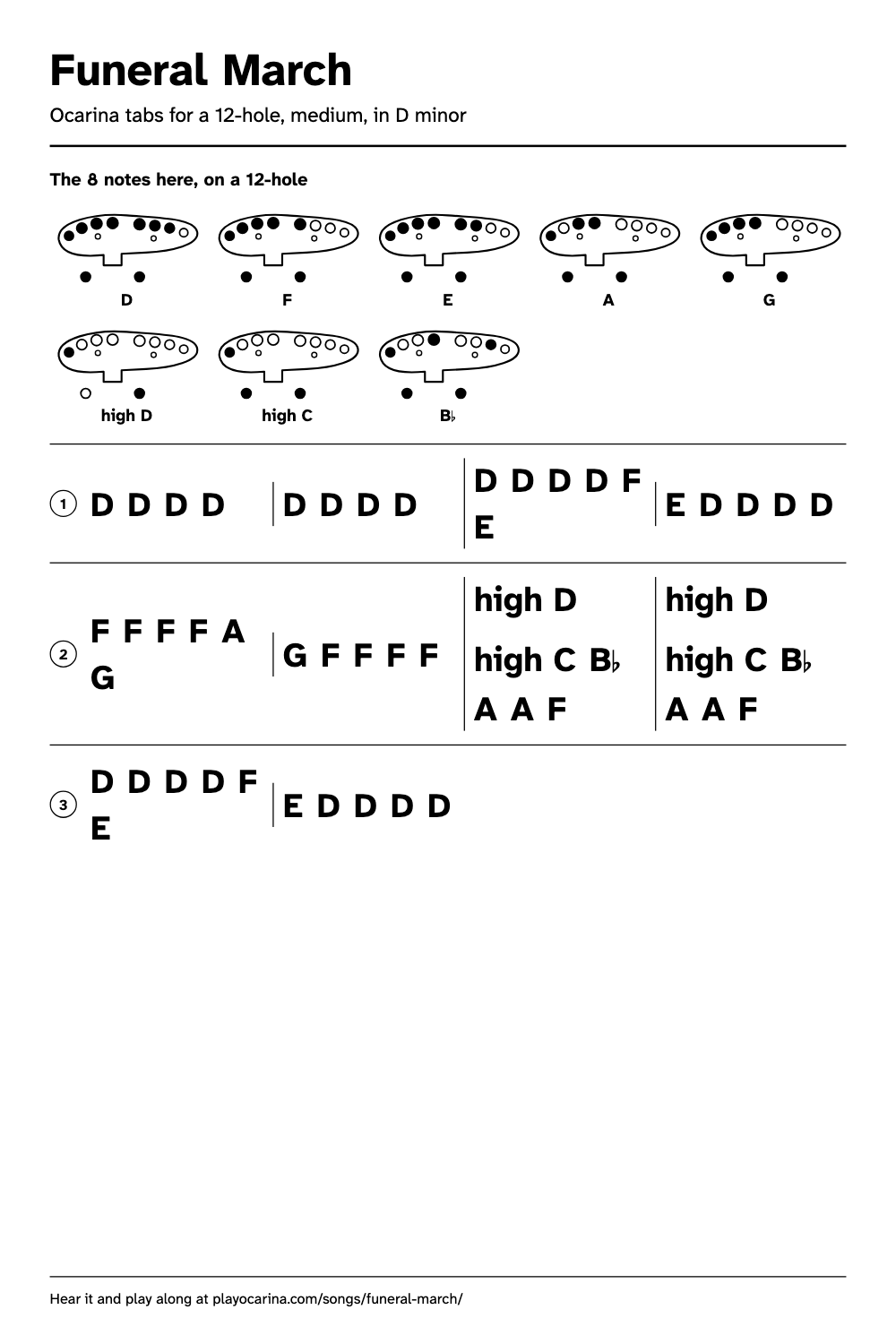
On a 12-hole. Read left to right, a line at a time.
- DDDDDDDDDDDDFEEDDDD
- FFFFAGTricky spot:GFFFFhigh Dhigh CB♭AAFhigh Dhigh CB♭AAF
- DDDDFEEDDDD
Chopin's Funeral March is the slow tread everyone knows: one note repeated in a dotted rhythm, D, D-da, then a long D, before the tune lifts to F. Here is its opening strain, the first 10 bars of the march, in D minor and in the printing's dotted rhythm. The rest of the march climbs more than two octaves above that first note, too wide for any ocarina, so the tabs stop where the strain comes to rest on a long D.
What is the hardest part of the Funeral March?
The leap from F up to high D that opens the seventh bar and again the eighth: the widest jump and the highest note in the tune. On a 12-hole, the Funeral March goes from F to high D: you lift the left ring, left middle, left index, right index and left thumb. On a 6-hole, you lift the left middle, left index and right thumb.
Most of the march stays on one or two notes, so the leap stands out: blow a little faster for the high D, then let the line fall step by step through C, B flat and A back to F. The rest of the work is rhythm. Each dotted pair is a long note and a very short one, three quarters of a beat and one quarter, so tongue the short note late and lightly, right before the next beat, rather than evening the pair out. Bars 7 and 8 are the same, and so are bars 3 and 4 and bars 9 and 10, so there are only five different bars to learn.
Where do you breathe in the Funeral March?
Breathe after each long D that closes a bar, at the end of bars 1, 2, 4 and 10, and after the long F that ends bar 6. Bars 7 and 8 have no long note, so take a full breath before the first leap to high D and a quick one before the second.
Which ocarina can play the Funeral March?
A 4-hole ocarina cannot reach high D, so play the Funeral March in this key on a 12-hole or 6-hole ocarina in C. On an ocarina in G or F, use the same fingerings: the tune sounds in a different key, which is fine when you play alone. Each linked chart has every fingering for its ocarina, and you can check your notes with a tuner such as our free ocarina tuner.
The 8 notes here, on a 12-holeHoles in words, with a picture
| Note | Holes to cover | Picture |
|---|---|---|
| D | Cover every main hole but the right pinky | |
| F | Cover every main hole but the right middle, right ring and right pinky | |
| E | Cover every main hole but the right ring and right pinky | |
| A | Cover the left pinky, left middle, left index, left thumb and right thumb | |
| G | Cover every main hole but the right index, right middle, right ring and right pinky | |
| high D | Cover the left pinky and right thumb | |
| high C | Cover the left pinky, left thumb and right thumb | |
| B♭ | Cover the left pinky, left index, right ring, left thumb and right thumb |
Drawn as you see it while playing: mouthpiece towards you, left hand on the left.
| Note | Holes to cover | Picture |
|---|---|---|
| D | Cover every hole but the right middle | |
| F | Cover every hole but the right middle and right index | |
| E | Cover every hole but the right index | |
| A | Cover the left index, left thumb and right thumb | |
| G | Cover every hole but the left middle and right middle | |
| high D | Cover the left thumb | |
| high C | Cover the left thumb and right thumb | |
| B♭ | Cover the right index, left thumb and right thumb |
Drawn as you see it while playing: mouthpiece towards you, left hand on the left.
Was the Funeral March played at Chopin's funeral?
Yes: an orchestral arrangement of it was played at the graveside when Chopin was buried, on 30 October 1849. He wrote the march before the rest of the work, probably in 1837, and made it the third movement of his Piano Sonata No. 2, which came out in May 1840 in Leipzig, Paris and London. Our tabs follow Breitkopf & Härtel's first German edition, whose title page names Troupenas in Paris and Wessel in London beside it. In that printing the tune starts in the left hand and passes to the right hand in the third bar; we play it as one line, moved up from B flat minor. Chopin died in 1849. The piece has no words. Music: Frédéric Chopin (1810-1849), the march from the third movement of his Piano Sonata No. 2, published in 1840.