Mozart's Symphony No. 40 on the ocarina
On a 12-hole it starts F, E, E, F. Medium, 40 notes, in A minor.
Mozart's Symphony No. 40
Bar 1 of 8
What are the notes for Mozart's Symphony No. 40?
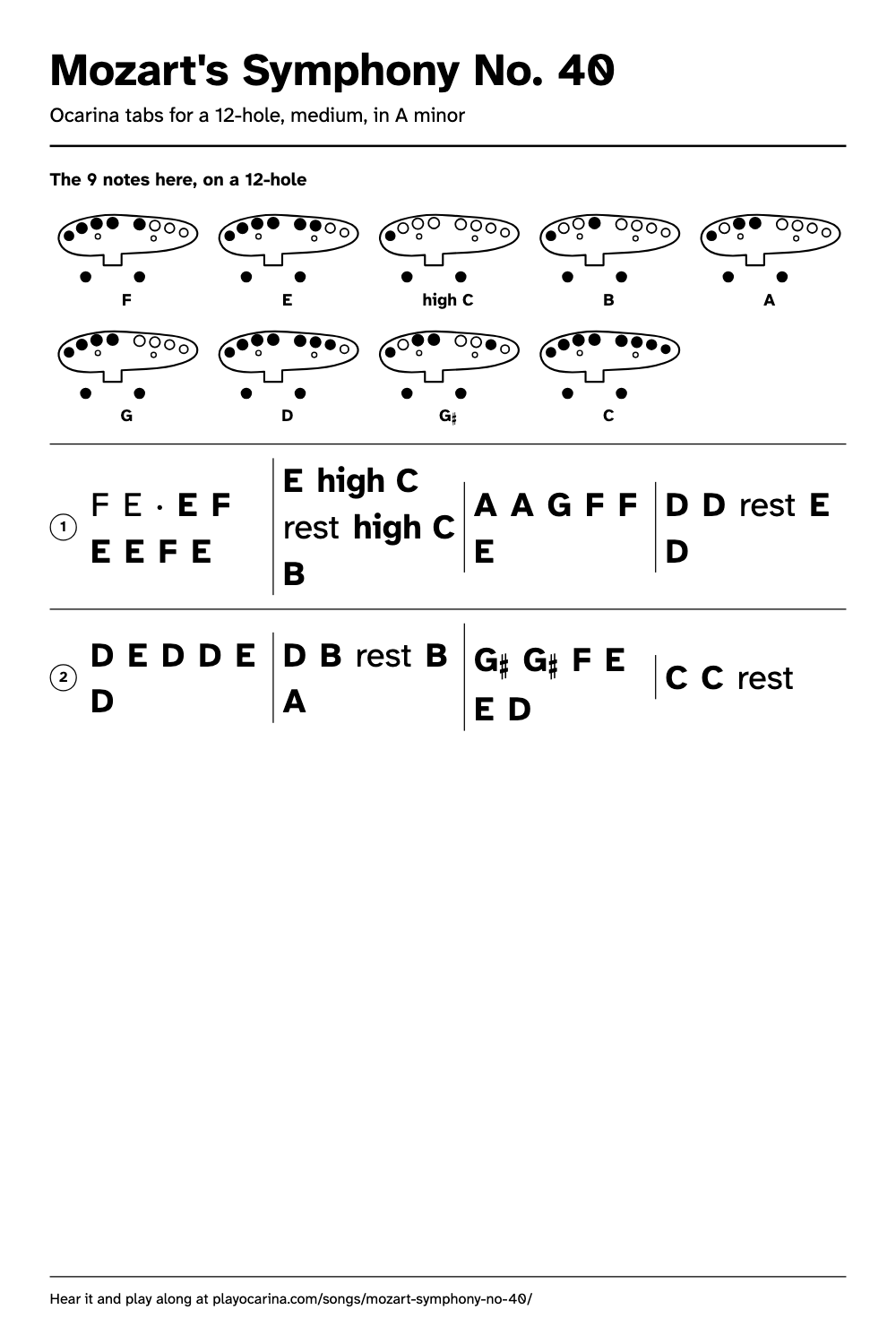
On a 12-hole. Read left to right, a line at a time.
- FE EFEEFETricky spot:Ehigh Cresthigh CBAAGFFEDDrestED
- DEDDEDDBrestBAG♯G♯FEEDCCrest
Mozart's Symphony No. 40 opens with a quick, sighing pair of notes, F falling to E, repeated three times before the line jumps up to high C. This is the main theme, the first nine bars of the first movement, in the rhythm of the printing, moved from G minor to A minor: C up to high C with one sharp, G♯. It is two matching halves, the second a step lower than the first, and each ends on two plain quarter notes and a rest.
What is the tricky spot in Mozart's Symphony No. 40?
The jump from E up to high C in the third bar, straight after the run of repeated E's, and the same shape again a step lower, D up to B, in the seventh. On a 12-hole, Mozart's Symphony No. 40 goes from E to high C: you lift the left ring, left middle, left index, right index and right middle. On a 6-hole or 4-hole, you lift the left middle, right middle and left index.
The printing slurs each quick pair, F to E and E to D, so tongue the first note of the pair and let the second follow on the same breath; the longer note after it is tongued again. That gives the theme its sighing pulse. Keep the E's light so the high C does not come out as a burst of air. The one sharp, G♯, comes twice in the eighth bar and falls straight to F, an unusually wide step for neighbouring note names: hear it before you play it.
Which ocarina can play Mozart's Symphony No. 40?
Any 12-hole, 6-hole or 4-hole ocarina in C plays Mozart's Symphony No. 40 in this key. On an ocarina in G or F, use the same fingerings: the tune sounds in a different key, which is fine when you play alone. Each linked chart has every fingering for its ocarina, and you can check your notes with a tuner such as our free ocarina tuner.
The 9 notes here, on a 12-holeHoles in words, with a picture
| Note | Holes to cover | Picture |
|---|---|---|
| F | Cover every main hole but the right middle, right ring and right pinky | |
| E | Cover every main hole but the right ring and right pinky | |
| high C | Cover the left pinky, left thumb and right thumb | |
| B | Cover the left pinky, left index, left thumb and right thumb | |
| A | Cover the left pinky, left middle, left index, left thumb and right thumb | |
| G | Cover every main hole but the right index, right middle, right ring and right pinky | |
| D | Cover every main hole but the right pinky | |
| G♯ | Cover every main hole but the left ring, right index, right middle and right pinky | |
| C | Cover every main hole |
Drawn as you see it while playing: mouthpiece towards you, left hand on the left.
| Note | Holes to cover | Picture |
|---|---|---|
| F | Cover every hole but the right middle and right index | |
| E | Cover every hole but the right index | |
| high C | Cover the left thumb and right thumb | |
| B | Cover the right middle, left thumb and right thumb | |
| A | Cover the left index, left thumb and right thumb | |
| G | Cover every hole but the left middle and right middle | |
| D | Cover every hole but the right middle | |
| G♯ | Cover every hole but the left middle and right index | |
| C | Cover every hole |
Drawn as you see it while playing: mouthpiece towards you, left hand on the left.
| Note | Holes to cover | Picture |
|---|---|---|
| F | Cover the left middle and left index | |
| E | Cover every hole but the right index | |
| high C | All holes open | |
| B | Cover the right middle | |
| A | Cover the left index | |
| G | Cover the left index and right index | |
| D | Cover every hole but the right middle | |
| G♯ | Cover the right middle and left index | |
| C | Cover every hole |
Drawn as you see it while playing: mouthpiece towards you, left hand on the left.
Why does Mozart's Symphony No. 40 start before the tune?
Mozart begins the first movement with its accompaniment, played by the lower strings with the violas divided, and the violins come in with the tune only at the end of the first bar. That is why our tabs start on two quick notes before the first full bar. Mozart entered the symphony in his own catalogue on 25 July 1788, in the same few weeks as his 39th and 41st. Our tabs follow the right hand of Max Pauer's piano arrangement, printed by Schott in Mainz around 1915, moved from G minor to A minor; a Breitkopf & Härtel full score of 1893, the conductor Henry Wood's copy, has the same tune in its first violins. Mozart died in 1791 and Pauer in 1945. Music: Wolfgang Amadeus Mozart (1756-1791), the opening theme of the first movement of his Symphony No. 40 in G minor, K. 550, 1788.