God Save the King on the ocarina
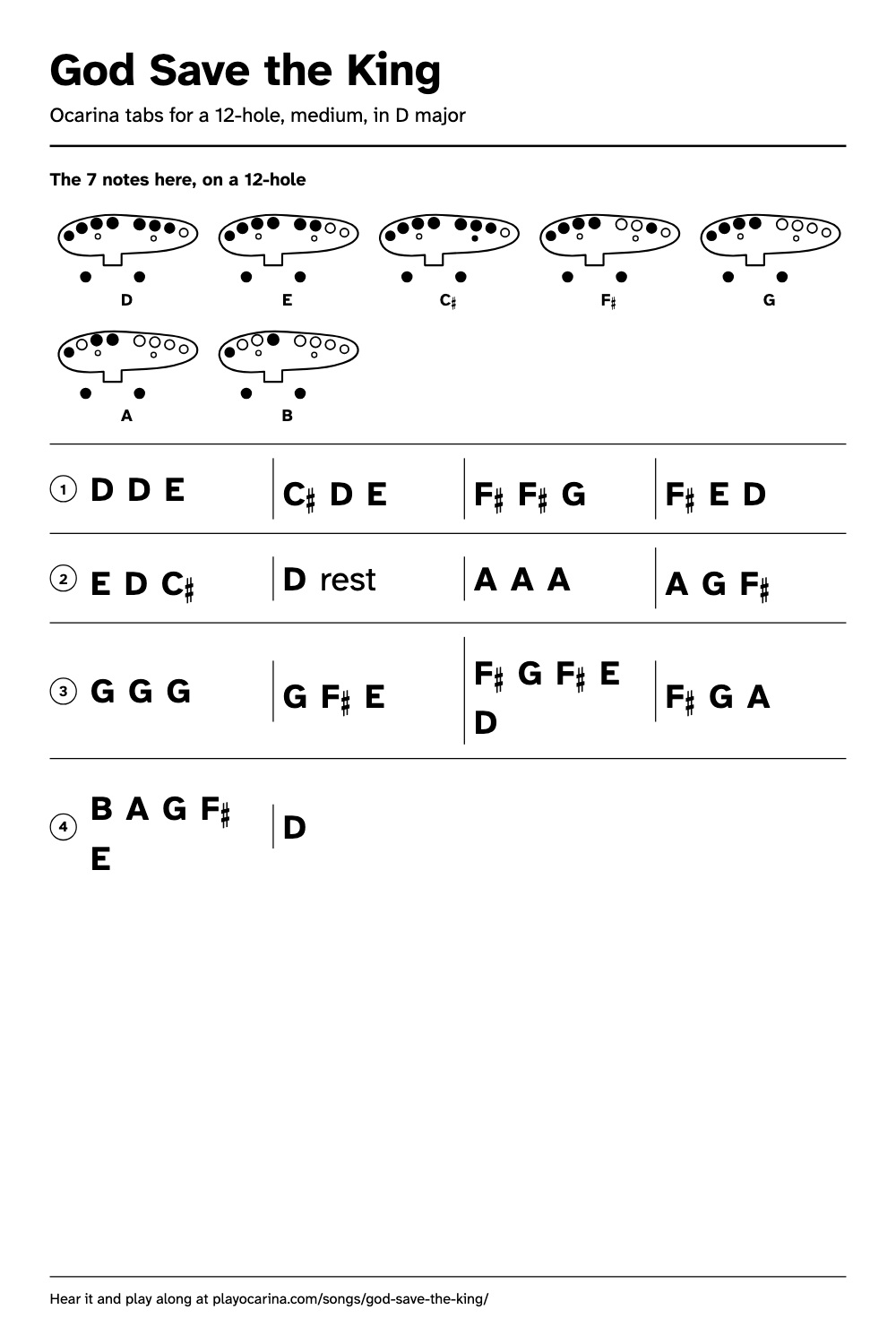
On a 12-hole it starts D, D, E, C♯. Medium, 42 notes, in D major.
God Save the King
Bar 1 of 14
What are the notes for God Save the King?
On a 12-hole. Read left to right, a line at a time.
- DDEC♯DETricky spot:F♯F♯GF♯ED
- EDC♯DrestAAAAGF♯
- GGGGF♯EF♯GF♯EDF♯GA
- BAGF♯ED
God Save the King starts on two long D's and rises to E, then dips to C sharp and comes back to D. Here it is in D major, one verse, 14 bars of 3/2 from C sharp up to high B, as a songbook printed it in 1913. Nearly every bar is two or three long notes, so the tune moves slowly and leaves time to breathe and to place the two sharps.
What is the hardest bar in God Save the King?
The eleventh bar, where the long notes stop and the tune steps down G, F sharp, E, D in four quick beats. On a 12-hole, God Save the King goes from G to F♯: you cover the right ring. On a 6-hole or 4-hole, you cover the right middle.
Play that bar on its own until the four notes are even, then add the long F sharp that follows it and the climb up through high A to B. F sharp and C sharp are the only notes outside the plain D major scale, so they are the ones to check slowly. The tune is in 3/2, so count six quarter beats to the bar: each half note takes two, and a dotted half takes three.
Where do you breathe in God Save the King?
After the long D that ends the first line: it is followed by two beats of rest, and the rest is your breath. The last D is held for six beats, so take a full breath before the last bar.
Which ocarina can play God Save the King?
Any 12-hole, 6-hole or 4-hole ocarina in C plays God Save the King in this key. On an ocarina in G or F, use the same fingerings: the tune sounds in a different key, which is fine when you play alone. Each linked chart has every fingering for its ocarina, and you can check your notes with a tuner such as our free ocarina tuner.
The 7 notes here, on a 12-holeHoles in words, with a picture
| Note | Holes to cover | Picture |
|---|---|---|
| D | Cover every main hole but the right pinky | |
| E | Cover every main hole but the right ring and right pinky | |
| C♯ | Cover every main hole but the right pinky, plus the right sub-hole | |
| F♯ | Cover every main hole but the right index, right middle and right pinky | |
| G | Cover every main hole but the right index, right middle, right ring and right pinky | |
| A | Cover the left pinky, left middle, left index, left thumb and right thumb | |
| B | Cover the left pinky, left index, left thumb and right thumb |
Drawn as you see it while playing: mouthpiece towards you, left hand on the left.
| Note | Holes to cover | Picture |
|---|---|---|
| D | Cover every hole but the right middle | |
| E | Cover every hole but the right index | |
| C♯ | Cover the left middle, left index, right index, left thumb and right thumb; half-cover the right middle | |
| F♯ | Cover every hole but the left middle | |
| G | Cover every hole but the left middle and right middle | |
| A | Cover the left index, left thumb and right thumb | |
| B | Cover the right middle, left thumb and right thumb |
Drawn as you see it while playing: mouthpiece towards you, left hand on the left.
| Note | Holes to cover | Picture |
|---|---|---|
| D | Cover every hole but the right middle | |
| E | Cover every hole but the right index | |
| C♯ | Cover the left middle, left index and right index; half-cover the right middle | |
| F♯ | Cover every hole but the left middle | |
| G | Cover the left index and right index | |
| A | Cover the left index | |
| B | Cover the right middle |
Drawn as you see it while playing: mouthpiece towards you, left hand on the left.
Who wrote God Save the King?
Nobody can say for sure. The 1913 songbook we follow credits Henry Carey, who died in 1743, but Wikipedia lists the author as unknown and says the first printing that looks like today's tune came out in 1744, with a different version in The Gentleman's Magazine in 1745. Other anthems and songs use the same tune, among them Liechtenstein's anthem and the American song My Country, 'Tis of Thee. We show the melody only. Music: traditional, long credited to Henry Carey (died 1743).