Gossec's Gavotte on the ocarina
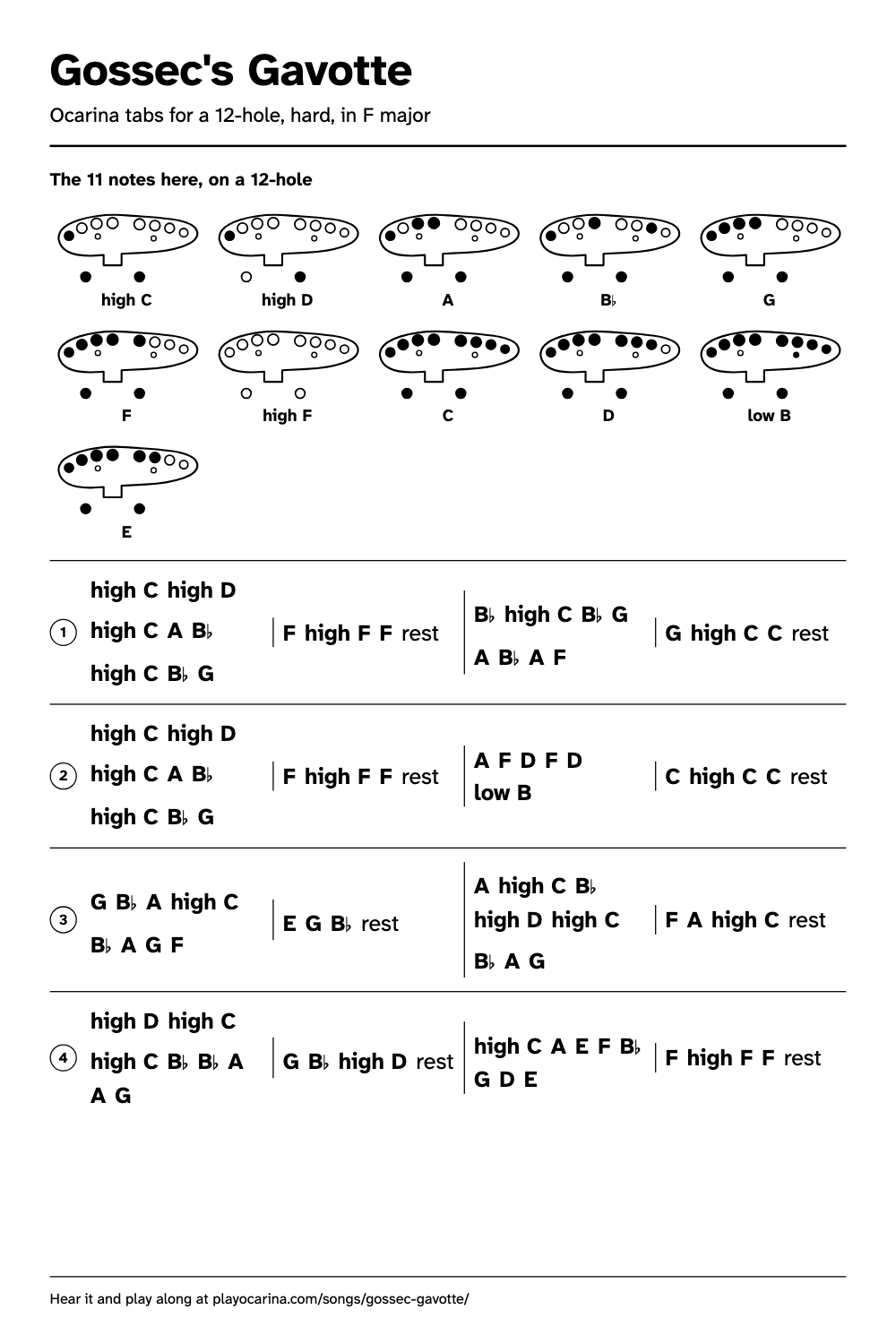
On a 12-hole it starts high C, high D, high C, A. Hard, 86 notes, in F major.
Goes up to high F, so it does not fit a 6-hole or 4-hole.
Gossec's Gavotte
Bar 1 of 16
What are the notes for Gossec's Gavotte?
On a 12-hole. Read left to right, a line at a time.
- high Chigh Dhigh CAB♭high CB♭GTricky spot:Fhigh FFrestB♭high CB♭GAB♭AFGhigh CCrest
- high Chigh Dhigh CAB♭high CB♭GFhigh FFrestAFDFDlow BChigh CCrest
- GB♭Ahigh CB♭AGFEGB♭restAhigh CB♭high Dhigh CB♭AGFAhigh Crest
- high Dhigh Chigh CB♭B♭AAGGB♭high Dresthigh CAEFB♭GDEFhigh FFrest
Gossec's Gavotte opens with a bright run of eighth notes: C, D, C, A, B♭, C, B♭, G, then a quarter F, a jump up an octave to high F and back. It was written in D major; here it is moved up to F major so that it fits a 12-hole ocarina, where B♭ is the one flat. The tune runs from a low B, played once, up to high F. These are the sixteen bars of the gavotte itself, with the first half played once; the printing we follow goes on to two middle sections and the gavotte again, which we leave out, along with the small grace notes.
What is the tricky spot in Gossec's Gavotte?
The octave leap in the second bar, from F up to high F, the top note of a 12-hole, and straight back down. The same three notes come back in the sixth bar and in the last bar of the tune. On a 12-hole, Gossec's Gavotte goes from F to high F: you lift the left pinky, left ring, left middle, left index, right index, left thumb and right thumb.
High F is played with every hole open, so the leap is mostly about air: lift all your fingers together and blow a little faster, then cover them again and ease the breath as you come back to F. Both F's are quarter notes, a whole beat each, so there is time to get the fingers there. B♭ comes up in most bars and is the other thing to learn first: practise A, B♭, C slowly before you try the runs at speed, and only then bring up the tempo. The runs of eight eighth notes go in even, light tongued notes, as a dance wants them, with the quarter notes after them a little more settled.
Where do you breathe in Gossec's Gavotte?
Every second bar ends with a quarter rest, so there are eight short phrases of two bars each. Breathe in the rest after each one, and do not try to carry the breath through two phrases.
Which ocarina can play Gossec's Gavotte?
A 6-hole ocarina cannot reach low B and high F, and a 4-hole ocarina cannot reach low B, high D and high F, so play Gossec's Gavotte in this key on a 12-hole ocarina in C. On an ocarina in G or F, use the same fingerings: the tune sounds in a different key, which is fine when you play alone. The linked chart has every fingering, and you can check your notes with a tuner such as our free ocarina tuner.
The 11 notes here, on a 12-holeHoles in words, with a picture
| Note | Holes to cover | Picture |
|---|---|---|
| high C | Cover the left pinky, left thumb and right thumb | |
| high D | Cover the left pinky and right thumb | |
| A | Cover the left pinky, left middle, left index, left thumb and right thumb | |
| B♭ | Cover the left pinky, left index, right ring, left thumb and right thumb | |
| G | Cover every main hole but the right index, right middle, right ring and right pinky | |
| F | Cover every main hole but the right middle, right ring and right pinky | |
| high F | All holes open | |
| C | Cover every main hole | |
| D | Cover every main hole but the right pinky | |
| low B | Cover every main hole, plus the right sub-hole | |
| E | Cover every main hole but the right ring and right pinky |
Drawn as you see it while playing: mouthpiece towards you, left hand on the left.
Where does Gossec's Gavotte come from?
It is from Gossec's opera Rosine, ou L'épouse abandonnée, of 1786; Gossec lived from 1734 to 1829. Our tabs follow a 1908 violin and piano arrangement by Emil Kross, printed in Leipzig by Bosworth in an album of violin pieces, which credits the tune to "Fr. Jos. Gossec". The print gives the gavotte, then two middle sections, then the gavotte again. We take the violin line of the gavotte, which carries the tune, move it from D major to F major to fit a 12-hole, and leave out the piano part, the middle sections and the small grace notes before the high D and A. Music: François-Joseph Gossec (1734-1829), the gavotte from his opera Rosine, 1786.