Humoresque on the ocarina
On a 12-hole it starts C, D, C, D. Medium, 48 notes, in C major.
Goes up to high D, so it does not fit a 4-hole.
Humoresque
Bar 1 of 8
What are the notes for Humoresque?
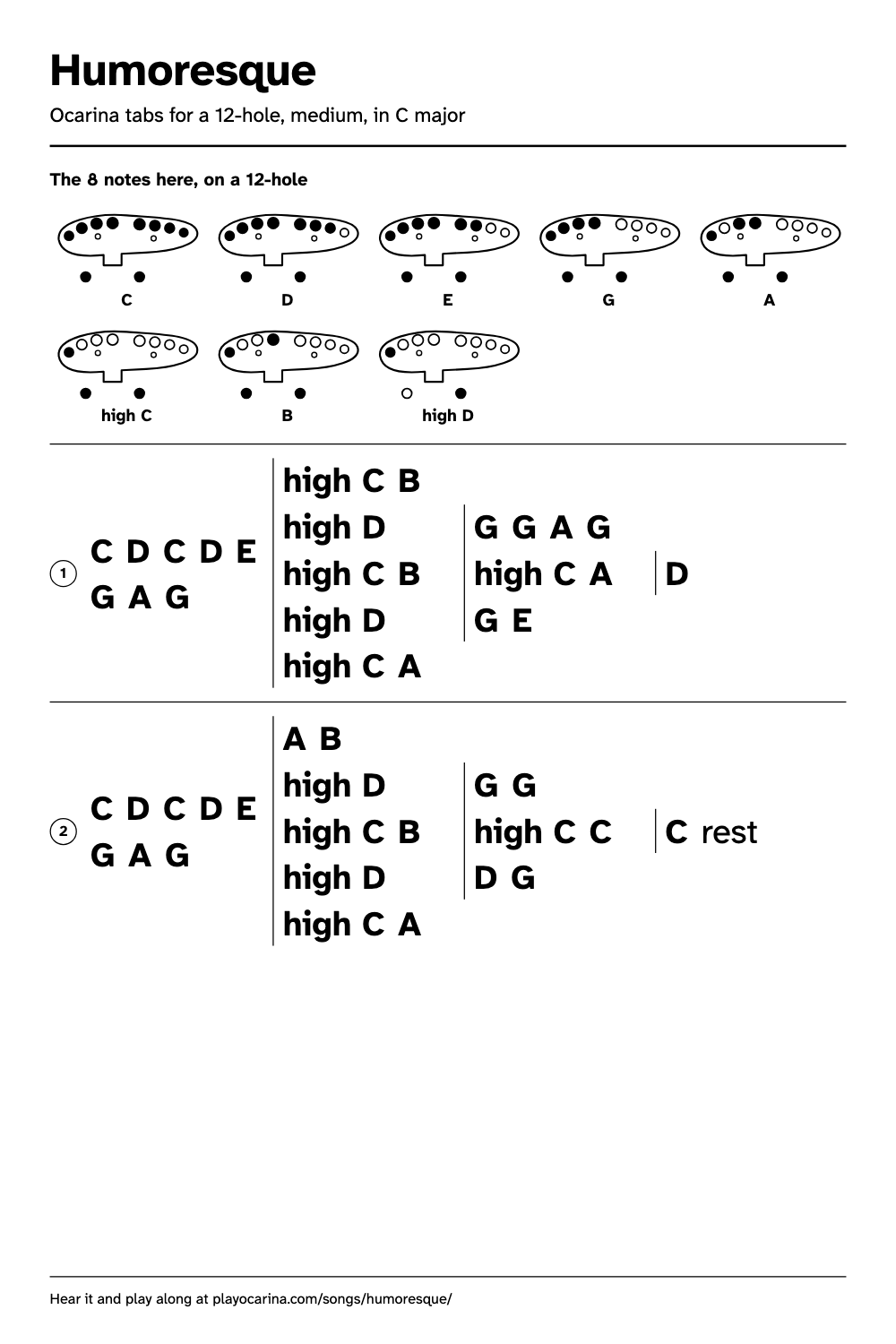
On a 12-hole. Read left to right, a line at a time.
- CDCDEGAGhigh CBhigh Dhigh CBhigh Dhigh CAGGAGhigh CAGED
- CDCDEGAGABhigh Dhigh CBhigh Dhigh CATricky spot:GGhigh CCDGCrest
Humoresque, the best-known of Dvořák's eight Humoresques, opens with C, D, C, D, then climbs E, G, A and steps back to G. It is moved here from G-flat major to C major, so there are no sharps or flats, and it runs from C up to high D, which suits a 12-hole or a 6-hole ocarina. This is the main theme, the first eight bars up to the repeat sign. The page plays it once, without the chord passage that follows it in the piece.
What is the hardest part of Humoresque?
The drop in bar 7, where the tune falls from high C all the way down a whole octave to C in one quick step, just before the two closing notes. On a 12-hole, Humoresque goes from high C to C: you cover the left ring, left middle, left index, right index, right middle, right ring and right pinky. On a 6-hole, you cover the left middle, right middle, left index and right index.
Give the high C a firm breath and then ease the air right off for the low C, since both notes are short and the jump comes with no time to prepare. Most of the tune is one long note followed by a short one, a third of a beat and then a sixth, so count each beat as two uneven steps and keep the short note light, with a soft "du" on each. Bars 1 and 5 are the same, and bars 2 and 6 differ only in their first note, so there is less to learn than it looks. The only long notes are the held D in bar 4 and the final C.
Where do you breathe in Humoresque?
On the D held through bar 4, which lasts two full beats, and again in the short rest at the very end. A bar is too quick to breathe inside, so plan to play bars 1 to 3 and then bars 5 to 8 each on one breath.
Which ocarina can play Humoresque?
A 4-hole ocarina cannot reach high D, so play Humoresque in this key on a 12-hole or 6-hole ocarina in C. On an ocarina in G or F, use the same fingerings: the tune sounds in a different key, which is fine when you play alone. Each linked chart has every fingering for its ocarina, and you can check your notes with a tuner such as our free ocarina tuner.
The 8 notes here, on a 12-holeHoles in words, with a picture
| Note | Holes to cover | Picture |
|---|---|---|
| C | Cover every main hole | |
| D | Cover every main hole but the right pinky | |
| E | Cover every main hole but the right ring and right pinky | |
| G | Cover every main hole but the right index, right middle, right ring and right pinky | |
| A | Cover the left pinky, left middle, left index, left thumb and right thumb | |
| high C | Cover the left pinky, left thumb and right thumb | |
| B | Cover the left pinky, left index, left thumb and right thumb | |
| high D | Cover the left pinky and right thumb |
Drawn as you see it while playing: mouthpiece towards you, left hand on the left.
| Note | Holes to cover | Picture |
|---|---|---|
| C | Cover every hole | |
| D | Cover every hole but the right middle | |
| E | Cover every hole but the right index | |
| G | Cover every hole but the left middle and right middle | |
| A | Cover the left index, left thumb and right thumb | |
| high C | Cover the left thumb and right thumb | |
| B | Cover the right middle, left thumb and right thumb | |
| high D | Cover the left thumb |
Drawn as you see it while playing: mouthpiece towards you, left hand on the left.
Which of Dvořák's Humoresques is the famous one?
The seventh of eight. Dvořák wrote the cycle, Humoresques, Op. 101, in the summer of 1894, finished the score on 27 August, and Simrock in Berlin published it that autumn. The critic David Hurwitz calls No. 7 "probably the most famous small piano work ever written after Beethoven's Für Elise". Our tabs follow the 1894 Simrock edition, which prints it in G-flat major with six flats; its title page says that No. 7 could also be bought on its own, for 1.50 marks. Fritz Kreisler and Mischa Elman each recorded their own violin and piano arrangement in 1910, and Wikipedia's sample of the piece is a viola and piano version shifted up to G major; ours moves it to C. We leave out the small grace notes at the start of bars 2 and 3, the left hand and the inner voices, and we join the tiny rests in the printed figure to the note before them. Dvořák died in 1904. We show the melody only. Music: Antonín Dvořák (1841-1904), the main theme of Humoresque No. 7, Op. 101, 1894.