Hungarian Dance No. 5 on the ocarina
On a 12-hole it starts E, A, high C, A. Medium, 19 notes, in A minor.
Goes down to low A, so it does not fit a 6-hole or 4-hole.
Hungarian Dance No. 5
Bar 1 of 8
What are the notes for Hungarian Dance No. 5?
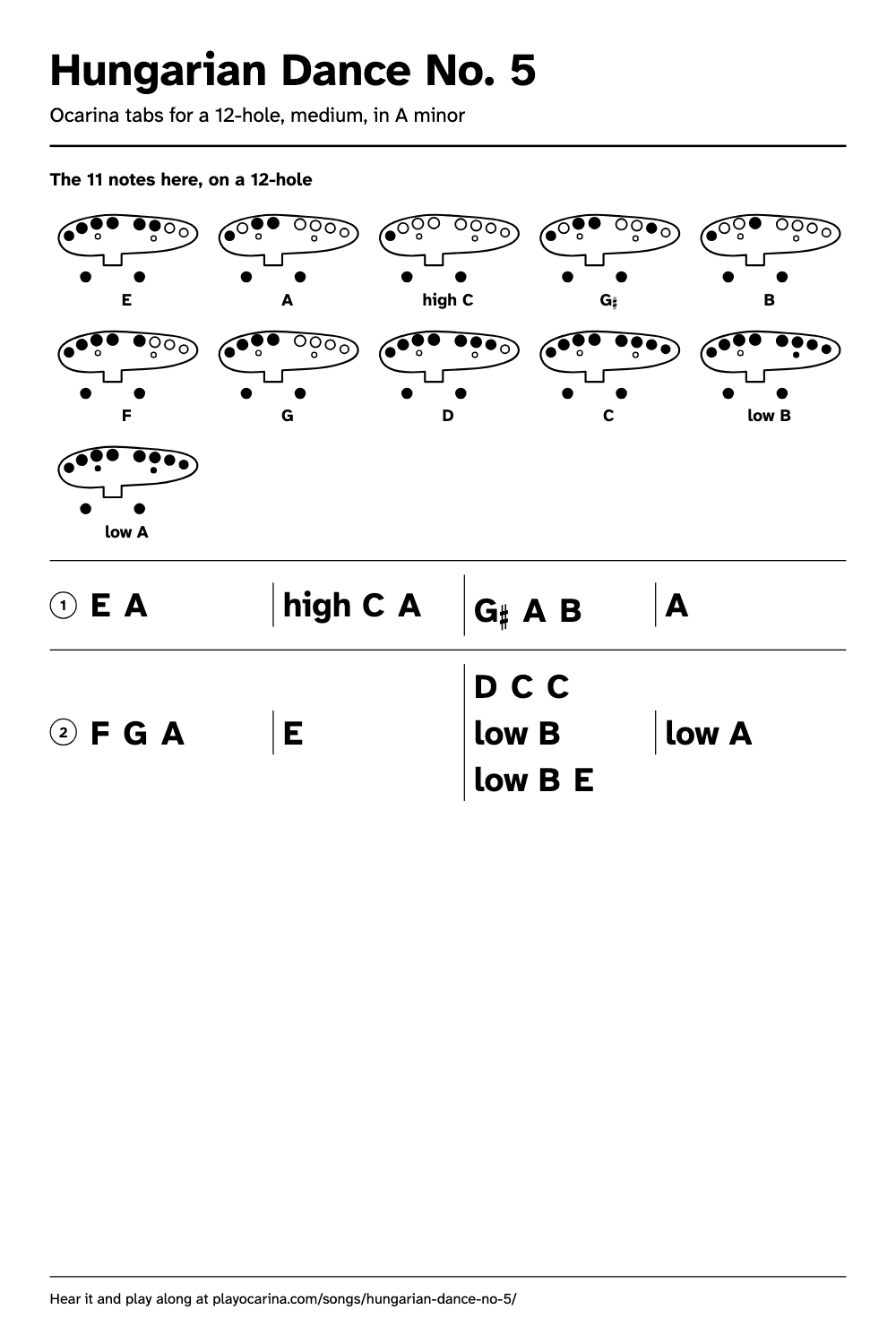
On a 12-hole. Read left to right, a line at a time.
- EAhigh CAG♯ABA
- FGAETricky spot:DCClow Blow BElow A
Hungarian Dance No. 5 starts on a long E that leaps up to A, then a long high C falls back to A, and a long G sharp turns quickly through A and B before the phrase settles on A. The answer starts on a long F that rises quickly to A, sinks to a long E, and ends in a quick run down to low A. Here is that main theme in A minor, eight bars of 2/4, from low A to high C. The last note, low A, needs a 12-hole ocarina with both sub-holes covered.
What is the tricky spot in Hungarian Dance No. 5?
The end, where a quick E jumps down to low A, the lowest note in the tune, with every hole and both sub-holes closed. On a 12-hole, Hungarian Dance No. 5 goes from E to low A: you cover the right ring, right pinky, left sub-hole and right sub-hole.
Seventh bar first: four quick notes D, C, C, B, then a long B and a short E that springs straight into the final low A. Practise E to low A on its own, slowly, until all the fingers land together and the low note speaks without a squeak. Blow gently for the low A; too much air makes it breathy. In the first bars, give each long note its full length and play the two quick notes after it lightly, as a pair: the theme's swing comes from that long-short pattern.
Where do you breathe in Hungarian Dance No. 5?
Breathe after the A at the end of the fourth bar. The second half then runs to the final low A without a break.
Which ocarina can play Hungarian Dance No. 5?
A 6-hole or 4-hole ocarina cannot reach low A and low B, so play Hungarian Dance No. 5 in this key on a 12-hole ocarina in C. On an ocarina in G or F, use the same fingerings: the tune sounds in a different key, which is fine when you play alone. The linked chart has every fingering, and you can check your notes with a tuner such as our free ocarina tuner.
The 11 notes here, on a 12-holeHoles in words, with a picture
| Note | Holes to cover | Picture |
|---|---|---|
| E | Cover every main hole but the right ring and right pinky | |
| A | Cover the left pinky, left middle, left index, left thumb and right thumb | |
| high C | Cover the left pinky, left thumb and right thumb | |
| G♯ | Cover every main hole but the left ring, right index, right middle and right pinky | |
| B | Cover the left pinky, left index, left thumb and right thumb | |
| F | Cover every main hole but the right middle, right ring and right pinky | |
| G | Cover every main hole but the right index, right middle, right ring and right pinky | |
| D | Cover every main hole but the right pinky | |
| C | Cover every main hole | |
| low B | Cover every main hole, plus the right sub-hole | |
| low A | Cover every main hole, plus the left sub-hole and right sub-hole |
Drawn as you see it while playing: mouthpiece towards you, left hand on the left.
Who wrote the tune of Hungarian Dance No. 5?
Brahms based it on a csárdás by the Hungarian composer Béla Kéler, "Bártfai emlék" (Memories of Bártfa), which Brahms took for a folk song. Brahms wrote his Hungarian Dances for piano four hands, and the first book, Nos. 1 to 5, came out in 1869. Our tabs follow the primo part of Simrock's first edition in Berlin, moved from F sharp minor up to A minor, and teach the eight-bar main theme, not the faster middle section. Kéler died in 1882 and Brahms in 1897. We show the melody only. Music: Johannes Brahms (1833-1897), the fifth of his Hungarian Dances for piano four hands, 1869, on a csárdás by Béla Kéler (1820-1882).