I Vow to Thee, My Country on the ocarina
On a 12-hole it starts E, G, A, high C. Medium, 89 notes, in C major.
Goes up to high E, so it does not fit a 4-hole.
I Vow to Thee, My Country
Bar 1 of 24
What are the notes for I Vow to Thee, My Country?
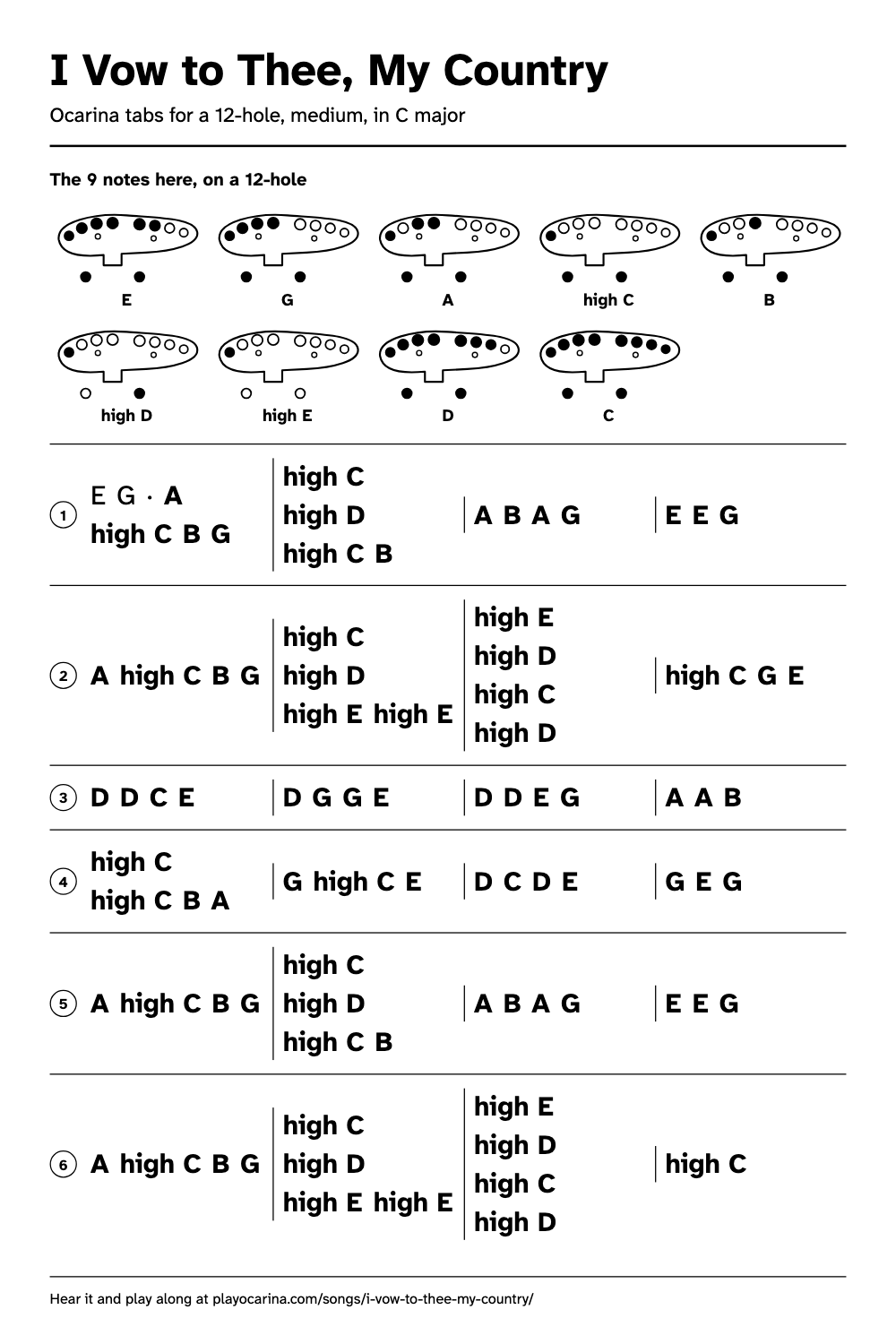
On a 12-hole. Read left to right, a line at a time.
- EG Ahigh CBGhigh Chigh Dhigh CBABAGEEG
- Ahigh CBGTricky spot:high Chigh Dhigh Ehigh Ehigh Ehigh Dhigh Chigh Dhigh CGE
- DDCEDGGEDDEGAAB
- high Chigh CBAGhigh CEDCDEGEG
- Ahigh CBGhigh Chigh Dhigh CBABAGEEG
- Ahigh CBGhigh Chigh Dhigh Ehigh Ehigh Ehigh Dhigh Chigh Dhigh C
I Vow to Thee, My Country is sung to Thaxted, the broad tune Holst lifted from the Jupiter movement of The Planets. It starts with two quick notes, E and G, before the first bar, then A, high C, B, G. Here is the whole verse in C major, 24 bars of slow 3/4, from low C to high E. It fits a 12-hole and a 6-hole ocarina in C.
What is the hardest note in I Vow to Thee, My Country?
High E, the top of the tune, which comes after a quick high C and D in the sixth bar and again in the last line. On a 12-hole, I Vow to Thee, My Country goes from high D to high E: you lift the right thumb. On a 6-hole, you lift the left thumb.
High E sits one step above high D, so it needs faster air than anything else in the piece; blow firmer as you step up from D and keep it there for the two E's that follow (more on high notes). The other trap is rhythm. Most phrases open with a long A, then C, then a dotted B with a very short G after it: count the B as most of a beat and let the G be a quick pick-up into the next bar, not an even pair. The middle eight bars drop to the bottom of the ocarina, around low C and D, so ease the air right off there or those notes go sharp.
Where do you breathe in I Vow to Thee, My Country?
Each phrase ends on a two-beat note followed by two quick notes that start the next one. Breathe at the end of the long note, cutting it a little short, so the two quick notes come in on time. Five of the verse's six phrases end this way; the last one ends on a long high C.
Which ocarina can play I Vow to Thee, My Country?
A 4-hole ocarina cannot reach high D and high E, so play I Vow to Thee, My Country in this key on a 12-hole or 6-hole ocarina in C. On an ocarina in G or F, use the same fingerings: the tune sounds in a different key, which is fine when you play alone. Each linked chart has every fingering for its ocarina, and you can check your notes with a tuner such as our free ocarina tuner.
The 9 notes here, on a 12-holeHoles in words, with a picture
| Note | Holes to cover | Picture |
|---|---|---|
| E | Cover every main hole but the right ring and right pinky | |
| G | Cover every main hole but the right index, right middle, right ring and right pinky | |
| A | Cover the left pinky, left middle, left index, left thumb and right thumb | |
| high C | Cover the left pinky, left thumb and right thumb | |
| B | Cover the left pinky, left index, left thumb and right thumb | |
| high D | Cover the left pinky and right thumb | |
| high E | Cover the left pinky | |
| D | Cover every main hole but the right pinky | |
| C | Cover every main hole |
Drawn as you see it while playing: mouthpiece towards you, left hand on the left.
| Note | Holes to cover | Picture |
|---|---|---|
| E | Cover every hole but the right index | |
| G | Cover every hole but the left middle and right middle | |
| A | Cover the left index, left thumb and right thumb | |
| high C | Cover the left thumb and right thumb | |
| B | Cover the right middle, left thumb and right thumb | |
| high D | Cover the left thumb | |
| high E | All holes open | |
| D | Cover every hole but the right middle | |
| C | Cover every hole |
Drawn as you see it while playing: mouthpiece towards you, left hand on the left.
Where does the tune of I Vow to Thee, My Country come from?
From Holst's own orchestral suite. It is the broad middle theme of Jupiter, the fourth movement of The Planets, and in 1921 Holst fitted it to a poem by Cecil Spring Rice, who, as a footnote in Curwen's 1921 printing says, wrote the words while he was British Ambassador in Washington in 1918. Our tabs follow that printing, a unison song for voice and piano, which also carries Holst's own note that the melody is taken from Jupiter. The tune is named Thaxted after the village where Holst lived, and under that name it is hymn 188 in the 1925 Songs of Praise. In the tenth bar the 1921 page gives singers a choice of a low G or the G an octave higher; we take the higher one, as the 1925 hymnal does, which keeps the tune on a 6-hole. Holst died in 1934 and Spring Rice in 1918. We show the melody only. Music: Gustav Holst (1874-1934), the tune Thaxted from Jupiter in his suite The Planets; words by Cecil Spring Rice (1859-1918).